
Due to a glitch with WordPress, the embed code for the original video [currently at almost 500 000 views] doesn’t work. This analysis should be viewed while watching the video, which you can do at this link.

00:01 [Smiles]: I think a lot of people think I’m used to talking about this, and the fact that it’s still [gulps emotionally] bothers me…[looks at the ceiling for inspiration] is good because otherwise ummm…[looks blankly at the ground] I wouldn’t be able to convey it…honest-ly.


Shakedown: For her first question, Knox’s interviewer asks what she’s nervous about. It’s a good question. What does she have to be nervous about when it’s a show by Amanda Knox, starring Amanda Knox, about Amanda Knox?
Knox begins with what appears to be nervous giddiness, but she’s smiling. There’s a nervous glee about it, delight, even. Knox kicks off by setting the record straight. She thinks that a lot of people think she’s used to talking about this…the anonymous this being the murder of her 21-year-old British housemate, Meredith Kercher. Kercher lived in the room right next door to Knox in a small villa in Perugia Italy. They were both foreign students, both young women, both studying Italian, Kercher was further along the lines of her studies than Knox, had a better room with a better view, and had a proper boyfriend in Italy before Knox did.
But the bottomline was innocent or guilty, prime suspect or key witness, Knox was supposed to be the best witness to whatever happened to Kercher, not only because they lived together, but because the house had evacuated that holiday weekend, at the time of Kercher’s murder, meaning of the villa’s residents, only the two foreign girls were in town that weekend – Kercher and Knox. Since only Knox lived to tell the tale, and sell it for a record $4 million, and she’s been doing that ever since, it matters what her version of events it. The thing is, Knox has confused that with her mattering.
People, she says, think she’s used to talking about this…and the implication is, she isn’t. She looks suddenly, suitably emotional, after smiling openly just seconds earlier. She’s not used to talking about Meredith, you see…because she’s a sensitive person, and also a victim in the story. Her sensitivity speaks for itself. How could a a sweet, sensitive person murder someone else? And if talking about it bothers her, how could she be capable of murder? [On the other hand, if talking about it, writing about it, making a living from telling the story of how she didn’t murder Kercher doesn’t bother her, then would murdering her really bother her?]
The fact is, Knox has been talking about the Kercher murder ever since it happened. In the days following the murder she sent a group email to everyone she could think of, she wrote a series of contradictory confessions, she made several long phone calls and was wire-tapped talking at length to folks she hadn’t spoken to in weeks, rationalizing her behaviour. She kept the Ialian police busy for hours, as they tried to untangle actionable information from the endless verbal diarrhea and bullshit.
While awaiting trial, Knox received a diary, which she filled up with self-indulgent versions of herself, including the Damascus moment when she suddenly remembered everything for the umpteenth time. So this newfound sensitivity to discussing this case eleven years later is bogus.
What’s a lot clearer, is the enormous amount of PR that was generated in this case, by the Knox camp, and in which Knox herself and her family were vital participants. Media shy people don’t hire powerful PR people to tell them how to dance in front of the cameras. People who wish to court and manipulate and profit from the attention, however, do exactly that.
How they dressed mattered, and repeating the same aphorisms over and over again, until they became post-truth, vital. The whole outside-court narrative was an important strategy, because in Italy, juries aren’t sequestrated from hearing the news. And so, if the public and the media narrative can be altered, so can the minds of juries. It took a while, and a lot of dosh, but that’s what ultimately happened in this case. The influence campaign worked.
Far from Knox not talking about this, whenever she takes to the public stage, this is what she wants to talk about.
As for not being used to it, Knox studied drama in high-school, and her memoir is replete with examples, from Knox herself, who wished [craved actually] to be the center of attention. It annoyed Meredith and her two Italian flatmates, Laura and Filomena, it made Meredith’s British friends feel uncomfortable, and even her one-time lover, Sollecito, found her loud spontaneity at times, insufferable – including when it happened in his own home.
When Knox was in court, she was strong enough to stand up, and address her Italian judges in Italian, telling them her version of events in a slew of spontaneous declarations.
When Knox was in prison, her prisonmates didn’t get along with her either. Knox also accused the dude running the prison of sexual abuse, and the police interrogating her of being abusive. She accused her own boss of committing the murder she’d been implicated in.
All of this was true in Perugia in 2007, and it’s still true today. With Amanda Knox, someone else is invariably to blame, and right now, it’s the media.
A final point on this first comment. Someone very close to me died when I was a teenager. The thought would never occur to me to say I’m glad her death still bothers me, because that allows me to be honest about my feelings about it. Why wouldn’t I be honest? Why wouldn’t I be able to say what I felt and still feel about it?
The next clip in the video jumps to a voiceover from a 2007 news bulletin.
No one could explain the exact sequence of events…

00:51: I think people forget that I was having the time of my life in Italy. [Glances up] Wandering the city when the flea market came to town, eating roasted chestnuts…
Shakedown: Once again, Knox admits to thinking about what people think of her, a lot. In her first two sentences she mentions the same thing twice, what people are thinking. About her. She’s here to “set the record straight” on the same thing, for the umpteenth time. There are books films, four separate trials, and hundreds of articles, but Knox is here to change reality, change how people think about her. That’s what’s important.
And, so, here it is…
Knox was having the time of her life, but not “wandering the city” in search of “flea markets” and not “eating roasted chestnuts” either. So what was she doing? Knox was from a very strict Jesuit-type school in Seattle, and in America, drinking laws meant she was too young at age 20, to drink alcohol. Not so in Perugia. Marijuana was “as common as pasta”, as she put it in her memoir, and she peppers her account of Kercher’s murder with smoking or rolling the odd joint, whether with Sollecito, or other boys.
Also, Knox worked at the time as a waitress in a bar. Her boss wanted to fire her because she flirted more than she worked. Nothing is wrong with any of these behaviors, the only thing that’s off is Knox not being honest about them. Isn’t she here to reclaim her story, and set the record straight? Then why not do that? Why this banter about flea markets and roasted chestnuts, in the context of an infamous and brutal murder? Why this rainbow filled fairy tale and not the truth?
So we see how immediately Knox can’t be truthful about who she was in Italy, or what she was doing. Was she going to flea markets and eating chestnuts [which anyone can theoretically do, anywhere in the world], or was she fucking as many Italians as she could, getting drunk, getting high, basically doing what expat students are known to do, and why they decide to leave home and study abroad in the first place?
Now, what’s the deal with Knox looking up and to her right during these interviews? She does this twice in the first minute of the Scarlet Letter.
This pattern of staring straight up to the ceiling while being interviewed on camera is nothing new for her. Knox did it most memorably when Chris Cuomo asked Knox if she’d murdered Kercher. Knox looked right up, this time to the left [into memories] then looked down and couldn’t hold back a huge grin.
Did you murder Meredith Kercher?
HUGE SMILE.


Typically when people look up and to the right they are lying or tapping into their imagination.
According to the Independent:
…when right-handed people look up to their right they are likely to be visualising a “constructed”, or imagined, event. In contrast when they look to their left they are likely to be visualising a what is known as a “remembered” memory. For this reason, when liars are constructing their own version of the truth, they tend to look to the right.
The same article refers to verbal hesitations [honest-ly] and excessive hand gestures, as symptoms of deceit.

Notice the mismatch between smiley glee talking about how much it bothers her referring to the thing [Kercher’s murder] and the straight-faced, stern, hands handcuffed to her waist description of how I was having the time of my life in Italy. Yes, someone got in the way of that time of your life, not so?
1:10: I was 20, Meredith [oh, you can say her name?] was 21 [slight wink or wince as she says it]…I was the one who barely spoke Italian, I was the one who was overly enthusiastic about everything and Meredith was like [blurts out laughing]…okay, let’s have pizza [throws her arms into air, laughing open-mouthed].
Shakedown: Again, is there any sense of authentic discomfort talking about Meredith? When she does she can’t stop laughing. And what she says about Meredith couldn’t be less meaningless. She’s 21 years old, Knox is 20, and Meredith suggests…they get pizza.


Notice Knox’s use of semantics [she’s a journalist, so it’s not an accidental choice of words either]:
I was the one…
I was the one…
This suggests Knox as the one who is the odd one out, the outsider, the one always in trouble, but also Knox the way she sees herself in her world. I was the one…I am the one…this is about me…
Knox’s emotional range in 2 minutes is extraordinary: from tearful contemplation, to imaginative rumination, to laughter – in seconds. If this is annoying to watch, how unbearable was it to live with?
1:15: And it was great [suddenly serious again], and I really appreciated her…[can’t find the right word]…just being there…and being…[has to look up again for inspiration, I appreciated her for being…?] uh…[looks up to the right]…this warm welcoming presence [as if Knox has remembered what to say on the subject of Meredith, not remembering Meredith as a real human being that once lived.]


1:34: [Upbeat again] I was into this classical Italian music, and so, when this- um, I saw this flyer for a classical music concert, that was going to be at my university. I was like – Yes! I invited Meredith to come along with me. And…we went to the music concert, sat next to each other…And I just made eye contact with…this…Italian guy…who…was…a nerdy…Italian guy [grins].
Shakedown: And so that concludes information about Meredith. Now, back to me. I was interested in I got the flyer…I invited Meredith…Actually, Meredith was probably more interested in music, especially classical music than Knox, and since Meredith had invited Knox everywhere up to that point, [Knox invited Meredith to the bar where she worked, that was pretty much it] Meredith probably invited Knox to the concert, not the other way round.
It’s interesting how Knox feels she has to say that she and Kercher sat next to each other. Also noteworthy that the first thing Knox does at the concert isn’t listening to the music, or share anything with Kercher [Kercher’s already gone in her mind], she makes eye contact with an Italian dude. 
It’s likely both Sollecito and Kercher knew a bit about classical music. Sollicito because he was Italian, and the son of an affluent doctor, Kercher because her taste in music was more eclectic than Knox’s. Her favorite song at the time of her death was U2’s With or Without You. Kercher was also more interested in classical subjects like history, than Knox.
Besides this, we have Knox’s playlists from the time of the murder, and there’s just regular pop-music on it, the kind of Nirvana type stuff students listen to when they’re high.
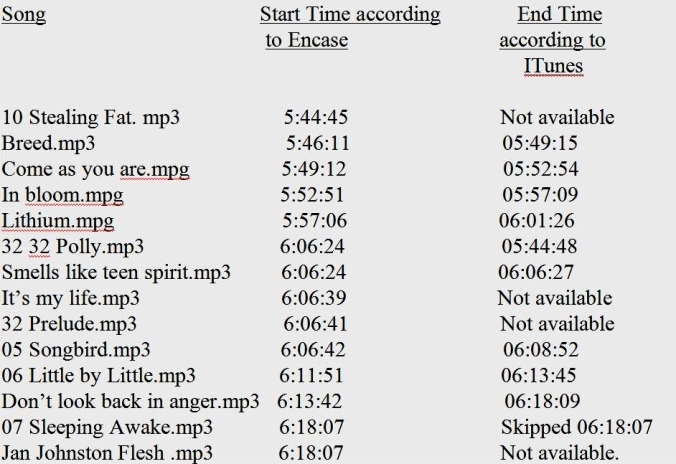
Knox’s MySpace page, in which she refers to herself as Foxy Knoxy, hardly even refers to music amongst her interests.

In a real sense, Meredith was more accomplished in the musical genre than Knox. Meredith had been invited to appear in a well-known music video in Britain.
Also, I doubt Knox found a flyer at her university and gave it to Kercher. More likely it was the other way round. Knox’s job at the bar was to hand out flyers, something she admits in her memoir was a real drag. Also, Knox attended a language school, whereas Kercher was at the far more prestigious and much bigger University of Perugia. The latter had about 20 000 students, while Knox’s school had less than 2000 students enrolled. So it was far more likely that Kercher found a flyer about an Italian classical music show, than that Knox found one in the small confines of a language school where there were mostly foreign kids.
Knox goes all wishy washy and regurgitates the same crap about her blissful romance. What this has to do with Kercher or anything else is anyone’s guess, but it does reinforce this core sense that when it comes to Knox, everything must be about her, and her having what she wants, including how reality must appear when it comes to her story. She must look right, in a story where she’s implicated in someone’s murder. This may seem logical, but it’s not simply someone who wishes to simply clear their name, this is someone who wants to luxuriate in the attention, in the wash and rinse, of the media, speculating about her role in a murder. You’d imagine an innocent person wanting to dispassionately and soberly go through evidence and perhaps make helpful suggestions for the investigators or prosecutors. Instead, she gravitates endlessly into the fickle and fake details of her own narcissism. She tells a fairy tale about herself at the expense of a murdered young woman who she clearly doesn’t give a fuck about. And that’s the point. It’s narcissism that takes no prisoners. It’s me-me-me at the expense of you.
This level of inadequacy and insecurity, so many years later, versus Meredith’s mature, socialized and more successful integration into the expat life reveals why there might be a motive for murder. Jealousy. Envy. It’s you at my expense and I’m going to reset the scales, and turn the tables.
Knox spends a lot of time describing her puppy-love with Sollecito. Going into detail about smiles and looks, and looking emotionally happy as she goes through it. Oh yeah, meanwhile Kercher left the concert to join her friends. Kercher’s seat is taken by Sollecito, and ten days later, Sollecito’s DNA would be left on Kercher’s bra strap, which was deposited under her bloodied corpse in her bedroom, under a duvet. There’s also some evidence pointing towards the possibility of Knox’s DNA found on the same bra hook.
2:32: I was in puppy love, and we did everything together.
Shakedown: Not quite. They didn’t spend Halloween together; in fact Knox didn’t seem to spend it with anyone. Not with Kercher or her friends, and not with her boyfriend, who was working on his thesis. During the ten days of their romance, Knox also spent at least one day completely apart from Sollecito. Other witnesses, like Filomena, reported that Knox was having second-thoughts about Sollecito, feeling guilty about cheating on her American boyfriend… As for Sollecito, in his memoir he describes being irritated and unable to sleep, because Knox tended to wake up early and play music.

2:40: Knox is asked: At this time, did you have any inkling, that your life would never be the same? Knox looks down, her one hand wringing in the grasp of the other. Then she slowly says: No.
Shakedown: Still careful, still counting her words on the simplest of questions.
2:45: I felt like I was alone in the world…
Shakedown: Not quite. Knox lived with Sollecito for the next few days after Kercher’s murder. They went out to dinner with friends. When the police called saying they wanted to see Sollecito, he irritably told them when they were done with dinner. Knox and Sollicto were famously caught going lingerie shopping during this same period. While all of Kercher’s friends fled Perugia, Knox wanted to stay on, even completing her homework and handing it in. Handwritten, there wasn’t a single crossed-out word. Knox’s family and friends were calling her constantly, advising her to go to the embassy, while Knox said everything was fine.
I felt like I was alone in the world…
I’m sure that’s how Kercher felt while she was being murdered in her own bedroom.
3:17: I was in a jail cell [leaning forward, looking down], and I did not have access to international news…[blinks, then looks up, to her right]…what I didn’t understand, for a very long time…was that…the courtroom…and the media…were feeding each other.
Then the interview reveals how the media unfairly stereoptyped Knox as a sexual deviant. The media made-up the fact that Knox was a sexualised nymphet.
3:55: They came up with this whole theory, with a sex game, that I orchestrated, that ended [Knox flicks her head angrily] in Meredith’s murder.
Shakedown: When Knox refers to they, she means the prosecutors. The prosecutors, following the evidence, felt that this wasn’t just a murder, but torture with a sexual dimension to it. Did the prosecutors also pluck this idea out of thin air? Like the staged-burglary, the staged sexual assault had a lot pointing towards it. If the staged-burglary had a broken window [but nothing stolen], the staged-sexual assault had Kercher naked post mortem [her clothes and bra were removed after her throat was cut], her body moved and her legs pulled open. Now, if you wanted police to think someone else killed your roommate, one way was to associate the crime with an intruder breaking in from the outside [as opposed to someone on the inside, committing murder]. Incidentally, the JonBenet Ramsey case, Oscar Pistorius case and the Madeleine McCann case all invoke the idea of windows ushering in phantom intruders who leave no traces of themselves.
The reason the cops suspected a sexual dimension was because the victim was found naked, her thighs propped on a pillow, and covered in blood. Her body was positioned in a way to suggest sexual violation. The only “problem”, if that is the right word, is that like the staged burglary, there was no evidence of an actual sexual attack. No sperm or body fluids. No bruising on the inner thighs. No severe trauma to Meredith’s genitals, no sign of rape.
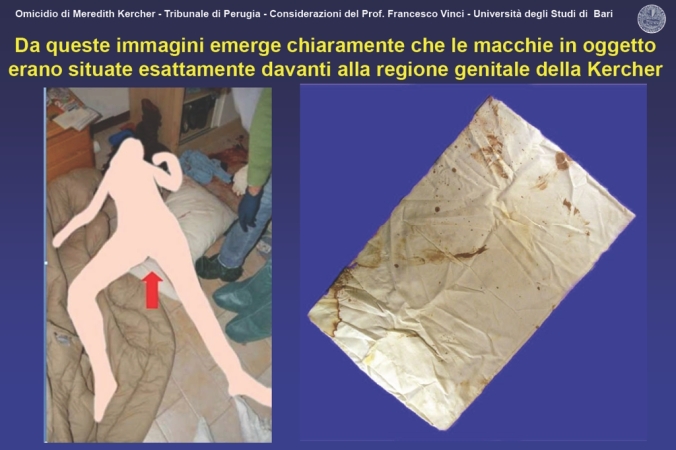
So the court was quite right to look into this aspect, and to investigate it. Obviously, the idea of a sexual attack on Kercher was intended to draw the narrative away from a female attacker, because how many murder-rapists of women are other women? Of course, only the most deceitful, despicable, misleading, manipulative and mendacious scum-of-the-earth criminal would do something like this, to cover their tracks. Only the world’s biggest shitbag would come up with something like this to cover up a crime. Most other criminals would remove the body from the scene and dump it somewhere else. Whoever did this was a brazen liar, someone capable of appearing on camera with the world watching, and lying [almost] straight-faced.
4:15: It didn’t…really…hit me…though…how big…and all-encompassing…the media was [shrugs] until I finally got out.
Shakedown: That’s strange that she didn’t know, because the court room was chock-full of reporters and cameramen each day of the trial. That’s unusual. Most trials don’t have a lot of reporters sitting in on them, let alone a full-house sitting in on everything. There were so many reporters covering Knox’s case, some had to sit in the metal jail cells reserved for especially dangerous criminals standing trial.
The other thing is Knox had a television in her prison cell, and her mother frequently visited her to tell her about the news, what the lawyers were advising, and what the media were saying.
Below is an excerpt from a prison intercept dated November 10th, 2007, just 9 days after Kercher’s murder. Knox is being visited by her mother Edda, in prison.
KNOX: Does he know what’s going on…?
EDDA: Well, the world…the world is making you out to be this…massive killer…monster.
KNOX: Are you serious?
EDDA: Oh yeah, oh yeah. And I have had…our house, everyone in the family, in the German family, have been assaulted by the media. It’s gone CRAZY!
Later in the same intercept from November 2007:
EDDA: …they are bombarded by the media, and they say: hold on! You know, the your friends, and Madison was … they were very warying and she …
KNOX: Why? They talked with Madison?
EDDA: Yes, and she said: “Amanda I know wouldn’t do such a thing”, your friends have said “Impossible 100%”.
KNOX: They talked with my friends?
EDDA: With everyone, Amanda.
KNOX: How did they find my friends?
EDDA:They [the media] traced my cell number, I don’t know how, and “NBC News Twenty Twenty “caught me as I was leaving today from the apartment, the secret apartment that I occupy in Perugia.
KNOX: What?
EDDA: Uh-uh … The lawyers have said something interesting, they said: Amanda found herself involved in something much bigger than her because…This is all a huge crap on an international level.
KNOX: I didn’t do anything…I can speak Italian.
EDDA: My God! What?
KNOX: I speak Italian.
EDDA: Do they know?
Later in the same excerpt, Knox’s mother conveys more speculation in the media, directly to Knox.
KNOX: My fingerprints on her face? I sure hope it isn’t true, because how can it be true? I didn’t do anything.
EDDA: Yes.
KNOX: It’s serious evidence, my prints on her face.
EDDA: I know.
KNOX: How can this be true?
EDDA: I just … I mean, there’s a lot of crap in the papers.
KNOX: This is in the papers; if they tell me that the police have evidence that there are…my fingerprints on your face, I don’t know what to say.
What the police found were at least fifteen bruises in the shape of fingers, all over Kercher’s face. The point of these bruises were to prevent Kercher from being heard while she was restrained, and to keep her mouth closed while her throat was slit. Investigators determined these bruises matched the size of a woman’s fingers; they were too narrow to be that of a man.
We’re around the halfway mark of the video clip; that’s a few minutes, enough of a sample to ask: how much of that looks like honesty?
If this blog garners enough attention and commentary, I’ll do a Part 2.


 Some people reckon Vincent van Gogh was
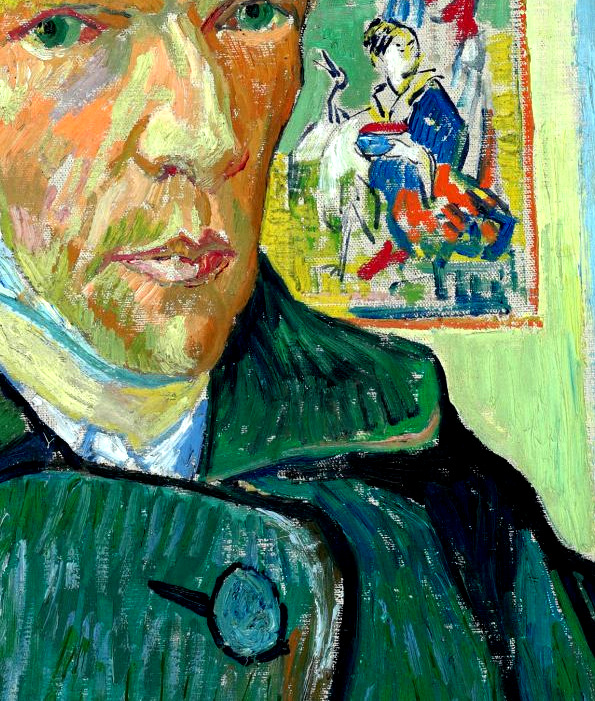
  Given the controversy surrounding “the ear incident”, Van Gogh’s 35-or-so self portraits are a valuable archive. Does he paint the side of his face missing the ear after December 1888? Does he see himself as mad? What is he saying?







 #SHAKEDOWN