Here’s the proof! Reeva Steenkamp fell to her left as she was shot, and what it means changes everything…by Nick van der Leek
When an eye doctor asks you to look at a chart, it’s first with one eye covered, then the other eye covered. This is to make sure your vision is 20/20 in both eyes. The danger in seeing with both eyes at the same time, is that one might fill in details that aren’t actually there, but you think they are.
That’s what happened in this case. The analogy for looking at the chart of letters with both eyes is the crime scene, with Reeva’s blood explicitly dripping all over the toilet.

The message, in scarlet letters is simple and obvious: Reeva died while sitting on the toilet/Reeva was found dead lying slumped over the toilet.

Reeva Steenkamp [Toni Garrn] after being shot inside the cubicle, as presented in the 2017 film Blade Runner Killer.
In the analysis below, I cover one “eye” of the narrative, and then the other “eye”, before revealing an extraordinary new truth, and one that changes everything.
MUCH ADO ABOUT FLAWED “TWO-EYED” RECONSTRUCTIONS
Channel 7 did the first fully-fledged reconstruction of the entire crime scene when their exclusive documentary premiered on Australian television on Sunday July 6th, 2014. I remember that day because it was the coldest night of the year in South Africa, and I was recording a radio interview on my research into the Pistorius case that Sunday evening with OFM’s Johrne van Huysteen.
But Channel 7’s was hardly the only reconstruction. The first reconstruction wasn’t done by Channel 7, who got it from The Evidence Room [hired by Team Pistorius in October 2013].
The first reconstruction was done by the police.

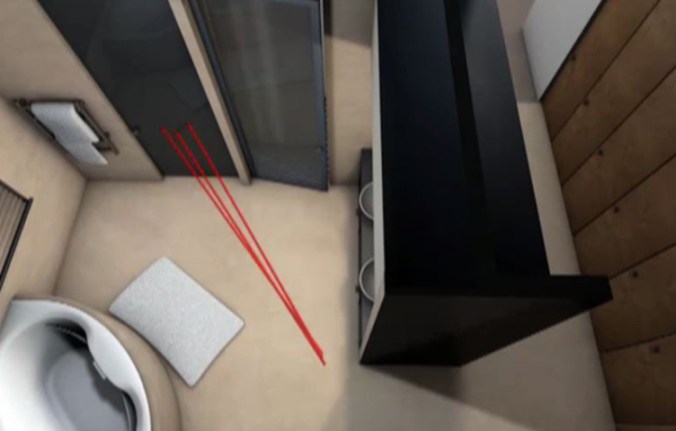
Note the toilet door has been pieced together with the blood evidence still in place. The window blinds are down and the slats closed in this in situ reconstruction. The toilet cubicle light didn’t work. The lazer scanner is positioned approximately hip height, right beside the entrance wall to the bathroom. From this perspective, with the door open, the angle of the bullet through the door is difficult to appreciate.
In hindsight, we may not think much of it, but if the cops didn’t salvage the door, the planks, the detritus and fragments, if they didn’t confiscate the door and reassemble it, we might never have found out what really happened to Reeva behind the door.
If the cops accepted Oscar’s tears and his bullshit story, if they didn’t suspect Oscar to begin with, [and let’s face it, he was a beloved South African celebrity at the time] the precise mathematics recorded when 4 bullets zipped through those fibres may have been lost forever.
Arguably, the official Dolus Eventualis verdict handed down by the Supreme Court of Appeal in December 2015 confirms that we’re still in the dark not only about what happened and why, but we’re still no closer to knowing how Reeva was shot.
ANIMATION THE “HOLY GRAIL”
Through various narratives and lines of inquiry I’ve followed, I’ve endeavoured to change that, and I’m satisfied I’ve made progress in terms of providing insight into the why and the what of this case.
For some time, however, I’ve maintained that the Holy Grail in this case was to animate the scene using the precise mathematics – the geometry of angles and trajectories – and matching these to the autopsy evidence, and allowing the science of gravity and falling bodies to colour in the rest.

An authentic, high quality render would reveal the pace of the shots, and precisely how Reeva reacted to them and where she came to rest in the cubicle.
Intuitively I’ve always felt Reeva did not land with her head on the toilet, as per Oscar’s and Mangena’s versions.
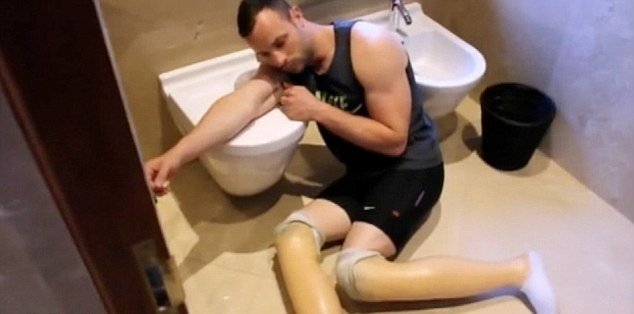
“Intuitively” may sound wishy washy, but it’s that same instinctive “gut-feel” that drove the cops to remove the door from its hinges, collect the planks and splinters, and test the evidence against Oscar’s version of events. They could just as easily have taken Oscar’s word for it, just as Masipa did. So don’t be too quick to dismiss intuition.
Despite my intuitions, and despite sketching the scene, researching the trajectories, and making a few forays into hiring animators, I never finalised my research into this area. I thought I would deal with it, finally, once Oscar’s sentence was finalised prompting the final narrative [Justice Eventualis]. And I guess that’s ultimately what’s happened. I have tested these intuitions to completion within the context of the Justice Eventualis story. But I was offered, serendipitously, a new angle on these issues via a completely different trial playing out while the Pistorius case was coming to its end.
FRESH IMPETUS FROM THE VAN BREDA CASE
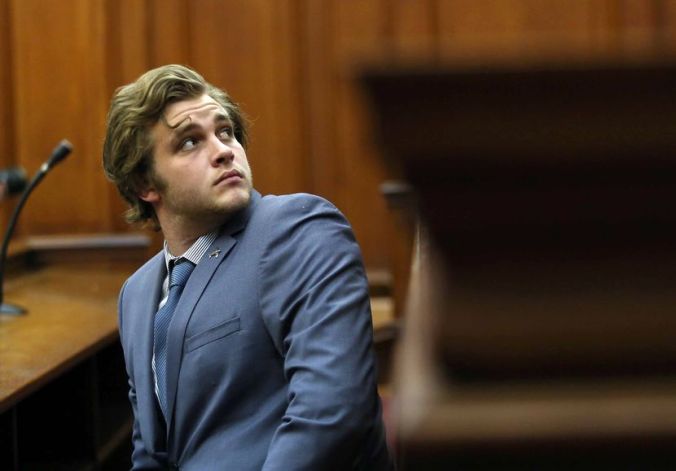
It was while sitting in on the Van Breda case in November 2017 that a fresh idea took root. I was watching the 23-year-old triple murder accused modelling his testimony in court, on a man the prosecutor claimed was about the same height as Henri’s phantom.

November 02, 2017. Henri van Breda demonstrates how he fight off his attacker inside the Western Cape High Court. PICTURE: ESA ALEXANDER/THE TIMES
That’s when the thought occurred to me: why not do the same thing in the Pistorius case? Why stop at the door and the trajectories when the most important part of the scene – Reeva – isn’t there. Everything about the Pistorius case is about trying to re-envision Reeva, so why not do so in the most critical part of the crime scene – the cubicle? Why not have a real person, a model of similar height, stand in behind the door for the murdered model? Why not use the cosmos of angles and lines and see how they lined up not only with the impressions on the opposite wall of the cubicle, but the wounds as per the autopsy?
One may say that Mangena already did that. Yes he did, through description. I want to do that through a practical demonstration, much as Galloway did with Henri and her model. The difference is, Galloway wished to discredit Henri’s phantom, whereas I wish to turn Pistorius’ nameless and shapeless burglar back into 29-year-old Reeva Steenkamp. She was, after all, behind the door, and she died, not some burglar.
Besides lining up the trajectories with Reeva’s injuries as they appear in the autopsy photos, I want to probe an area that’s missing from Pistorius’ story, from the state’s case and from the SCA’s judgment. How did Reeva fall, behind the door? What was the kinetics of it? What did the motion look and feel like – to her?
Does it matter? My intuition tells me that Reeva needed to move in order for her wounds to be inflicted where they were. And so, what does that mean? I’m not sure, but I suspect it means something. Will this exercise dislodge any new insights, will any new secrets stubbornly hidden in the murk be revealed? All I can do is try and see…
SETTING UP THE CRIME SCENE
Again, taking impetus out of the Van Breda case, I decided to set up the crime scene in my garage. I’d already compiled a scaled blueprint of the crime scene in order to figure out exactly where Oscar was standing. Using measurements provided by police ballistics expert Chris Mangena, and using the Mollett’s research as a reference, I bought a standard door, I traced the dimensions of the cubicle 1.4 metres x 1.3 metres] on the garage floor, and I measured out bullets A, B, C and D on the door.

Wooden door with scaled printout of bullet holes attached.
In order to be as accurate as possible:
- I made a colour print out of the most verisimilar photograph of the door, and scaled it up to real size. When I placed this photo over the door, I placed a small piece of wood the size of a pencil through the cubicle size of the door and noted where it punctured on the bathroom side of the door. The holes already drilled into the wood as per crime scene measurements perfectly matched the holes in the image.

- The angle of the holes through the 4 centimetre wide door had to be accurate as well. These angles were verified using data from the laser scanner used by the state, Oscar height on his stumps while holding a gun and his arms outstretched, and linking the holes in the door to the appropriate muzzle height at a distance of approximately 220 centimetres.
- Throughout the setup crime scene images were referenced in order to follow the “spirit” of the crime scene. Beside the downward and obtuse angle of the trajectory, the door is also located at the precise dimensions as it did in the toilet cubicle.
In terms of the 4 bullet holes I used the following data sets.
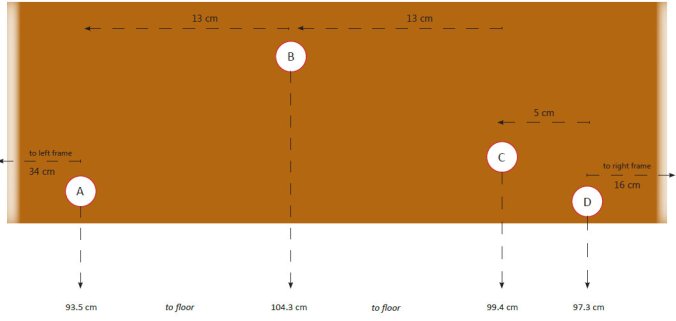
Precise measurements of ballistics through the toilet door. Image courtesy Calvin and Thomas Mollett, Oscar vs The Truth.
A is the lowest of the 4 shots, at 93.5 centimetres from the ground, and 34 cm to the right of the left edge of the door. A hit Reeva in her right hip. A is the only bullet of the 3 that struck Reeva to be completely absorbed by Reeva’s body.
B is the highest of the 4 shots, at 104.3cm from the ground, and 13 cm to the right of A, or 47 centimetres from the left edge of the door. B was the only bullet of the 4 to miss Reeva completely and smash into the tiled wall and ricochet into the opposite wall. The damage to the wall inflicted by bullet B is used as a background image for the cover of Justice Eventualis.
C is lower than B, at 99.4 centimetres from the ground, but slightly higher than A. C is spaced equidistant from B as B is from A [.i.e. 13 centimetres]. C struck Reeva on the front of her right forearm, slightly above the elbow area.
A fragment of C sliced clean through the right side of Reeva’s black shirt yet missed her torso underneath. 3 fragments – presumably from C – were all found in the area of the magazine rack, where the talons separated as they tore through Reeva’s arm.
Given the volcanic opening on the back side of Reeva’s right arm, one would expect an eruption of flesh, a spray of tissue and meat, to paint the rear wall of the cubicle behind her arm. Yet there is no blood spatter directly behind her indicative of this.


Notice the absence of any blood spatter from the bullet wounds to the arm on the wall above the magazine rack [brown rectangle]. There are only three possibilities to account for this: either the splatter was wiped away, or the arm was in front of the body causing the blood spatter to land on the vest [but still allow the bullet fragment to pass through without penetrating the torso – unlikely, or a combination of both.
D appears to be a minor variation of C, since it is just 5 centimetres to the right [B is to the right of A, C to the right of B and D to the right of C]. D is 97.3 centimetres from the ground, and 16 centimentres from the right edge of the door frame. Of the 3 bullets, D is the closest bullet in height to A, but still slightly higher. D sliced through Reeva’s left hand, near the index finger, and then penetrated and exited her skull. A fragment of bullet D remained in Reeva’s skull while another smashed through the other side. No spray of brain fragments – of the volume one would expect – is evident on the ball behind D either.
In effect, after wounding Reeva at A, the lowest shot of the 4, all subsequent shots were higher, starting with B which was too high, and then “modifying” to the more accurate C, and D, which were also both higher than A and both lower than B. C and D effectively were “averages” of A and B, which implies “modification” or aiming.
INTRODUCING THE MODEL
Reeva was short for a model at just 1.71 metres. Her gutsy determination got her into the door with Ice Models, a trait we tend to forget in the text of this crime, and the crime scene itself. Reeva not only had plucky resolve, she was physically fit and not afraid of opposition.
After my first-choice – a slim matriculant – cancelled at short notice, citing the death of her grandfather [no joke], I asked my sister to stand-in. She’s 1.74 metres, so 3 centimetres taller than Reeva, but close enough.
I had my sister look at the autopsy images herself and then draw bullet holes on her right thigh, right arm and left hand. I also showed her the idiosyncrasies of the right side of the magazine rack “tower” [facing away from the toilet], and matched it to a bruise with a tail in the autopsy images, evident on Reeva’s right buttock.
Note the idiosyncrasies of the original magazine rack were not precisely duplicated in the model provided in court, in the reconstructed cubicle. This proved to be a costly oversight.
I showed her how the nicks on Reeva’s spine were also inflicted by the flaring of the right side of the magazine rack tower as Reeva fell against the magazine rack.

Image courtesy Calvin and Thomas Mollett, Oscar vs The Truth.
Reeva’s fall against the magazine rack was the “sound of wood moving” Oscar spoke so often about in court, the sound he claimed was “someone coming out to attack me.”
Since she’s an architecture graduate, my sister is pretty good with angles, measurements and three dimensions. But the head wound is tricky, so I applied a toothpick, which I attached with sellotape over her hair at the appropriate angle and on the top, right side of her head.
To make the hip wound explicit, I gave my sister a piece of double sided tape, with one side of the adhesive exposed while leaving the bright blue surface as a marker. She then attached the marker to the outside of the grey Nike shorts I gave her. She also wore a sleeveless black top, though more figure hugging than the one Reeva wore on the night she died. And like Reeva, she was barefoot.
LINING IT UP
Once in the demarcated cubicle behind the door, I placed two white buckets inside to represented the toilet. This quickly limited the already limited space, and without telling my sister, she sought to avoid standing or sitting on the upturned buckets. Reeva likely did the same in terms of the toilet.
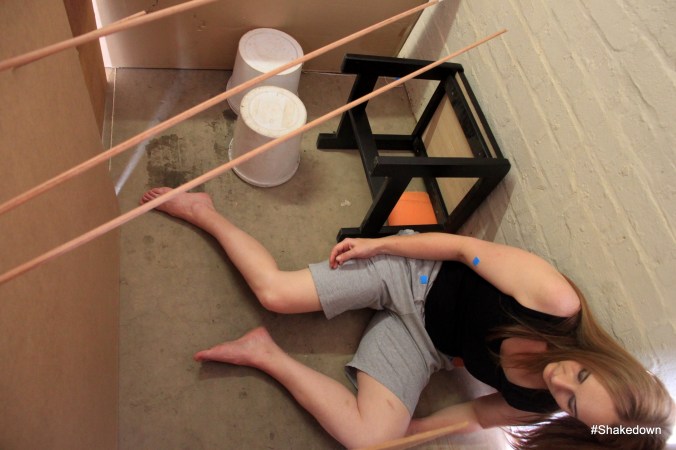
I handed my sister my phone. When I inserted a rod through Bullet A, it lined up perfectly with the hip wound. I took a photo at this point, showing that Reeva stood no more than a foot from the toilet door.
This was also more than enough space for her to be close to the door while holding up her phone in her right hand.
Bullet B, the only bullet that missed, was a lot more difficult to illustrate than Bullet A. Although it lined up with the opposite wall, the difficultly lay in freezing Reeva’s movement at the time B flew through the door and smashed into the wall behind her. This difficulty was because Reeva was off-balance when the bullet flew harmlessly over her right shoulder. If Reeva remained in the same position she was in when A hit her, B would have sliced through the mid right section of her abdomen.
In order to have my sister in the right position, I gave her a large, purple Pilates ball to sit on. She needed to move slightly to her right, and back, and sit down on the ball in order to avoid the rod completely.
To reiterate: If she remained in the same position as she was when A struck her, B would have struck her in the middle to right of her abdomen. It may seem a small point, but Reeva was not static after being hit by the first bullet. Besides her movement, bullet B also gives us some indication of a pause between bangs A and B. The rod for B was inserted to its full length until it “hit” the wall behind her, immediately ricocheting against the adjacent wall.
For Bullet C, I inserted a small black table from my own bathroom, situated opposite my toilet, in the reconstructed toilet. It’s approximately the same height, but obviously it doesn’t hold magazines, and unlike the original magazine rack, this small table allows one to sit on it. In order for C to line up with my sister’s arm, she needed to be in an almost-sitting position on the magazine rack.
Let me explain what I mean by “almost-sitting”. Firstly, she is low enough on the magazine rack to be “sitting” on it, thus dislodging it, but only half of her is actually sitting on it [based on the bruise-impression].
This also suggests that Reeva’s back and head are almost in line with the rear wall of the cubicle as well. This stands to reason – in order for her to be sitting anywhere on the magazine rack, she needed to have fallen all the way back to the rear wall of the cubicle.
This suggests that prior to firing the third bullet, Reeva had already stumbled against the magazine rack, perhaps kicking it with the heel of her left foot as she fell backward, or falling onto it and prompting the wood to screetch and/or judder against the floor, thus alerting Oscar – in the pause after B – to her position.
In addition, Reeva likely screamed in agony after bullet A, and ironically, the scream that saved her [or alerted others to her plight] might have also doomed her, as the shooter was able to track her movement behind the door to the right from just 2 metres away.
Oscar knew his own home just as we know ours. So any sound from the magazine rack would have told him, a practised sharp shooter, exactly where Reeva was.
A final point to note about Bullet C – in order for the bullet to pierce her arm and pierce her shirt yet miss her torso, Reeva had to have turned slightly to her left. In other words, away from the toilet. While my sister’s shirt was skin-tight, Reeva’s was more baggy, and Reeva’s torso also had the classic hourglass shape which allowed a fragment to penetrate the shirt and yet miss her midriff.
Reeva’s motion behind the door now emerges as a rapid downward and [in terms of Reeva behind the door] right to left motion. This motion is in keeping with the width between Bullet A and B, and also Reeva’s ability to “dodge” B.
You will recall the distance at the door from A to B is 13 centimetres, ditto from B to C, making a total of 26 centimentres or ¼ of a metre. Remember the width of the cubicle from toilet wall to the opposite wall is 1.4 metres. [We’ll ignore for the moment that because of the toilet inside, that distance – the distance Reeva had to move from right to her left is actually less than 1 metre].
So the fan-shape of four bullets penetrating the door is 1/5th the width of the cubicle, or ¼ the width Reeva had to move in [taking the toilet space out of the equation]. However on the other side of the door the distance between bullets A and D is greater, closer to half a metre.

This is the view of the bullet trajectories from Reeva’s perspective – i.e. from behind the door. Notice the “fan” shape, indicating a very wide area of impact.
This means – effectively – that after Reeva was hit with the first bullet, she had to move from the point a foot away from the door where she sustained A in the hip, 1 metre backwards and half a metre to her left in order to be wounded on the right side of her head: Bullet D.
Reeva was struck by Bullet D as she was still falling. The impressions on Reeva’s spine are at a slightly off vertical angle, meaning the upper nick is almost in line with Reeva’s vertebra, while the lower nick is to Reeva’s right. If Reeva was falling down against the magazine rack, the lower nick would have inflicted first, followed by the higher. The crucial aspect here is that the higher wound is also slightly to the right, meaning as Reeva approached the ground, she was still moving towards her left [away from the toilet]. Let’s look at that image again, but more carefully and more closely this time.

Image courtesy Calvin and Thomas Mollett, Oscar vs The Truth.
We can also see the height of the two wounds to her spine correspond to the height of the sharp flaring off the magazine rack, and the type of notches in the skin correspond to the beaked protrusion of the wood flaring.

The Mollett’s were right that these injuries were made from wood, and not as the defense claimed, from bullet fragments bouncing off the wall. However, they weren’t made by the cricket bat but by the magazine rack.
In my experiment, even though my sister is 3 centimentres taller than Reeva, she was still some distance off the ground when Bullet D struck the skull. I had to place a rolled up yoga mat under her in order to achieve the right height. Again, Bullet D and Bullet C were undoubtedly fired AS REEVA STRUCK THE MAGAZINE RACK.
Further, there had to have been a pause after Bullet A in order to allow Reeva to fall backwards, approximately one metre, and for Bullet B [which was well to the right of Bullet A] to miss her.
Since Bullet C was the same distance to the right as Bullet B, the only reason it struck Reeva was because it [and D] was fired quicker after Reeva passed the “starting line” of B’s trajectory, compared to A. How much quicker?
Gravitational acceleration is 9.80665 m/s.
Reeva’s height is 1.71 metres, and she was shot in the hip at a height of approximately 1 metre. Bullets C and D were fired at a height of roughly 1 metre as well, but with a 5 degree downward trajectory. So how long did it take for Reeva to fall from 1.71 metres in order for her head to align with a bullet below 1 metre? How long did it take her to fall 800 mm [0.8 metres]?
If she was free-falling, Reeva would have achieved a speed of 3.96 metres per second, and taken 0.4 seconds to fall from a standing position until her buttocks hit the ground. But she wasn’t freefalling. She fell backwards one metre, and sideways about half a metre, as well as down 0.8 metres.
Falling backwards to the right height would require a [not vertical] distance of 1.2 metres, and taken close to half a second. But if she fell straight down she’d still be out of the trajectory range for Bullet D. To get to D, she also has to fall half a metre to the right.
This suggests that there is something impeding the free fall, besides her left leg which still provides limited heft and mobility. Obviously, the magazine rack also impeded Reeva’s fall, which is why the bruise appears on her right buttock, and the nicks against her spine.
This bruise was also noted in the autopsy summary sketch, it just wasn’t sketched very well.
Notice the autopsy image sketch records the bulb of the bruise to the right buttock, but leaves out the tail to the right, left by the magazine rack.Image courtesy Calvin and Thomas Mollett, Oscar vs The Truth.
Since I’m not a genius in geometry, and since the algorithm has now becomes complex, what we can say is that Reeva’s fall from A to D is interrupted by landing on the magazine rack, which delays her fall but allows the shooter to track her [Bullet C].
Since there are effectively “two falls”, from the door onto the magazine rack, and from the magazine rack off it, we may assume 2 x 0.5 second drops. We’re still left with “only” a second. Except we’ve left out another equation: reaction time.
Reaction time is easy to leave out of the equation, simply because we know all the other metrics except the most important one: Reeva. What was this experience like for her? What would it be like for you? If a bullet struck you, out of the blue, would you immediately know what to do, or instantly move? It may stand to reason, but even the world’s most reactionary people – 100 metre track sprinters – even when primed to respond to a shot, take time to react.
The best Olympians in the world have a reaction time of 0.15 seconds. Since Reeva, I believe, was alarmed and thus “primed” for an emergency, we can assume the first shot triggered an immediate movement. Not just falling back, but to her left, away from Bullet A and B. This is why C and D needed to modify to track her, to the right.
The total time between Bullet A and D is estimated at around 1.5 to 2 seconds. That is an eternity when it comes to firing 4 bullets. It averages out to around two bullets per second, or 1 bullet every half second. But the four bullets weren’t fired in one burst, there was a pause at B, resulting in a miss. In that pause, I believe, lies Dolus Directus; the intent to shoot again after a moment’s reflection and recalibration. Had the prosecution done the math, and had the judge had an appreciation for mathematics, the entire trial could have been reduced to a time-stamped algorithm.
This could also have been demonstrated via a real-time to-scale geometrically-verisimilar animation.
THE MISSING AUTOPSY TESTIMONY
None of the insights or reconstructions could have been achieved without the autopsy evidence, and obviously, that narrative is excised out of the trial testimony and for that matter, the media coverage. It is this gaping hole, where one can join the dots through the door to Reeva’s wounds and to the ricochet off the rear wall, that allows one to really understand what it was like for Reeva behind the door. No wonder Oscar smashed down the door the first chance he had. The door represents a vital link that allows us to reconstitute this crime in a way that few other high-profile crimes do.
In the Channel 7 reconstruction, ditto the Mollett’s, I noticed a plank was easily smashed out almost immediately. With one plank out it’s easy to unlock the door. So why did Oscar go on smashing until the entire door was smithereens?

Well, because there were four bullet holes to get rid of. The holes could not only show where Reeva was standing, and moving as she was shot, but also where Oscar was standing.
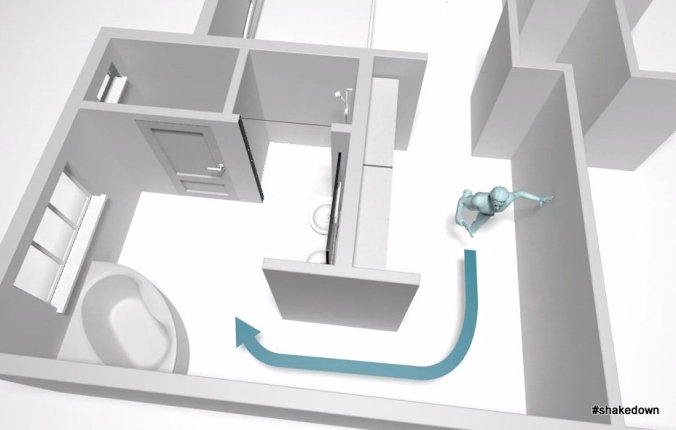
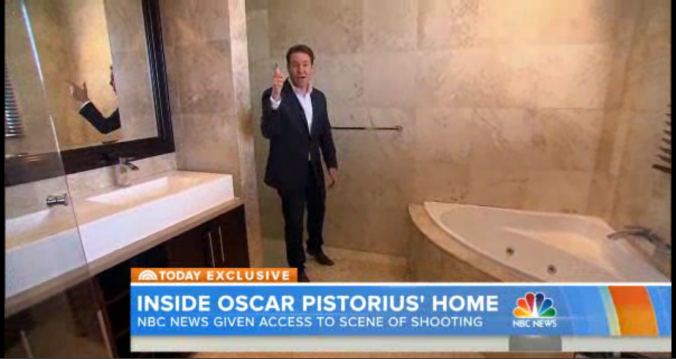
Oscar claimed the key was on the floor, this is why he had to smash the rest of the door down – so he could get to it. But if you’ve dislodged a plank, what’s easier – to smash down a door or to reach in with the plank and move the key closer.

Also, shouldn’t the key have fallen onto Reeva, if it fell, and if it did, if it was on the floor, wouldn’t it be covered in blood [it wasn’t].
WHAT IT MEANS
The main takeout from this experiment wasn’t to try to assess the period between A and D, although that remains a vital piece of data missing from this case. No, the reconstruction was intended to test the intuition that if Reeva was moving to her left, away from the toilet, and landed on the wrong side of the magazine rack, on the ground, while falling to her left, how could she have changed direction and ended up with her arm and head over the toilet bowl?
Additionally, if she had landed with the centre of her body in line with the far side of the magazine rack, could she still have slumped over onto the toilet? The answer is unquestionably no.
Irrespective of which direction Reeva was falling in, any situation where she was sitting on the floor would have made “slumping” over the toilet impossible. You can try it at home. Sit next to your toilet, and try to press your right ear to the toilet seat, and then when you relax, come to rest in this position. The position only be achieved, temporarily, if one is around 15-20 centimentres from the toilet, with nothing in-between. But the magazine rack was there!
According to the state Reeva lay over the magazine rack with her head on the toilet seat. Everyone seemed to make the same mistake, assuming the blood evidence on the seat was the finishing line, and thus, trying to get Reeva to that finishing line.
My experiment demonstrates that Reeva fell the other way, so that her head and torso faced towards the wall opposite the toilet [the wall towards which she fell from the commencement of Bullet A].
If Reeva fell to the left, where’s the blood? Why are there planks in this area? And why are there no large splodges of blood behind Reeva, against the wall, where the black talon made scarlet sprays of Reeva’s tissue, both from her head and her arm?
The answer is that some artefacts of this blood evidence do remain on the walls, on this side.
So – how did Reeva’s blood end up on and in the toilet bowl?
The only logical explanation, as I see it, is that when faced with the holocaust inside the cubicle, the accused immediately went to word minimising it. He had to make it look less bad than it did, and that meant getting rid of red paint on the walls, and on the floor. If he was going to claim Reeva went to the toilet, then she also needed to lay over the toilet, not on the wrong side of it.
How would it look if Reeva’s shot dead, and found like this? It would imply [correctly], that she wasn’t using the toilet, and if she wasn’t using it, how could it be an accident?
The state wrongly assumed that there was an innocent explanation for the light blood spatter on the magazine rack. This blood dripped from Reeva’s hair as she was hoisted over the bowl, and her blood from the wound on the right side of her head, and arm, allowed to drain directly into the bowl. There was also a flush to get rid of it, and perhaps to get rid of some pieces of wood too.
This is why there is barely one Coke can’s worth of blood in the cubicle and just outside of it.
If the idea of sanitising the crime scene seems extreme, consider that in no crime scene photos are there any clear foot or stump prints – in blood – leading to or away from the crime scene. Why not?
Surely if Oscar beat down the door, picked Reeva up, was covered in her blood [so much so that he washed it off his hands and chest], surely he stepped in her blood at some stage? But he didn’t. Those prints should be there but they aren’t.
There are no bloody stump prints in the passage of the carpet, in the bathroom, down the stairs, in the fabric of the carpet of Oscar’s bedroom, which he needed to navigate to go downstairs [while carrying Reeva]. So where are those bloody prints?
What happens when we put a real model behind the door?
Where is the remorse in someone who pretends someone is alive when they aren’t, and cleans up a crime scene moments after killing someone?
What happens when the real person re-emerges behind the door is that her murder is no longer trivialised. The opposite of minimising, or intentionally underestimating someone, is highlighting and emphasising who they were, and what happened to them. Only when we do that is the true nature of the crime made manifest.



 Every time Amanda Knox steps out of the cozy confines of Seattle, vitriol follows. Every time she’s asked to relate the events surrounding Meredith Kercher’s murder, she tells the same less-than-convincing story. So why does she keep doing it? by Nick van der Leek


 Knox calls Filomena afterwards to tell her her room’s been broken into [so Filomena can sort of take responsibility for the crime scene] and then decides to check in to Seattle too, right then, even though it’s around 01:00 on the other side of the world, and it’s been weeks since she called her mother.













 #SHAKEDOWN