Do we have to wait for prosecutors to tell us Chris Watts’ motive, or can we figure it out on our own? If we can’t, what does that say about our ability to intuit the thoughts, desires and machinations of those around us? If we can’t figure out hypothetical catastrophes in other folk’s families, do we have any chance of piecing the puzzles [hidden and less hidden] of the motives of those that are part of the fabric of our lives?
What true crime offers is a series of precedents and templates. The criminal psychology is never a new journey, although some tangents along the way may be a little unusual or even novel.
The best place to start in order to fathom a motive for Watts is Scott Peterson. There are many similarities: pregnant wife, business trips, Mr Perfect persona, picture-perfect marriage and family, fairy-tale home, sunny smiles all round versus fertilizer/oil, selling, foreclosure, financial ruin, her earning more than him and the collapse of the Picture Perfect Charade. There’s a lot of vanity in both marriages. There’s also a lot of shallowness. Under the vanity there’s no real wealth, just empty words.
Of course, to intuit a motive in the Watts case requires that we went to the trouble to figure out Scott Peterson’s motive. Did we? Was Scott’s motive that he wanted to have an affair? I hope that’s not your answer, because millions of married folk cheat on each other quite happily, without resorting to murder. The affair was a factor, and I believe it was a factor with Watts. Both good looking, charming and facile men. In both cases, women who knew or should have known their husbands were cheating, but kept up the pretense that everything was just fine, including through the new pregnancy.
Was money a factor? Of course it was. But millions of couples struggle through financial difficulty without resorting to murder, though perhaps less than the group committing adultery. Add together financial difficulty and adultery, and we’re starting to get somewhere, but we’re still not quite there.
The vital element of course is the pregnancy. In the Scott Peterson case, Scott endured the pregnancy for eight long months, until just before Christmas. He figured Christmas was a good time to do things when people would be away or not watching so closely.
In the Watts case, fifteen weeks proved to be his cut-off date. What does the pregnancy reveal about the motive? Simply that her husband’s threshold for commitment had been exceeded by a substantial margin.
It’s not just financial commitment, and financial overreach that’s at issue here. Like Scott, Watts is having a kind of existential crisis. He doesn’t want to be married.
He doesn’t want to be a dad. He doesn’t want to be burdened or pressured by life-sapping and gut-draining expectations. He was living a life he didn’t want to be living, and it was killing him. He was living a lie, and in his fucked psychology, the only way to fix that was by killing them. That way he could get his life back. By taking their lives, he got his.
It’s transactional, but then Capitalist society is rigged that way. Give and take, cash on delivery, no work no pay. So we’re wired to function in a transnational system, but every now and then someone thinks they can outsmart it. How to get something for nothing. How to get what you really want without paying the price.
So in a sense, it is the simply dimension of a man who wants his freedom. He wants to escape the bind he’s in. But we have to look at the scale of the things that are tearing at him. Moneylessness. Pregnancy and the raft of commitments and expectations that are part of that. And probably someone else pulling him away from the marriage, some sort of fairy-tale romance that offered him a better, alternative happily ever after.
When we add all of these together, we need to come up with a simple hypothesis. Why, in a single word, did Watts commit triple [actually quadruple] murder of his own family.
Greed.
He wanted more. But he wasn’t prepared to pay the price to get what he wanted, so he chose subterfuge, so that he could dodge paying for what he wanted, the same way he’d been dodging reality for year.
He wanted to have his cake and eat it. Just like Scott Peterson did. I suspect further investigation will show Watts was a spoiled kid, and used to entitlements. He didn’t like the drudgery of his job. He wanted to convert his family to oil and gold, cash in his chips and start a new life with someone else.
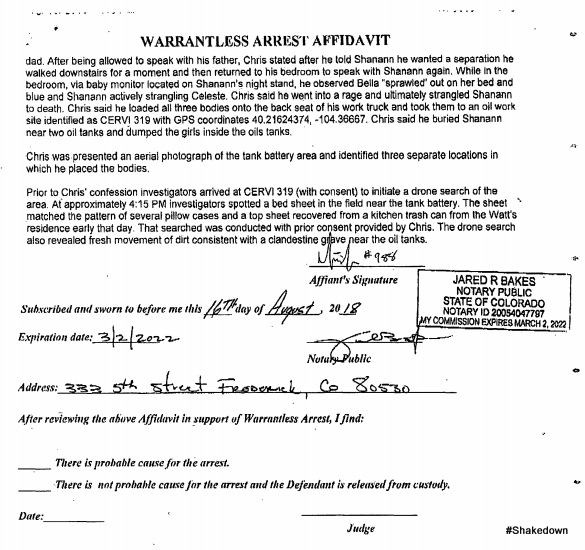
JUST IN from People Magazine – When Nickole Atkinson, Shanann’s friend, didn’t hear from her, she called Chris Watts to find out what was going on. That’s when he made this surprising disclosure to Nickole about his 6-year marriage:
“I didn’t find out that they were going to separate or anything like that until I called Chris that morning. When I called him and asked him where she was, that’s when he told me and I basically told him that that wasn’t my [concern] at that particular moment, because it wasn’t and that their business was their business, that they would either work it out or they wouldn’t.”
Why would Watts be chomping at the bit to tell someone their marriage was in trouble immediately after his wife was dead and the kids gone? Why would it not be okay for his own wife to know [or say] their marriage was in trouble?
So, it’s been reported that #ChrisWatts may have killed his wife because she made more money than he did. First of all, he is very dumb because that is what we call a meal ticket. But secondly, there are a lot of young women on my timeline who need to hear this: (1/2)
There could be other factors too, depending on issues of Watts’ identity. Without knowing his background, his make-up, his backstory, it’s difficult to be more accurate.
Now let’s see what the prosecutors have to say today…
“As a journalist we have to give up the right to have a public opinion about things…it’s not my job to judge…”
This was Zora Stephenson’s take on her exclusive interview with Chris Watts, the Colorado man who confessed to murdering his pregnant wife and two young daughters earlier this month.
Obviously Watts was addressing a phalanx of reporters simultaneously when he gave that infamous interview, not Stephenson directly, but regardless, getting Watts to talk when he did, and how he did, and for as long as he did, was a major scoop. Probably the recording will be fielded in a criminal trial as evidence.
Because the interview went viral, many wanted to know what the reporter’s thoughts were, standing there, getting a direct, firsthand impression of Watts. The public were disappointed to hear Stephenson wouldn’t give them her personal opinion because she couldn’t.
It wasn’t that she didn’t have an opinion. As soon as you sign up as a journalist, your opinion becomes a public opinion, and represents whichever media employs you. In a journalist’s contract, everything you say and write is owned – through copyright – by your employer. As such, they can also be sued if you express an opinion, especially one that’s subjectively accurate or even true, but not legally defensible.
For this reason it’s drilled into journos heads that they may not have an opinion. That the highest journalistic ethic is to remain neutral, kinda like Lady Justice herself.
Many in the public admire this, and think it’s admirable. It’s not. Being able to think for oneself, and think independently, is a sign of intelligence. Being able to speculate, especially in important matters that rock society like crime, is a sign of a healthy, self-aware community. Being restricted from expressing an opinion when you have firsthand knowledge is a kind of common commercial censure.
Many in the public take the lead from journalists, thinking it’s immoral and unChristian “to judge”. Only God and a court Judge can do that.
Okay, well, when you get married, who decides whether your partner is right for you, and trustworthy, and vice versa? Do you want to go to court and have a Judge decide? Well, many marriages do end there, in divorce court with a Judge telling each side how to split the marriage pile. In the real world, we do have to think for ourselves, we do have to reason, we do have to have an opinion about the quality of virtually everything, from the vegetables we buy to the air that we breathe. Those who give up this right become sheep, and sheep are led like lambs to the slaughter.
If true crime teaches us anything, it’s not to be a sheep. It’s to think.
So many of you have asked, “What did you think about your interview with Chris Watts”
So how do journalists and media companies get around the pitfalls of not being able to comment on true crime, even when they’re right there, covering it? Well, that’s why they’re always interviewing experts.
Just as experts are brought into court rooms to provide their “objective” assessments of a set of facts [even though these are often competing opinions with some supporting evidence], the media are allowed to “objectively” comment on interviews such as the one Watts gave, through experts. I often find these “expert” commentaries quite comical. It’s not as though these experts dedicate themselves to one case when the media asks for comment; they’re by their very nature true crime butterflies, jumping from flower to flower, and trying to get to as many as they can. In this sense the experts are like the journalists, jumping around from case to case, story to story, but not really sticking around to absorb one case for any length of time to really extract the marrow out of it.
That does happen when an expert becomes part of a defense team, someone like Dr. Henri Lee the forensic scientist, or a DNA specialist like Barry Scheck. But experts that are not part of a defense team that appear on air amount to little more than a circus act, expressing an opinion while holding up a CV and calling it truth.
After the Watts interview the media were desperate to do something with it, but because of legal perils and pitfalls, they had to have experts weigh in. And so they wheeled in their circus acts – the expert body language consultant, the ex-FBI profiler [who looks like someone’s granny], the professional lie detector etc.
It gets absurd when these experts are leaders in the field of pseudosciences – stuff like handwriting analysis, body language, lie detection, and the rest of it. Although there are groups who make a study of these areas, it’s hardly scientific. Although there are professional bodies that accredit one another, they’re hardly authoritative outside of these groups and clubs.
That’s not to say there isn’t merit in examining handwriting, or human behaviour, or that there aren’t patterns, or that plenty can’t be revealed, it’s just that one “expert” can easily be debunked by another “expert” interpreting exactly the same information in a different way.
A good example of Expert Wars in a court room is the handwriting analysis done in the Ramsey Ransom Note. 78 samples were taken, but only Patsy Ramsey’s handwriting was singled out as a possible match. Team Ramsey’s experts scored Patsy as a 4.5/5 for being the author of the note where 1 is certain and 5 is uncertain. Whever Patsy was interviewed she’d recite these numbers over and over again, like gospel. The prosecution handwriting experts – about half a dozen of them – either called her handwriting a 100% match for the Ransom Note, or extremely certain.
Which set of experts were right?
During the Wolf case, when the handwriting narrative was discussed as evidence, Lin Wood, the Ramsey’s defense lawyer managed to have all the prosecution’s handwriting analysts thrown out of court. He was able to demonstrate they didn’t belong to a particular professional body, and thus weren’t experts according to a particular standard.
With them gone, he could then field his own experts, and so it was no surprise when Judge Carnes accepted his version, that Patsy Ramsey wasn’t the author of the Ramsey Ransom Note.
Many of the experts courted by the media to prognosticate on court cases tend to be guns for hire either by prosecution teams, or by defense teams. It’s usually one side or the other. So a coroner or a polygrapher or a handwriting specialist or an ex-FBI profiler may make themselves available – at a fee – to testify in court, usually in support of a prosecution narrative, or to bolster a defense case.
They’re only too happy to talk to the media, it’s good for business, and so when they do, it’s all under the guise of “being objective”. But is it?
You’re only going to get a truly objective view of a true crime case from someone with no horse in the race. That’s not going to be an expert, and typically, it’s not going to be a journalist. There are a few journalists out there that have gone freelance, and cut themselves loose of their contracts [like me], who are allowed to do independent research and speculate, as long as they do so without defaming, or making absolute statements of guilt.
Media personalities who express their opinion well can become very wealthy and powerful, especially when they take their curated followings with them. Think about Oprah, Dr. Phil and Nancy Grace.
Nancy Grace is a special case. She’s empowered to comment and speculate because she’s an expert journalist in her own right; she’s a journalist with a law degree, and some experience in the Atlanta, Georgia courtroom as a prosecutor for the DA’s office. She’s smart enough to know how to speculate, or express an opinion in public that may be controversial or even inflammatory, but also legally sound. Many lawyers who field high-profile cases quit lawyering and become media pundits, like Marcia Clark. Legal commentary is a more fun gig, and if they’re compelling and charming in their coverage for the big networks, it pays well too.
Journalists who write books about criminals are also still beholden to their employers to toe the line, and be very careful about what they say or speculate on. A team of media lawyers will go through their narrative and make sure it reads like reporting, so that it’s just a recounting of dry facts and isn’t too subjective.
Lawyers sometimes write books too, but lawyers aren’t the best journalists, and constructing legal narratives doesn’t always translate to compelling prose on the page. That said, some do spectacularly well, especially when they hire ghost writers. Juan Martinez’ book on Jodi Arias for example is a major bestselling blockbuster, with well over 1000 reviews. It’s compelling stuff because of the prosecutor’s intimate knowledge of the case, and his many firsthand impressions and experiences with that particular murderess. This gives the reader a real sense of voyeurism, of being right there.
The bottomline when it comes to true crime is that you’re unlikely to get the authentic narrative from the media, just as you’re unlikely to get the actual story in court. What you will from the court and the media echo that follows, is opposing versions jostling for a legal stamp of approval. One version is the PR Apologia favouring an accused [where the family share their feelings of sympathy etc], the other version involves the sanitized neutral reporting on the objective facts [this person died at that time on Avenue X].
What the public really wants to know is why. They want motive. The media often tease their audience that they’re going to go there and expose these deepest of deep insights, they’re going to reveal all, that the accused is going to say why…and when you watch the documentaries, it’s actually about the accused denying they committed a crime. The media don’t talk about motive because they can’t. Even if they did, the accused wouldn’t want to be associated with a production than condemns them. So invariably, any media reporting that involves a criminal tends to be sympathetic to his case, otherwise he wouldn’t participate.
The media like to pretend to be biased, but they never are, and usually they’re biased towards the very criminals the public are outraged about. They have to be, because how the law works, if you say someone is innocent in public and they’re guilty, or possibly guilty, that’s okay, but if you say they’re guilty and you can’t prove it, then you’re guilty. In this way the media narrative always favours the defense narrative.
The public want to know what really happened, the thought processes that were involved, the whole dynamic. They want to see what is hidden. They want to speculate on the possibilities. Who is going to tell that story, because this is the hallowed ground of true crime?
It’s only the one with no horse in the race that’s going to deliver on that story.
After covering a series of high-profile true crime cases, I’m ashamed to admit how long it’s taken to pick up on the tongue flick as a behavioural giveaway of some significance.
It was probably thanks to the LIVEFEED video in the Henri van Breda axe murder trial, that I actually began to really notice it. Because it happens so quickly, you tend to miss it in real time, or even in television coverage.
Since the LIVEFEED was immediately available on YouTube, I was able to go back and review what I thought I’d seen and heard in court, and that’s when a whole new world opened. Henri often lifted his hand just as his tongue poked out, or just as his lip would snarl. It was virtually impossible to catch this unless one slowed down the YouTube video and rewatched it again and again.
Then I noticed the same thing in the Rohde case. Then you start seeing just how often it comes up in true crime. When you realize it’s out there, it starts coming out of the woodwork. What you want to watch out for, besides the tongue flick itself, is the context within which it happens. What is being said, what idea is being brokered when the person flicks their tongue?
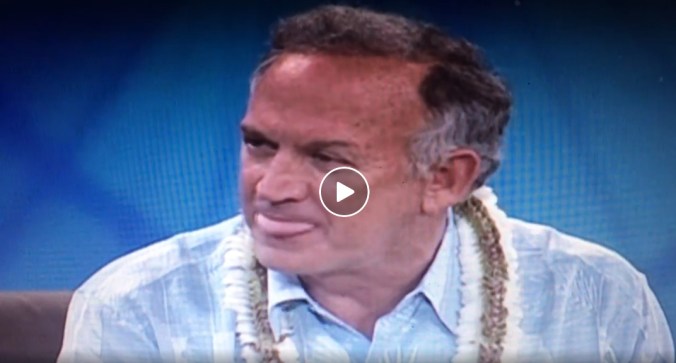
Below, John flicks his tongue as he’s congratulating himself about “the point at which justice comes into our system.” He’s referring to the Grand Jury system, and implying the Grand Jury voted not to indict the Ramseys, when in fact they had voted to indict. Watch the clip here.
In the screengrab below Patsy is explaining that the $100 000 is for the arrest and conviction of the killer of their daughter. If the killer was under age 10, then Colorado law wouldn’t even recognize the crime, so there could be no arrest or conviction, and so there was no way that reward could be paid out.
Patsy’s tongue flick happens as she says: “We feel there are at least two people on the face of this earth that know…” Uh-oh. Watch the clip here.
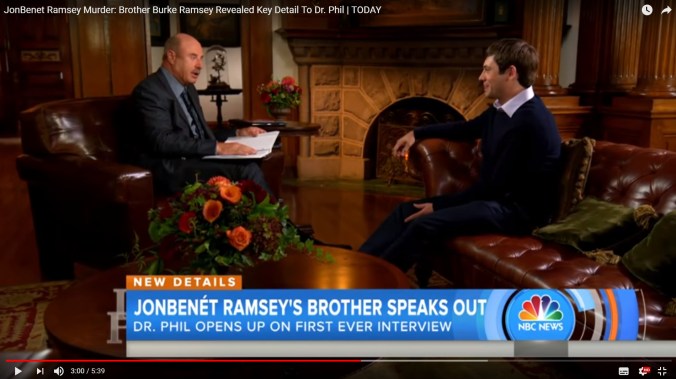
Burke’s tongue flick happens when Dr Phil is taking him through the morning when they discover JonBenet is missing. He describes Patsy coming into his room, and then a cop coming in and shining a flashlight [Burke pretends to be asleep]. When Dr Phil says: “It’s still dark when this happens…” Burke pokes out his tongue. Watch the moment here.
In the Madeleine McCann case, Gerry’s tongue flick happens immediately after he says: “Everything we’ve done is to increase the chances of her being returned.” Then he looks down, and the flick happens. Is that true? Is everything done to increase the chances of Madeleine being found and returned to them? Watch the clip here.
What prompted Scott Peterson’s tongue flick [below]? He says: “A lot of the questions are ‘how do you stay focused and keep working…?'” Does Scott mean the questions are about him continuing with his life almost as if nothing has happened? If so, part of the answer to that may be his affair with Amber Frey.
In the same interview he says “it [the affair, which by then was public knowledge because Amber had told the media] had nothing to with it…” and then “I had nothing to do with it.” Didn’t it?
Read the analysis on Chris Watts here. He does more than one tongue flick in his seven minute interview.
In the Rohde case, which is still sub judicae, Jason Rohde [accused of murdering his wife and staging it to look a suicide] not only flicks his tongue often, but shrugs constantly.
Henri van Breda was an excellent case to learn to catch the tongue flicks. Because of his laid-back demeanour on the stand, and his well-groomed and educated manner of answering questions, you tended to miss the tongue flicks entirely. Only when making a close study of the livefeed, watching snippets repeatedly, did you begin to notice the many times Henri would touch his face. Behind his hand you saw the tongue reflexively slipping out, and the lip curling, as if to hide a nervous smile or twitch of the upper lip.
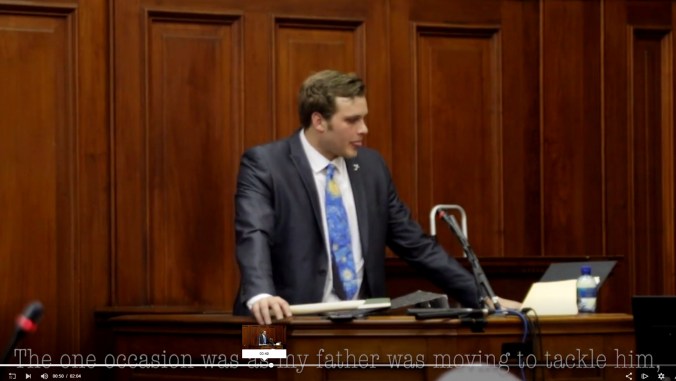
Below is a rare screengrab where his face is not obscured by his hand, although his head is turned away from the camera slightly. On this occasion, the convicted triple axe murderer was asked to demonstrate – using a balsa wood prop of the axe – how the axe murderer bludgeoned his father while he [supposedly] watched from elsewhere in the room. According to Henri, the attacker laughed while raining axe blows on his father in particular. It may be that his hand isn’t blocking his face on this occasion because it’s holding the axe.
What’s the actual significance of the tongue flick? It could be several things. It could be the psychological idea of tucking into a good meal, in the sense that what’s being asked is something of immense value, but the suspect is determined not to give this information up. As a result, there’s a sense of relishing this delightful leverage, of knowing something someone else doesn’t.
It may also be to hide another microexpression, like a smile, or a nervous curling of the upper lip, and in this sense the tongue flick might be reflexive.
Often we associate a flicking tongue with a snake. Snakes flick their tongue, but that is done to smell. Human beings aren’t trying to smell when they flick their tongues, except that those questioning them are trying to intuit something. So in a sense, there is this psychological effort to perceive something, to smell something. The tongue flick intuits that on a primal level. The suspect is asked a series of questions which the suspect probably could offer a lot more information. This information is on the “tip of their tongue”, but there would be dire consequences if this information is simply volunteered.
Also, the suspect tends to know before he is asked what is being asked [or suspected] of him. So when the question is fielded, often on camera, there is a sense of savouring it, almost as one would a nice meal.
The tongue flick’s real value, as I’ve mentioned before, isn’t that it happens, but when it happens. Catch the tongue flick and then go back and see what prompts it, and a world of psychological possibilities is revealed, including the crown jewel in unsolved true crime cases: motive.
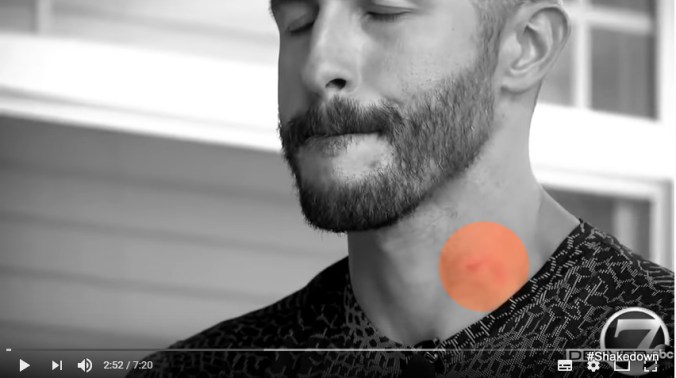
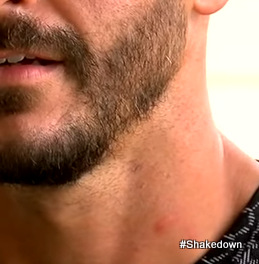
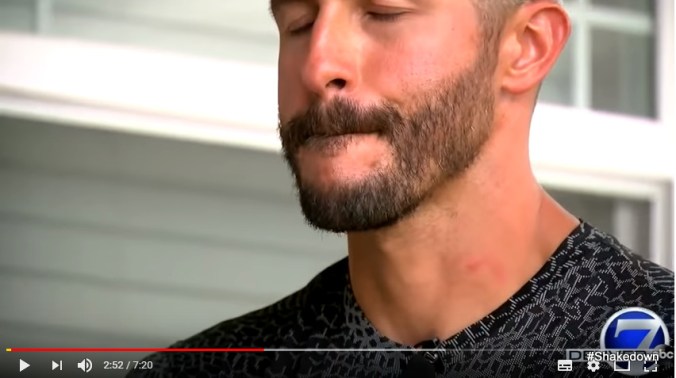
After posting the blog on lie spotting, MandyHVZ on REDDIT commented on a mark on Chris Watts’ neck. Check it out.
In some of the interviews Chris Watt gave, he’s faced away from the camera, like this one from CBS, where he says: “I don’t feel this is even real right now. It’s Earth-shattering. like a nightmare where I just can’t wake up from.”
The word “earth-shattering” is a colorful term. Watts volunteers this, but it’s a semantic Freudian slip because he’s buried his wife, and that required the shattering or breaking of Earth. These residues are in this mind as he’s being asked to share his thoughts and feelings. Some are slipping through.
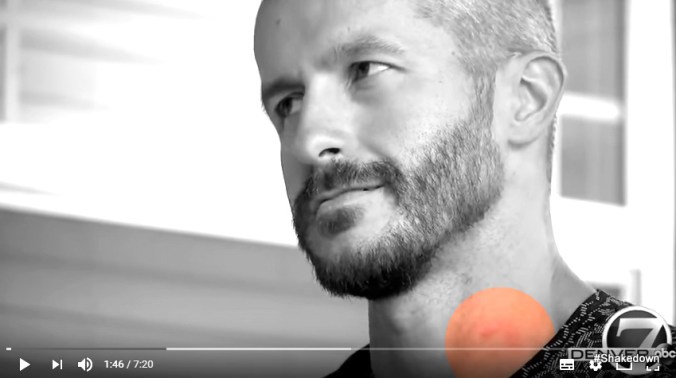
The reality is there were several cameras, and thus several camera angles. The Denver7 Channel had the all-important side-view. It’s from Denver7 that the screengrabs below were taken.
Although the autopsy results for Shanann are still pending, we know Watts strangled both his daughters. It’s likely Watts did the same to their mother in a so-called “silent death”. During a death by strangulation/suffocation, two things happen:
The killer is exposed to the death throes and thrashing of the victim of an extended period. It might be half a minute or longer.
The killer is in close proximity to his victim, almost head to head. This means he’s also within arm’s range of the victim, and her natural response is to lash out in a mirror image to what he is doing. If she can’t remove his grip around her neck, she attacks his neck in a desperate attempt to fight for her life.
Right at the end of the interview, Watts purses his lips and raises his left hand to his chin, blocking the view of the scar. Just reflexive touching, or was he conscious of the scar right through the interview and right at the end, could no longer resist the urge to block it from view?
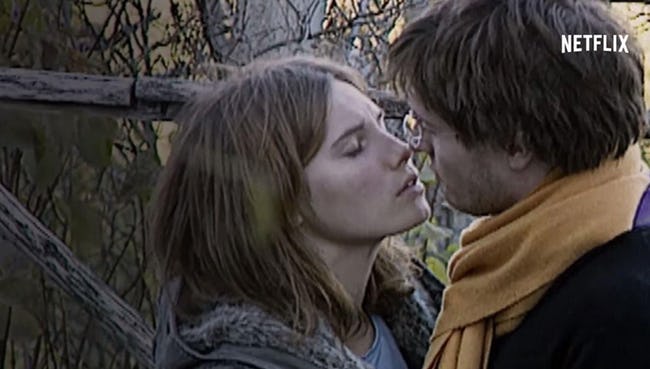
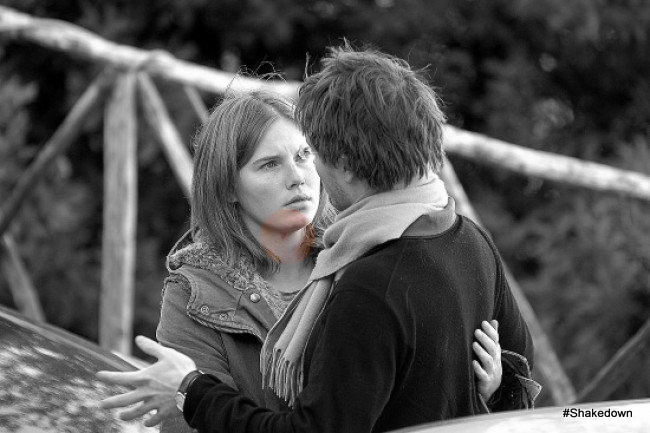
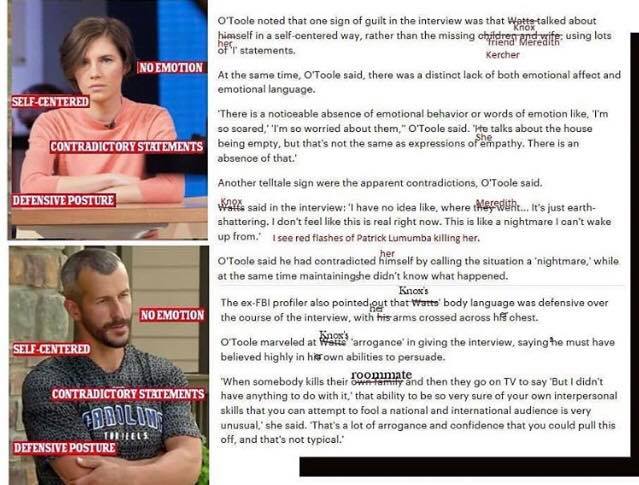
Sidenote: This reddish blemish reminds me of the same faded fresh scar on Amanda Knox’s throat, visible to all outside the scene of the crime but seen by none.
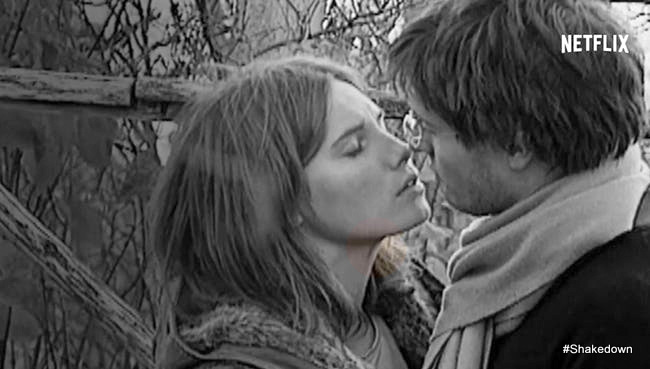
Also a lot of similar patterns in Knox’s situation and responses and Watts [see below]. Original Daily Mail article here.
Throughout the Oscar Pistorius case, Cape Town’s Kelly Phelps, a senior lecturer on criminal law at the University of Cape Town’s department of public law [and thus a legal expert] often provided expert counsel to the clueless mainstream media. Below are just a handful of Phelps’ contributions to the media narrative.
Experts differ on Oscar Verdict – on September 11 2014, when Judge Masipa found Oscar guilty of culpable homicide [a verdict ultimately overturned by the Supreme Court of Appeal to murder] Kelly Phelps told the media:
“I support her finding and her reasoning… Culpable homicide was always a likely outcome in this case,” she said.
There’s a lot more where this comes from. I remember Phelps very well during my coverage of the Pistorius case between 2014 and 2017. I remember not agreeing with virtually every criminal law assessment she made. Ulrich Roux, on the other hand, I remember made fairly astute calls and sensible commentary during the first third of the trial narrative, but his handle on the case got a little more wobbly from there onwards, I thought.
In order to comment on a court case with true insight requires more than a passing knowledge of a trial, and a lot better source of information than coverage by the mainstream media. To pick the nuances you really have to be there, or failing that, study everything that’s out there. Most of these experts simply don’t have the time for that, so it’s no wonder their assessments are glances and glimpses, and of dubious worth otherwise, especially when there are long court narratives. The Van Breda case has been pending for the past three years and counting. That’s a lot of intrigue to have to catch up on at short notice.
When Phelps cast her pearls to the media during the Pistorius case, which was a five year trial narrative from beginning to final conclusion, I wondered whether it was just bad luck, or whether one of us was consistently critically misinformed about the case.
You can say what you want, in spite of Phelps’ prognostications from the get-go, let the records show, the most authoritative courts in the country have consistently found otherwise, contrary to her expert academic counsel to the media regarding Pistorius.
Now, with Henri van Breda, she appears to be doing to same thing.
Over the weekend, Cape Town’s Weekend Argus quoted the criminal law lecturer [whom they describe as a legal analyst on the Oscar Pistorius trial for CNN] saying:
“I’m convinced after reading the defence’s papers that they stand a decent chance of getting a Supreme Court hearing…it’s not unthinkable the Supreme Court could be swayed into acquitting him. [The state’s]argument is strong, but the defence’s is equally so. This case is not as open and shut as the public have been led to believe.”
This whopper from Phelps makes me wonder how much time she has spent following this case, between her duties as a university lecturer. If I had to score the state’s case against the defence case I’d say it was a 9-1 whitewash. Botha only gave the appearance of fielding a defence, in my view.
In the Pistorius trial, we saw similar legal sleight of hand. Oscar really had no defence, but Barry Roux managed to convince a few, at least for a while, that he did, or at least that there was some doubt to consider. I’d score the Pistorius defence’s case slightly better, at 8-2.
The only point for the defence in the Van Breda trial was that Henri presented a version in court, which was better [barely] than presenting no version. I agree with what Desai said during the application for leave to appeal hearing, rarely do you come across a case as open and shut as this one. It goes without saying that Henri was a very unconvincing witness on the stand, among a host of other problems which I’m not going to go into here.
[Phelps] said to understand the complexity of the trial, it was important to grasp the distinction between circumstantial and direct evidence. “Direct evidence supports the truth of a claim directly. For example, if a witness saw an accused shoot and kill the deceased, this testimony is direct evidence of the guilt of the accused. After reading the defence’s appeal application it’s clear that another reasonable inference may be able to be drawn. And if the Supreme Court is persuaded then Henri van Breda will walk free.”
It sounds like the same sort of drivel about Oscar, doesn’t it? There are very few high-profile criminal cases where someone actually sees someone else commit a crime. Direct evidence cases basically negate the need to even have a trial. Something that’s self-evident typically doesn’t need to be tested in court, just look at the CCTV footage. Case closed.
A good example, said Phelps, is the way the defence challenged the State’s persuasive argument that De Zalze’s security was not penetrated. “Van Breda’s lawyers refer to unrefuted testimony that real alarms went off on the night in question, which were never explained by the State. Furthermore, they point out that the majority of the fence was not covered by cameras and there were in fact 191 prior incidents of crime reported to the police. This clearly shows that the security is not impenetrable.”
If you sat through the court testimony, and you were properly appraised of the DeZalze estate – it’s size, it’s extent, the mapping, the location of #12 Goske Street in the fabric of the estate, the various security layers etc – then you’d know the perimeter security isn’t a good legal argument in this case. You’d also know the alarms that went off sound like a promising defence but they’re not; they’re just false alarms picked up the perimeter sensors that are typical at estates of similar size.
#VanBreda Oh dear, Botha going on about the DeZalze estate's perimeter security.
Phelps said while the State’s case was compelling enough to secure a conviction, it nevertheless provided no motive as it is not a legal requirement in South African law. “However, motive is an important persuasive tool as it adds plausibility to the State’s case. So why did Van Breda just decide out of the blue one morning to axe his family to death? It beggars belief it’s deeply implausible. “The State provides a compelling narrative but no context to drive it. They did not put forward a shred of evidence to explain why Henri would have murdered almost his entire family. Ultimately, the lack of motive might sway the Supreme Court.”
On paper, this also sounds like a brilliant legal argument, and certainly the court and the media all scratched their heads post conviction. It was as if for the first time people wondered – shit, if he did it, why would he? And then a few people pontificated about a boy being wounded by his dad, as if that’s never happened in every other family in the world that’s ever raised teenage boys or male siblings.
Once again, Phelps is making the same mistake she made with Oscar Pistorius. There the state, the court and the media all failed to address motive as well, and yet ultimately, Oscar was found guilty of murder and sentenced to the appropriate sentence.
In South African criminal law, all you have to prove is intention, also known as Dolus. In the Van Breda case the state went even further, proving premeditated murder.
The Van Breda case has far more intentionality than the Pistorius case, because Van Breda puts himself at the scene in his own version, and because he’s there when four people are slaughtered at arm’s length from where he’s standing like a statue. He’s right there as his brother and father are being hacked multiple times – he’s standing right there in the same room. Murdering someone with an axe takes time. Each blow takes a moment to lift and smash, and then there’s another blow, and the victim may move and perpetrator must change position to land the blow where it will inflict the most damage. Killing one person with an axe takes time, even after you’ve landed your blows. Imagine how long killing four people, one after another, takes? Imagine how tiring it is.
And by his own admission, Henri does nothing while the one family member is attacked, then the other, then the other and does nothing for several hours afterwards when he has the house to himself, to help any of his family members even though he has minimal injuries, and he’s well aware that they are seriously injured and still alive.
The fact that Marli survived in spite of her injuries, and despite her brother’s callous lack of compassion, indicates there was something that could have been done, there were lives that could have been saved.
Yet Henri can also offer no explanation for why he didn’t come to the aid of any of his four slain family members, and yet he came to his own aid. According to his version, he fought off the attacker with ease, but only when the phantom confronted him. In this sense there is a clear intention to fight for his own survival, but then not to assist his family whose suffering persists for hours on end, and for many more minutes during his ridiculous phone call in which he expresses a deplorable lack of urgency given the circumstances.
Van Breda’s 20-something emergency phone call is another huge piece of evidence which we didn’t have in the Oscar Pistorius case.
In my view – and I don’t think this is legal rocket science by any means – Judge Desai will not grant an appeal, neither will the Supreme Court of Appeal and neither will the Constitutional Court.
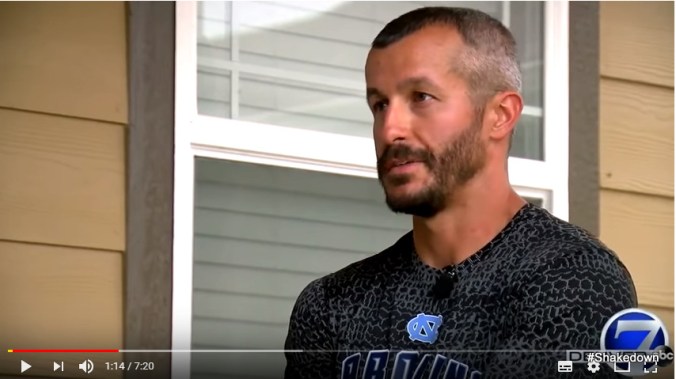
Have a look at the seven minute interview Chris Watts gave while his pregnant wife and two daughters were still missing. Make a mental note of any inappropriate behaviour, micro-expressions, mannerisms, phrases or words that raise red flags. Ready? Go!
It hasn’t taken long for the media and the public to draw comparisons between Chris Watts and Scott Peterson. These two assholes even look similar. People magazine’s so-called experts have called Chris Watts “very convincing” in front of the cameras. Here’s the full quote:
Investigative experts tell PEOPLE, Watts’ behavior comes as no surprise. “He has an incredibly large ego,” says Dale Yeager, a criminal analyst and forensic profiler who is unconnected with the case. “He was very convincing in front of the camera, which means he really comes off as sociopathic. That doesn’t mean he is mentally ill, just that he has a personality defect.”
Drawing a parallel between Watts’ case and that of Scott Peterson, who notoriously murdered his pregnant wife and then repeatedly gave interviews, Yeager says, “He’s Scott Peterson, just less charismatic.”
Australia’s News.com.au also fielded one of their true crime specialists to give their “expert” take on Watts.
To the untrained eye, Watts may have given the impression of a quietly anxious husband and father seemingly clueless about the whereabouts of Shanann, 34, Bella, 4, and Celeste, 3. But to renowned body language specialist Judi James, the subtle quirks in his physical behaviour told a different story to the one coming out of his mouth.
Ms James has identified nine techniques that Mr Watts may have used to conceal his guilt as he was filmed on the front porch of the family’s home in Frederick, Colorado on Tuesday.
She says Mr Watts may have gone to extraordinary lengths to appear calm and unruffled in the belief that was how innocent people behaved.
What a crock of shit. You don’t need to be a forensic profiler or a body language specialist [whatever that is] to intuit decepion. You just need to pay attention, be alert, and some familiarity with other true crime cases and their patterns doesn’t hurt.
Now, without any further ado, what are Chris Watts’ tells?
Lack of affect. The biggest clue that something is seriously wrong and seriously off here is the most obvious. Watts simply doesn’t look or sound upset. On many occasions in the interview he smiles. A genuinely grieving father and husband to a 15-week pregnant wife would be anxious, distraught and overwhelmed. There’s none of that here.
No urgency. When the reporter asks Watts what’s going on, Watts immediately leaks a smile of contempt while shaking his head. Why? Because he knows – or thinks he knows – k9 units or cadaver dogs aren’t going to find anything at his home. [Watts killed his wife and two daughters and later dumped his wife’s body near an oil rig where he worked, he stuffed the bodies of his two daughters, Bella [4] and Celeste [3] into a large gas drum to disguise the smell]. It’s noteworthy that the first thing Watts thinks about when asked what’s happening is the dogs [and the idea of scent and smells].
When the reporter asks the very open-ended question about what’s going on, Watts’ tongue darts out of his mouth. This is at about 33 seconds into the clip, and happens so quickly, if you blinked just then, you’d miss it. In a scenario where a killer goes to a lot of effort to kill and cover up, when asked what happened, this is an opportunity not only to savour his efforts, but to verbally cover them over. The licking of the lips is the psychological equivalent of being about to dig into a meal. Often this poking of the tongue is also intended to hide or cover a microexpression. As Watts begins to answer, he seems to be holding back a smile.
When Watts actually answers the question, he starts off with a stutter. Well, he has a reason to be nervous. What happened? Watts’ story is the typical story you hear, everything is “perfectly normal”. But if it was perfectly normal, why are things fucked up? Something was far from right, something did happen – triple murder – but Watts is doing his best to pass it off as no big deal. The problem is, that’s completely inappropriate to the situation. It’s a big deal that his wife’s gone, that his children are gone, and by trying to seem unemotional about the circumstances prior to and around their disappearance [in effect his words are hiding what he did], Watts is revealing a mismatch.
Watts’ words matter. He refers to texting his wife, and Shanann not texting him back. “If she doesn’t get back to me that’s fine,” he says, and shrugs. Shitballs it’s not fine. In an emergency situation when you want someone back, them not getting back isn’t fine. This narrative aspect is also a mismatch to what Watts says later in the interview, that he really hopes he gets his family back. Also, what really concerned “a lot of other people” [not him] wasn’t that Shanann didn’t get back to him [as if that was normal or reasonable], but because she didn’t get back to them.
Once again, the microexpression as Watts describes Shanann “not getting back” to him is so quick at 52 seconds, it’s almost invisible. The screengrab below doesn’t quite capture the triangular curl of the lip, so it’s better to watch the clip in real time a few times to catch it. There’s a slight snarl, a slight lifting of his left upper lip. This is a key indicator of contempt. Contempt in true crime is a critical red flag. A genuine victim tends to feel the opposite – helpless, humble, agonised. Contempt is a kind of sadistic and scornful pleasure at the expense of a murder victim, after the fact.
When Watts describes walking into the house there’s another microexpression, another smile leaking through. He’s dismissive and flippant. Rather than sympathising with his own feelings of anguish, or reliving them, he’s smiling. All that comes from the first 75 seconds, and these are just the highlights.
When the reporter asks Watts to spell his wife’s name, the second tongue flick happens. Once again, Watts is either trying not to smile, or he’s enjoying the new context he’s in. There’s duping delight in spelling out something as basic as his wife’s name when he knows so much more, and he’s not going to tell them, when he’s done so much more, and they don’t know!
When Watts names his daughters at 1:24, there’s another slight smile. Fortunately the cameraman zooms in at this point, as if he’s also trying to catch the little nuances.One of the ways we try to hide a smile is by pinching our cheek muscles against our lips, causing the smile to be crushed or overpowered by the cheek muscle. Again, the screengrab doesn’t really do the mechanism of this microexpression justice, and since it’s so reflexive, it’s better to catch in real time and the context of what is said when it happens. When Watts has finished spelling out Celeste’s name, he briefly repeats the same “cheek-crush” microexpression.
When Watts provides the ages of his two dead daughters, Watts gulps and immediately afterwards there’s another tongue poke. Once again, providing such basic information to the reporter may be amusing to Watts given what he’s done to them. Watts is relishing this, taking sadistic pleasure in being able to account for the complex details of the crime in such simple terms, information he knows is virtually useless in the scheme of things. But there’s also a degree of anxiety underlying the questions and his answers – the stakes are high, is he being convincing?
When the reporter asks how many times Watts called his wife, Watts tilts his head and says matter-of-factly that he called Shanann three times and texted her three times. Here Watts tries to turn on the charm, trying to convey himself as a caring spouse. He crinkles his forehead and continues to talk matter of factly. Again, what’s missing here is requisite emotion. There’s no concern, no anxiety, instead, there’s charm and swagger.
The reporter has asked Watts a very simple question. How many times did Watts call his wife. He goes into verbal diarrhea, providing a lot of extraneous information, suggesting that he thought she was just busy, that’s why she didn’t answer, or that she was getting back to other friends and not him. Again, not only are the words themselves inappropriate [he seems resigned to the fact that she’s not communicating with him, but is communicating with others], but Watts only figures something is wrong when his wife’s friend showed up. Only then did it “register” that something was wrong. All the reporter asked was how many times he called his wife, and Watts has confessed here that it took a friend to “bring it home” that something was amiss with his wife, despite the fact that she wasn’t home, and the kids weren’t, and he was. [Shanann and the two girls were all murdered in the home, and then their bodies dumped at the oil refinery where Watts worked]. Throughout Watts’ overly long answer, he hardly blinks, he touches his face a few times and otherwise stands with his arms folded.
He’s too controlled under the circumstances, and when emotions do leak through, they’re the wrong ones. Also, he keeps smiling or looking like he’s about to smile.
Just after 2 minutes, the reporter asks: “Do you think she just took off?” There’s another tiny snarl of the upper lip. It’s another expression of contempt. Think about contempt in the context of that question. Do you think she just took off? Is there contempt for the reporter, or for the idea that she’d dump him, and not the other way round?
Have a look at Watts face as he says he doesn’t want to think about what happened to her [or talk about it – and for obvious reasons]. Then he says: “I hope she’s somewhere safe right now, and with the kids.” The duping delight is etched prominently on his face, and once again there’s a slight sneer of contemptuous and cruel satisfaction, and yes, he’s still smiling.
At 2:48 Watts describes his “traumatic night just trying to be here…” Why is being at home traumatic? What should be traumatic is wondering how is family are? This is evidence of Watts’ ego and sociopathy. He’s trying to convey emotion, but all he can convey is his own narcissism. And he’s still smiling.
As the reporter gears up for another question, Watts sways slightly from side to, purses his cheeks, and gulps again. On a few occasions in the interview he seems slightly out of breath. He’s nervous, but trying to look composed. It’s the wrong emotion for an innocent man. An innocent man doesn’t care how he looks, he cares about the victims and he’s emotionally compromised. There’s grief and anxiety – for them.
When asked about his relationships with the kids, Watts nods and bites his lower lip, repeating an earlier expression. Clearly the family dynamics played a crucial role in why Watts felt justified in murdering his wife and children. But is he really going to say what the dynamics were really like? Is he really going to reveal his motive? Well, that’s why he’s biting his lip.
When Watts actually answers the question, he stutters and shakes his head while saying “the kids are my life”. Obviously the opposite was true. Watts felt his children were killing him in some way; perhaps financially, perhaps robbing him of his freedom, who knows. When Watts tries to think of an example of how he loves and misses his kids, what he comes up with is the cliched example of a parent telling his kids to eat their vegetables. That’s his favorite memory of his children? This kind of vapid persona suggests extreme narcissism, someone incapable of feeling someone else’s feelings.
19. At 3:09 Watts cracks a joke: “You know, you’re not going to get your dessert…” Again, Watts takes sadistic pleasure in comparing this expression to the reality. The reality is both his daughters are dead and dumped in an oil drum. He knows they’re never going to get their dessert ever again, and this is a source of amusement, even delight to him. This is a sick bastard, but then he had to be to commit quadruple homicide [his wife, his unborn child, and his two small children]. That makes Watts a mass murderer, given that the definition requires the killing of four people without a cooling off period.
As Watts describes his daughters’ patterns, he can’t remember what exactly they watch. Again, he’s flippant. His memories of his kids aren’t personal or intimate. It’s not a father playing with his kids or sharing a moment, it’s him seeing them watching television. It’s sterile. And Watts is callous and offhand about it, smiling and flapping his hand casually – these gestures from the head of the house tell a lot about the true family dynamic underlying this terrible tragedy.
That’s an analysis of less than half the interview, but I think it’s enough. Why is it important to study a shithead like Watts and figure out his MO, and his patterns? Because the failure to figure out when someone is lying to you, especially someone close to you, could get you killed. You could be a child, or a spouse in a family, you could be pregnant or engaged, or trying to make it work, and you might be living day to day with someone who means to kill you, or if not kill, do harm to you. Perhaps financially. Perhaps in a host of ways.
It’s important that we as social creatures are awake and alert to the many little gestures that give away a spectrum of our inner feelings, from mostly harmless disassociation, to toxic and callous sadism, to seditious and insidious and potentially destructive narcissism.
It’s important that we’re wise to these expressions masking incredibly destructive impulses in those close to us, and those around us. If it doesn’t apply to us in our relationships or friendships, it may come in useful with someone out there and our ability to look into their relationships, where those in them maybe can’t see the wood for the trees.
True crime has always been about figuring out ourselves and each other through the struggles and motivations, the life and death stuff going on with other people. Failure to figure this out places us at risk, if not in danger in the real world. In a world where tabloids and their “experts” advise us on how convincing the likes of Watts is in an interview, we need to be sharper than that. And with a little practice and attention to detail, we can be.
The good news is, when you know what you’re looking for, and when you’ve seen it once, it’s easy to pick up the pattern. The trick is to look and listen carefully, to pay attention not only to the words but to the context of the words, and to have the confidence to think for yourself, to make up your own mind, rather than accept someone else’s version of events as gospel.
In a marriage, especially a doomed marriage, this simple ability to discern the difference between a genuine person and deception, could save lives. In the real world, the ability to discern the difference between reality and fiction can mean the difference between success and failure. A society that can read itself right is self-correcting. The same applies to us as individuals.
When we develop the capacity to intuit lies, we’re forewarned. Because we have a handle on reality, we’re less easily to mislead or manipulate. We can act, we can change reality before it happens, rather than as we see so often in true crime, piecing it all together when it’s too late, after the fact.
How many people thought Chris Watts was probably guilty when you saw that interview w/ him on the porch? I don't like to hastily judge people's reactions but he was acting emotionless & the "emotional conversation" he admitted to were huge red flags to me.
Notice how different Watts presents himself in court. The glasses are meant to convey sensitivity and minimize the perception of masculine aggression, and malice.
Visit this link to watch Chris Watts’ reaction to his wife’s pregnancy test. Given that they’d bought an expensive house in 2013, and Watts’ had filed for bankruptcy in 2015, the news couldn’t have been received well in his heart of hearts.
The couple declared bankruptcy in 2015, and despite Shanann’s frequent Facebook posts boasting of the Lexus and frequent paid trips she was awarded for selling health supplements, the couple [in 2018] was facing a $1,500 civil suit from their homeowners’ association. They purchased their five-bed, four-bath home for $400,000 in 2013, and their mortgage payment was about $3,000 a month, according to bankruptcy records.
Ironically Watts situation and Scott Peterson’s are almost a carbon copy – new house, new child on the way, and a job that’s not quite paying the bills. Divorce more messy than murder? Only if you’re a sociopath.
When I first heard Advocate Botha’s arguments in his bid to win leave to appeal I was very underwhelmed. I didn’t get a sense that Botha was volunteering anything new on behalf of his notorious client. There were no game-changers. There was nothing that stopped one in one’s tracks and went, wow, I never thought of that, this could change everything.
After further analysis Botha’s arguments do have a little merit. He starts off challenging the state and the court a quo on the “premeditation” findings. In the first three minutes of the hearing Botha emphasised precisely this aspect.
Let’s review the transcript.
BOTHA: Even if the court confirms the guilty finding, on counts 1 to 3, there’s a reasonable prospect the court of appeal may find that the state failed to prove beyond reasonable doubt that the applicant planned the murders, or that the murders were premeditated. Of course in that premise [clears throat], in that event, the charges – if a court of appeal agrees with us on that aspect – the mandatory life sentences fall away. And the court will then consider [correcting himself] will then be free to consider afresh, a sentence without the uh-uh…provisions of section 51 B…the Criminal Law Amendment Act being applicable.
In theory this is a reasonable argument. It worked in the Oscar Pistorius case. Premeditation is often very difficult to prove, especially in circumstantial evidence cases.
In the Oscar Pistorius case, had Oscar shot Reeva with his prosthetic limbs on, the court would have had a strong case for premeditated murder. Why? How? Because in Oscar’s own version he was asleep with his legs off. If he had the presence of mind to put on his prosthetic limbs and arm himself [an activity that took time, perhaps half a minute] and rather than flee the scene, approach the danger and shoot, well that creates a mosaic of premeditated action doesn’t it? When Oscar was putting his limbs on, had he formed an intention in his mind?
As it turned out, Oscar wasn’t on this prosthetic limbs when he fired the shots, which was a huge early miscalculation and embarrassment to the state and the state’s case.
Personally I believe Oscar was guilty of premeditated murder, because he heard Reeva screaming [I believe], because he approached the screaming cubicle, because he fired four shots into it, and because each shot’s trajectory differed markedly from the other, which means he was tracking his target who was unsighted, using sound. Using her screams to see her.
3 of the 4 shots were on target, despite the fact that Reeva was moving behind the door, and the last shot was a head shot. The sound she made when she received this wound, was falling on the wooden magazine rack. This sound would have told the shooter exactly where Reeva was.
I covered a lot of this in my book Justice Eventualis, cross-referencing expert testimony with ballistics angles and measurements. I even reconstructed a to-scale scene in my garage with a real door.
Ultimately though, despite a fairly good palette of evidence, the state failed to prove premeditated murder, and ultimately failed to prove that Oscar murdered Reeva.
In the end Oscar was only found guilty [Dolus Eventualis] of indirect intent, in the sense that he murdered an unarmed intruder, not Reeva. Indirect intent, such as throwing a hand grenade into a crowd may be an indirect way of killing specific people, but it’s intent nevertheless. You might not know who you’re killing, but you clearly intend to kill nonetheless. I cover this intention in detail in Slaughter, my book on mass murderers.
Morning light reflects off the Mandalay Bay hotel and the broken windows where shooter Stephen Paddock conducted his shooting spree from the 32nd floor in Las Vegas, Nevada, U.S., October 3, 2017. REUTERS/Mike Blake
It’s difficult to see more premeditation and a clearer motive in mass murderers, and yet the media and even the FBI often are unable to say why these mass murders happen. They can’t say why the Vegas shooter Stephen Paddock killed a record number of Americans. Ditto Newtown’s Adam Lanza, Virginia Tech’s Seung Hui Cho or the JThe Dark Knight cinema shooting in Aurora by James Holmes.
Because of the state’s failure to prove premeditation and direct intent, technically and legally, Oscar is only guilty of murdering someone, not of murdering Reeva. Wherever Reeva is right now, I’m sure she’s not happy with that. If you were murdered, would you be?
In any event, not all cases are born equal, and the Van Breda case – in terms of intent – is a lot simpler than the Pistorius case. Obviously where there are four victims, three of whom are bludgeoned to death, and the fourth also bludgeoned but miraculously survived, you have clear premeditation. Just in the act of successively murdering one, then another, then another, and then attempting to murder a fourth, you have an assailant who has a very clear intention. In an axe murder death isn’t instantaneous. It requires several blows to the head and neck, and in this case, all four received blows to the head and neck. Henri is the only family member who didn’t.
One sees this intent reinforced by the fact that Henri also didn’t come to the aid of any of his family members after they were attacked.
Even though he knew his brother and sister were alive, struggling to stay alive for at least two hours, he didn’t come to the aid of either of his siblings, or even comfort them. In fact, there’s some reason to believe Henri laughed while he massacred his family. In his own version he described the axe murderer laughing while hacking his father to death. This isn’t premeditation, but it suggests if he wanted his family dead, after killing two family members, he was prepared to still let nature take its course.
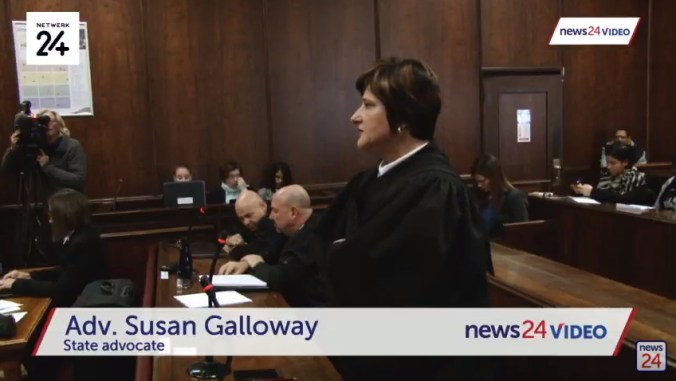
In my books on Van Breda I’ve gone into some detail why the second axe murder – of his father – is clearly premeditated. Galloway skillfully avoids getting her hands dirty in these arguments by simply stating that if the family members were all upstairs, and the axe was downstairs, it required Henri [who claimed he was also upstairs], to go downstairs in the middle of the night when everyone was asleep, collect the axe and then head upstairs and carry out the slaughter he had in mind.
I agree that this implies premeditation, just as the fact that the crime occurred when it did, at about 03:00, about three hours after a neighbour heard the sounds of raised male voices arguing.
I also feel this ought to be sufficient, except we see a mirror image of this scenario in the Oscar case. It’s not a 100% reflection, but it is similar. In Oscar’s story he got out of bed, went to the balcony door to close the curtains, heard a sound, went to retrieve his gun from under the bed [right where Reeva was supposed to be sleeping, but blanketed in impenetrable darkness].
Oscar claimed he either spoke to Reeva in a low tone, or whispered to her. In this schema he spoke to her too softly for her to hear, that’s why she didn’t answer, but in the reality of the story, Reeva wasn’t there to begin with, she was already in the toilet, and had locked the door.
The point is, like Van Breda, Oscar also had to retrieve his weapon from somewhere else, and then approach his target. Instead of a stairway, he went along a hallway, was presented with an empty bathroom, and someone inside a locked room. Oscar’s story that he’d communicated with Reeva throughout waves the flag that he’d warned her he was armed, and this was in a sense a warning shot. In Oscar’ version, Reeva’s failure to acknowledge herself cost her her life. Oscar was justified in being afraid and trigger happy, and Reeva died because she failed to raise her voice and identify herself. That’s his explanation.
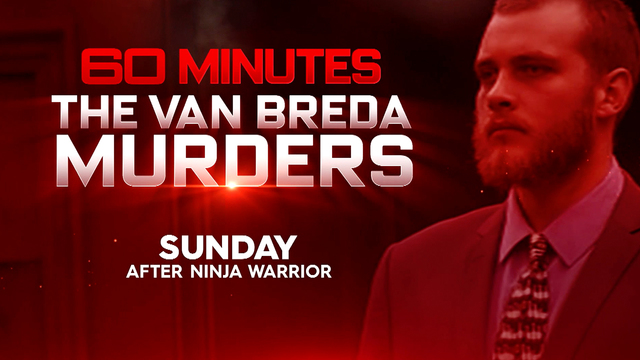
I don’t wish to conflate the two cases more than that, other than to point out Henri’s girlfriend invoked Oscar’s testimony and how Oscar was blamed when he showed emotion, and blamed when he didn’t. Danielle said in her exclusive interview with 60 Minutes that Henri was trying very hard not to fall into the same trap. But what she seems to have missed is that Oscar was found guilty of murder. It’s not as if he was innocent and his emotions were wrongly found to be inappropriate by the media. He was guilty and thus his inappropriate emotions made sense. The same applies to Henri, doesn’t it?
At face value then, Botha’s argument that the premeditation narrative is a little shaky holds some water. But for anyone familiar with this case, and applying the logic that premeditation is implicit in multiple serial killings, then Botha’s arguments are very shaky indeed. The Van Breda axe murders are almost at the scale to meet the classification for mass murder. If Marli had died, Henri would officially be regarded as a mass murderer. Even worse, a mass murderer exclusively of his own family members.
In terms of Judge Desai, he was combative and interrupting throughout Botha’s arguments. He was also scornful straight off the bat when Botha said this was merely a “circumstantial evidence” case.
The Judge is correct that most criminal cases are circumstantial evidence cases. In criminal cases, direct evidence tends to be lacking, often because the perpetrators conduct their crimes in secret, and tend to remove the direct evidence implicating them.
Examples of direct evidence are eye witnesses. A fingerprint isn’t direct evidence. In a circumstantial evidence case, a court must draw inferences based on the mosaic of information provided.
My favorite moment during the 28-minute hearing was when Galloway accused Botha of nit-picking the circumstantial evidence, causing him to miss the wood for the trees. That’s exactly what he’s done.
If I had to bet, I’d say the Judge won’t grant an appeal, because this would be little more than giving further opportunity for further fruitless nit-picking. If that happens, Botha can apply to the Supreme Court of Appeal [SCA] directly, just as Gerrie Nel did when Judge Masipa denied him leave to appeal her “shockingly light” sentence.
If the SCA refuse to grant an appeal, and they tend to be very strict in the cases they do grant leave to, Botha can apply to the Constitutional Court. Oscar did this when the SCA ruled against him. The Constitutional Court rarely rule on criminal matters, and it’s virtually inconceivable that they’d want to hear this case.
We have seen that Judge Desai has been somewhat sympathetic towards Henri. That said, he has been exceedingly patient hearing Botha’s case, even when it’s been hours and hours of much ado about nothing. Prior to sentencing, Desai repeatedly offered Botha the chance to provide evidence in mitigation of sentence. Botha and his client spurned this offer, a decision both may rue for the foreseeable future.
If Desai refuses leave, it’s also possible that in future another application may be lodged, fielding a new set of evidence. The Drugs Narrative, in my opinion, may yet be out there, but I wouldn’t count on those chickens before they hatch.
Shakedown will provide an analysis of the legal arguments made here in more detail at the end of the week, prior to Judge Desai’s decision on the matter on Monday August 20th.
Judge Siraj Desai will hear arguments from both counsel on why his findings ought to be appealed. If the defence are able to field a reasonable amount of “new information”, and if the Judge feels there’s a reasonable prospect of success, or a reasonable case to be heard, then he’ll grant an appeal. What the court wants to avoid is simply rehearing the same case, retrying Henri effectively.
Double jeopardy is a procedural defence that prevents an accused person from being tried again on the same (or similar) charges and on the same facts, following a valid acquittal or conviction. As described by the U.S. Supreme Court in its unanimous decision one of its earliest cases dealing with double jeopardy, “the prohibition is not against being twice punished, but against being twice put in jeopardy; and the accused, whether convicted or acquitted, is equally put in jeopardy at the first trial.”
In the Oscar Pistorius case the Judge granted an appeal on her verdict of culpable homicide, the Supreme Court of Appeal [SCA] then came to a different outcome, Dolus Eventualis [murder with indirect intent]. The SCA sent the case back to the court a quo for sentencing on their verdict. Masipa then sentenced Oscar to a “light sentence”. The state again asked for leave to appeal – just the sentence – but in the second instance, Masipa refused to grant leave. So the state took the case directly to the SCA. The SCA decided to grant the appeal, heard it, and sentenced Oscar accordingly – an effective prison term of 15 years for murder.
In my view, Desai will grant the defence an appeal simply in the interests of hearing a case “to completion”. To his credit, Desai’s trial exhausted very many avenues of legal argument though, so an appeal, if it happens will be very limited in scope.
So what new evidence, and perhaps new witnesses, will the defence bring forth? We’ve already seen one of them:
Another potential witness might be Henri’s girlfriend Danielle Janse van Rensburg. Remember it was Danielle who effectively introduced the Epilepsy Narrative. She apparently was talking to Henri when he had a seizure, she then called her father, a GP, and the next thing the court was informed that Henri had epilepsy. All of this happened right at the end of the trial in November, when Desai was hoping to pronounce his verdict.
Advocate Pieter Botha left the court and the public with this cliffhanger to ponder on over the holiday season when the courts went into recess.
Dr Butler says he didn't discuss diagnosis with #VanBreda or his girlfriend, other than to say he would check for epilepsy or stress-related seizures.
Usually discusses likely diagnosis, but due to unusual circumstances and possibility of malingering he didn't.
Court accepts that he suffers from epilepsy. The only other source of information regarding the incidents is the girlfriend. She did not testify and the accused himself did not testify court makes no finding in this regard #VanBreda
So the Epilepsy Narrative is likely to be fielded, I believe, as new evidence. As I tweeted in May, I believe this evidence was intentionally withheld as a defence strategy, allowing them a back door – a legal loophole – to take the case to trial. It was clear throughout most of this trial that Botha was losing this case for his client.
What do the defence hope to gain through the Epilepsy Narrative? It’s unclear. According to Henri, he blacked out after the crimes were committed. If the defense can persuade the court that epilepsy was there to begin with [something I’ve maintained throughout my book series], then this may have an impact of his memory and theoretically on his culpability.
It’s a weak defence in my view, but who knows, the court may feel curious in the face of “no motive” to find out more. Personally I think this would be a poor reason to rehear the case, but legalities aside, more might be revealed.
What’s interesting to note, over the past few weeks and days leading up to the leave for appeal hearing, we’ve seen a PR Narrative emerge. We’ve seen a Twitter account pop up “Support For Henri”, although if anything, this account shows how little support Henri has amongst the public. To date Henri’s support on Twitter stands at a meagre 17 souls.
Amazing how dishonest the media is. 60 minutes doesn't reveal a motive, it pretends to be apologia for #Vanbreda>Perth axe attack: The reason why Henri van Breda murdered his family revealed https://t.co/keK8ACQRbt via @
We’ve seen a big effort to get the “Henri’s Innocent” narrative into the media, via Henri’s key Apologists, his aunt Leenta Nel [the sister of the murdered mother, Teresa van Breda] and Henri’s girlfriend.
According to Danielle, and what she told 60 Minutes Australia, Henri told her “everything”. Well, then why didn’t she testify in his defence at trial? Why is she talking to the international media instead? But rather than eye-opening insights during the 60 Minutes “world exclusive”, all Danielle basically did was stand by her man. She didn’t field a detailed, evidentiary argument about why he was innocent, except to use sentiment, saying the Henri she knew didn’t like to cause pain to anything. Well, his entertainment choices seemed to suggest otherwise.
Or she simply used words to say she didn’t agree with certain findings, but wasn’t able to provide real insight as to why it made sense that her knowledge was more authoritative or credible.
We also know that Stefan van der Westhuizen, his former best friend, described Henri taking him at the throat when he told Henri Marli was having second thoughts about Henri’s innocence [prior to the trial].
Stefan van der Westhuizen, who cried in court when Henri was convicted on all charges, has gotten engaged in the meantime.
Missing from the roll is Marli. If Marli testified in Henri’s appeal, that would be something, especially if she testified as part of his defence. That Marli hasn’t participated, and all indications are that she will not, speaks volumes. Think about the credibility of a girlfriend testifying in support of her beau, while a close family member who was not only at the scene of the crime, but the only survivor of the axe attack, maintains her silence. All this while millions hang in the balance.
The Drug Narrative is unlikely to be fielded in an appeal, not by the defence at any rate. Conceivably, it could be introduced as a mitigating factor, but also as an aggravating factor. Curiously, some journalists have accepted Danielle’s “rumor control” that Henri’s drug use is all a myth [and throw in a giggle for good measure]. If Danielle says it, it must be true, right?
So many things I agree with and some I don’t. But I’m glad the rumors were cleared up – Henri was not using crystal meth and he did take a sleeping tablet the night before his verdict – these I believe are true. #vanbreda#henrivanbredahttps://t.co/FzDrXlI2BU
The Drug Narrative might be fielded by the prosecution, in the event that Desai grants the appeal. Personally I wasn’t surprised, I was shocked when the Drug Narrative was completely excised out of the court case. The fact that Henri and Danielle were arrested on drugs, Henri spent the night in jail as a result, and attended a court hearing on drugs, and yet despite this, never a word about this was whispered in court beggars belief.
Interestingly, Danielle also plays a key role in this area. When the two were arrested for dagga possession, Danielle took the rap for it. The drugs were hers, she said.
I entered into a discussion with Anthony Molyneaux about the Drug Narrative on Twitter, but I see he’s muted/removed it. Molyneaux was effectively calling the entire drug story a myth, simply because Danielle [on the eve of the leave to appeal hearing] said so.
But is the absence of evidence an absence of evidence? Sometimes, often, the absence of evidence is evidence.
I’ve dealt with this aspect in detail in my books about the case. The Drug Narrative being so neatly excised from the trial narrative raises red flags, but even if Henri used dagga, that doesn’t make him a druggie. Of course, it doesn’t mean he isn’t one either. One might say, in light of “no evidence” there is no evidence. Again, that’s the lazy approach to this case.
The Amanda Knox case also involved an extremely brutal and bloody murder inside her home, a burglar narrative, and so on. The Drugs Narrative was also neatly excised from that case, even though it was well-known Knox was using marijuana regularly, and Perugia was a hotbed for much harder drugs, like heroin and coke. In Knox’s memoir she wrote about sleeping with a coke dealer on her first train trip into Perugia.
Coming back to Van Breda, what we know is he was expelled from university, he wasn’t on a Gap Year quite as voluntarily as he claimed. We also know that because of his record, he couldn’t get into local universities either. Julian Jansen in his book refers to Henri’s university mates nicknaming him “Druggie” [page 61]. If this information wasn’t credible, the Van Breda’s could theoretically sue Jansen/Naspers for defamation. So why haven’t they? On the contrary, the Van Breda brothers are in regular and close contact with Jansen, often granting him and Media24 exclusives. If they disputed Jansen’s knowledge, some of which cites “anonymous family sources” or friends of family, surely they’d cut him off and not grant further interviews.
And yet they haven’t.
And why would anyone come up with a rumor like that in the first place? Creative license?
According to Jansen Henri “clashed repeatedly with authorities” [in Mebourne, Australia] over drug use. The drugs appeared to be the reason Henri was sent home. Jansen also cites “great discord” in the Van Breda household over drug use. What else could cause severe discord in a wealthy family? Why else would university studies be permanently suspended for an otherwise intelligent kid from a well-to-do family?
In my own family, I had a close relative who was a junkie. This person stole some of my personal possessions. You can see from the way I’ve written this, that I’d rather not identify this person, or reveal whether it’s a he or a she. Why? Because there’ a huge stigma around it, and because of our family relationship, I’d rather not worsen things for this person. So there’s a reason drug use is difficult to see; there’s a collective effort to hide it away. Family are complicit in this. Do I have evidence that this person close to me was a junkie? Like Henri, this person also spent a single night as I recall in jail when this person was caught for possession. This person also used a lot of a dagga in public, and heroin in private. This person eventually had a near death experience due to a heroin overdose; I know because I saw the tubes down the throat, and the ventilator firsthand.
As much as Molyneaux disparages the “tabloid media”, in the September 22 2016 edition of YOU magazine, reporters photographed a donkey cart driver interacting with Henri in front of Henri’s digs. This was just nine months after the incident, and prior to his arrest. When they interviewed him, the man admitted to supplying Henri with dagga on a few occasions. Here he was coming to the guy’s house in broad daylight! The tabloid admitted the man may have been lying.
But why would a tabloid purposefully make up a rumor like that, complete with a photo, in the first place? Creative license?
But why would the Weekend Argus purposefully make up a rumor like that, complete with a photo, in the first place? Creative license?
For me the clearest signs of the Drug Narrative are from Henri himself. Like the family member I mentioned, Henri smokes a lot of cigarettes, and in his own version, drinks a fair amount of alcohol. In his version of the crime, he has himself drinking and staying up until 03:00 while everyone else is asleep.
After the crime he chain smokes three cigarettes, he has a beer at a friend’s home, and later on asks for his father’s whisky when his uncle chaperones him through the crime scene.
The cops on the scene say Henri smelled of alcohol.
#VanBreda had had at least six glasses of wine that night. People they had told thought it was caused by the alcohol.
While none of this is evidence, it’s clear that even as a young 20-year-old, Henri was particularly fond of substances, including addictive substances. This isn’t absolute evidence, but it’s getting there.
I interviewed a few people who said they had witnessed Henri’s erratic behavior. He apparently removed his clothes in a parking lot, and was singing in a mall. He appeared high or intoxicated to the people who saw him. According to Molyneaux, this is hearsay I guess.
I also discussed the impacts of various drugs on criminality. I’d done similar research in the Knox case. Because I have limited experience with drugs, I wanted to know which drugs were more or less likely to cause criminal behaviour. The sources I spoke to said dagga is the least likely to spark criminal action because of its “mellowing” effect. Alcohol was cited as a good candidate, especially for it’s tendency to remove inhibitions and compromise judgement. Cocaine was seen to be another possibility, especially if mixed with alcohol, thereby inducing paranoia, but also an extraordinary clearheaded arrogance that once the crime had been committed, it could be “handled”.
It might be hearsay and speculation, but sometimes when you dig, more is revealed. Sometimes when you dig, it goes nowhere and you quickly encounter contrary evidence, such as an interest in sport, or healthy eating, or healthy relationships with clean living folks, or an affirming approach etc. You don’t get that here. You have a pattern. Drug addicts are also notorious and habitual liars. Drug addicts are used to living a lie. We saw that in the Knox case too.
If the Drug Narrative mirrors the Epilepsy Narrative, then there’s also the Psychopath Narrative. This disturbs Danielle the most – the impression that Henri is emotionless. I think there’s a reason Henri tries so hard to hide his emotions. It’s because those same emotions empower the Drug Narrative. Some hole has to be soothed*, and so, having committed a crime, those giveaway emotions must be hidden or the real Henri will be exposed. This is why there is not one Henri in this case, but two. The Henri we see, and the Henri we don’t see.
Henri himself intuits two axe murderers, two phantoms, in his version of what happened. One he sees, and one he doesn’t see. These psychological breadcrumbs speak volumes. People who know true crime through and through, know the gold isn’t to be found at the level of what’s visible, but what’s hidden.
Perhaps an appeal will expose some of that.
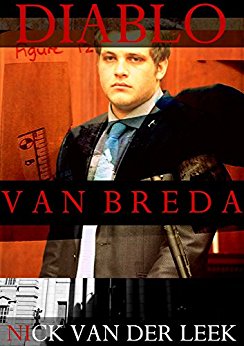
*I describe the source of Henri’s pain in Diablo, available here.







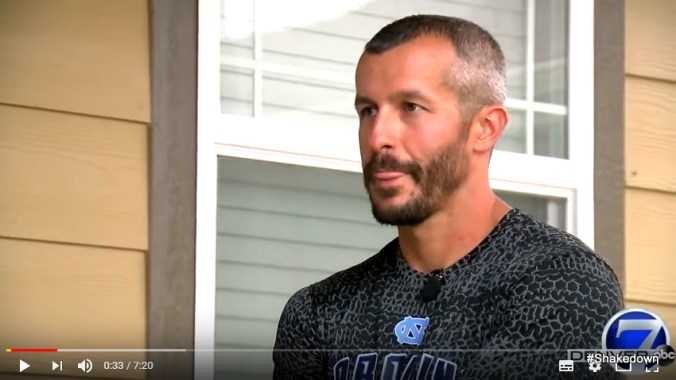











 Have a look at the seven minute interview Chris Watts gave while his pregnant wife and two daughters were still missing. Make a mental note of any inappropriate behaviour, micro-expressions, mannerisms, phrases or words that raise red flags. Ready? Go!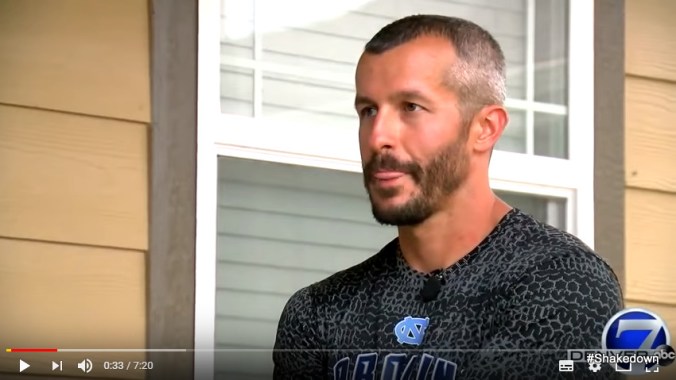










 #SHAKEDOWN