A Shakedown of The Scarlet Liar

Fullscreen capture 20180506 192325

Due to a glitch with WordPress, the embed code for the original video [currently at almost 500 000 views] doesn’t work. This analysis should be viewed while watching the video, which you can do at this link.
Fullscreen capture 20180506 192803

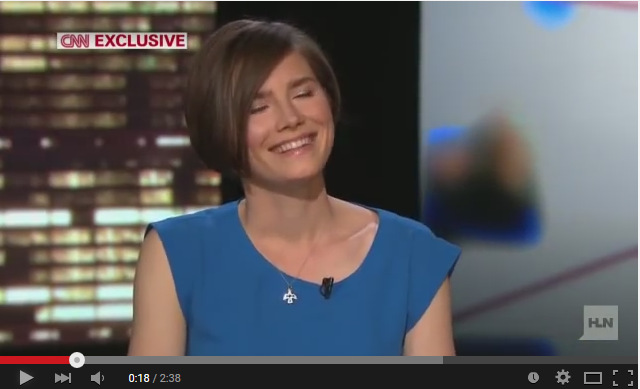
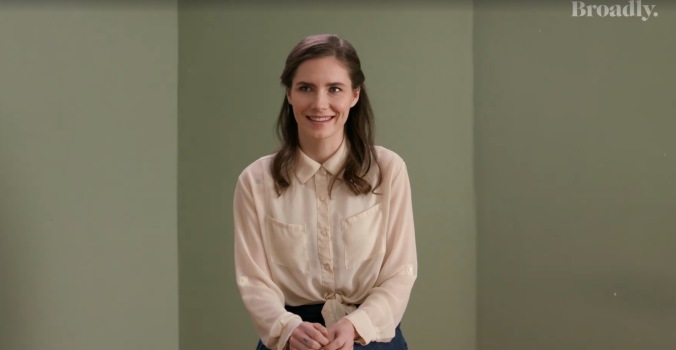
00:01 [Smiles]: I think a lot of people think I’m used to talking about this, and the fact that it’s still [gulps emotionally] bothers me…[looks at the ceiling for inspiration] is good because otherwise ummm…[looks blankly at the ground] I wouldn’t be able to convey it…honest-ly.

Shakedown: For her first question, Knox’s interviewer asks what she’s nervous about. It’s a good question. What does she have to be nervous about when it’s a show by Amanda Knox, starring Amanda Knox, about Amanda Knox?

Knox begins with what appears to be nervous giddiness, but she’s smiling.  There’s a nervous glee about it, delight, even. Knox kicks off by setting the record straight. She thinks that a lot of people think she’s used to talking about this…the anonymous this being the murder of her 21-year-old British housemate, Meredith Kercher. Kercher lived in the room right next door to Knox in a small villa in Perugia Italy.  They were both foreign students, both young women, both studying Italian, Kercher was further along the lines of her studies than Knox, had a better room with a better view, and had a proper boyfriend in Italy before Knox did.

But the bottomline was innocent or guilty, prime suspect or key witness, Knox was supposed to be the best witness to whatever happened to Kercher, not only because they lived together, but because the house had evacuated that holiday weekend, at the time of Kercher’s murder, meaning of the villa’s residents, only the two foreign girls were in town that weekend – Kercher and Knox. Since only Knox lived to tell the tale, and sell it for a record $4 million, and she’s been doing that ever since, it matters what her version of events it. The thing is, Knox has confused that with her mattering.

People, she says, think she’s used to talking about this…and the implication is, she isn’t. She looks suddenly, suitably emotional, after smiling openly just seconds earlier. She’s not used to talking about Meredith, you see…because she’s a sensitive person, and also a victim in the story. Her sensitivity speaks for itself. How could a a sweet, sensitive person murder someone else?  And if talking about it bothers her, how could she be capable of murder? [On the other hand, if talking about it, writing about it, making a living from telling the story of how she didn’t murder Kercher doesn’t bother her, then would murdering her really bother her?]

The fact is, Knox has been talking about the Kercher murder ever since it happened. In the days following the murder she sent a group email to everyone she could think of, she wrote a series of contradictory confessions, she made several long phone calls and was wire-tapped talking at length to folks she hadn’t spoken to in weeks, rationalizing her behaviour. She kept the Ialian police busy for hours, as they tried to untangle actionable information from the endless verbal diarrhea and bullshit.

While awaiting trial, Knox received a diary, which she filled up with self-indulgent versions of herself, including the Damascus moment when she suddenly remembered everything for the umpteenth time. So this newfound sensitivity to discussing this case eleven years later is bogus.

What’s a lot clearer, is the enormous amount of PR that was generated in this case, by the Knox camp, and in which Knox herself and her family were vital participants. Media shy people don’t hire powerful PR people to tell them how to dance in front of the cameras. People who wish to court and manipulate and profit from the attention, however, do exactly that.

How they dressed mattered, and repeating the same aphorisms over and over again, until they became post-truth, vital. The whole outside-court narrative was an important strategy, because in Italy, juries aren’t sequestrated from hearing the news. And so, if the public and the media narrative can be altered, so can the minds of juries.  It took a while, and a lot of dosh, but that’s what ultimately happened in this case. The influence campaign worked.

Far from Knox not talking about this, whenever she takes to the public stage, this is what she wants to talk about.

As for not being used to it, Knox studied drama in high-school, and her memoir is replete with examples, from Knox herself, who wished [craved actually] to be the center of attention. It annoyed Meredith and her two Italian flatmates, Laura and Filomena, it made Meredith’s British friends feel uncomfortable, and even her one-time lover, Sollecito, found her loud spontaneity at times, insufferable – including when it happened in his own home.

When Knox was in court, she was strong enough to stand up, and address her Italian judges in Italian, telling them her version of events in a slew of spontaneous declarations.

When Knox was in prison, her prisonmates didn’t get along with her either. Knox also accused the dude running the prison of sexual abuse, and the police interrogating her of being abusive. She accused her own boss of committing the murder she’d been implicated in.

All of this was true in Perugia in 2007, and it’s still true today.  With Amanda Knox, someone else is invariably to blame, and right now, it’s the media.

A final point on this first comment. Someone very close to me died when I was a teenager. The thought would never occur to me to say I’m glad her death still bothers me, because that allows me to be honest about my feelings about it. Why wouldn’t I be honest? Why wouldn’t I be able to say what I felt and still feel about it?

The next clip in the video jumps to a voiceover from a 2007 news bulletin.

No one could explain the exact sequence of events…

Fullscreen capture 20180506 200023

00:51: I think people forget that I was having the time of my life in Italy. [Glances up] Wandering the city when the flea market came to town, eating roasted chestnuts…

Shakedown: Once again, Knox admits to thinking about what people think of her, a lot. In her first two sentences she mentions the same thing twice, what people are thinking. About her. She’s here to “set the record straight” on the same thing, for the umpteenth time. There are books films, four separate trials, and hundreds of articles, but Knox is here to change reality, change how people think about her. That’s what’s important.

And, so, here it is…

Knox was having the time of her life, but not “wandering the city” in search of “flea markets” and not “eating roasted chestnuts” either.  So what was she doing? Knox was from a very strict Jesuit-type school in Seattle, and in America, drinking laws meant she was too young at age 20, to drink alcohol. Not so in Perugia. Marijuana was “as common as pasta”, as she put it in her memoir, and she peppers her account of Kercher’s murder with smoking or rolling the odd joint, whether with Sollecito, or other boys.

Also, Knox worked at the time as a waitress in a bar. Her boss wanted to fire her because she flirted more than she worked. Nothing is wrong with any of these behaviors, the only thing that’s off is Knox not being honest about them. Isn’t she here to reclaim her story, and set the record straight? Then why not do that? Why this banter about flea markets and roasted chestnuts, in the context of an infamous and brutal murder? Why this rainbow filled fairy tale and not the truth?

So we see how immediately Knox can’t be truthful about who she was in Italy, or what she was doing. Was she going to flea markets and eating chestnuts [which anyone can theoretically do, anywhere in the world], or was she fucking as many Italians as she could, getting drunk, getting high, basically doing what expat students are known to do, and why they decide to leave home and study abroad in the first place?

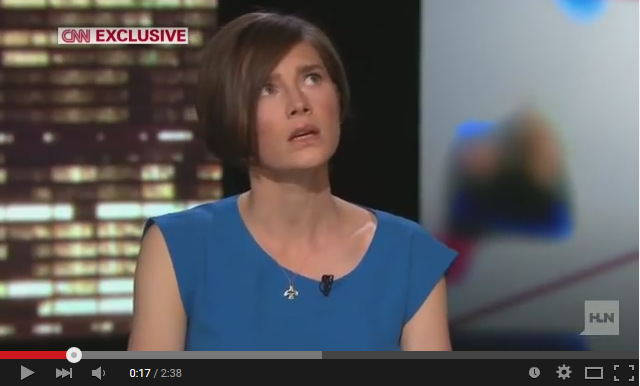
Now, what’s the deal with Knox looking up and to her right during these interviews? She does this twice in the first minute of the Scarlet Letter.

This pattern of staring straight up to the ceiling while being interviewed on camera is nothing new for her. Knox did it most memorably when Chris Cuomo asked Knox if she’d murdered Kercher. Knox looked right up, this time to the left [into memories] then looked down and couldn’t hold back a huge grin.

Did you murder Meredith Kercher?

HUGE SMILE.
Fullscreen capture 20150617 024347 PMFullscreen capture 20150617 024410 PM

Typically when people look up and to the right they are lying or tapping into their imagination. 

According to the Independent:

…when right-handed people look up to their right they are likely to be visualising a “constructed”, or imagined, event. In contrast when they look to their left they are likely to be visualising a what is known as a “remembered” memory. For this reason, when liars are constructing their own version of the truth, they tend to look to the right.

The same article refers to verbal hesitations [honest-ly] and excessive hand gestures, as symptoms of deceit.

Fullscreen capture 20180506 203328

Notice the mismatch between smiley glee talking about how much it bothers her referring to the thing [Kercher’s murder] and the straight-faced, stern, hands handcuffed to her waist description of how I was having the time of my life in Italy.  Yes, someone got in the way of that time of your life, not so?

1:10: I was 20, Meredith [oh, you can say her name?] was 21 [slight wink or wince as she says it]…I was the one who barely spoke Italian, I was the one who was overly enthusiastic about everything and Meredith was like [blurts out laughing]…okay, let’s have pizza [throws her arms into air, laughing open-mouthed].

Shakedown: Again, is there any sense of authentic discomfort talking about Meredith? When she does she can’t stop laughing. And what she says about Meredith couldn’t be less meaningless. She’s 21 years old, Knox is 20, and Meredith suggests…they get pizza.

Notice Knox’s use of semantics [she’s a journalist, so it’s not an accidental choice of words either]:

I was the one…

I was the one…

This suggests Knox as the one who is the odd one out, the outsider, the one always in trouble, but also Knox the way she sees herself in her world.  I was the one…I am the one…this is about me…

Knox’s emotional range in 2 minutes is extraordinary: from tearful contemplation, to imaginative rumination, to laughter – in seconds. If this is annoying to watch, how unbearable was it to live with?

1:15: And it was great [suddenly serious again], and I really appreciated her…[can’t find the right word]…just being there…and being…[has to look up again for inspiration, I appreciated her for being…?] uh…[looks up to the right]…this warm welcoming presence [as if Knox has remembered what to say on the subject of Meredith, not remembering Meredith as a real human being that once lived.]

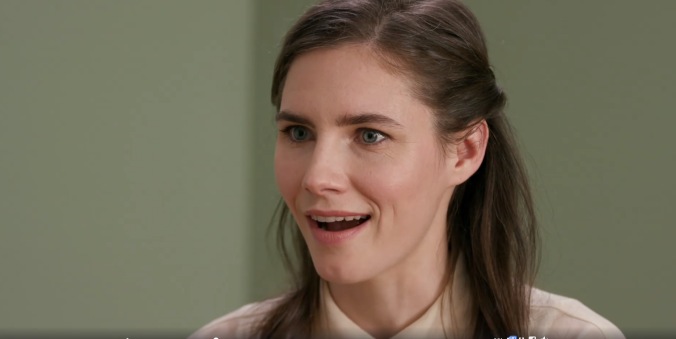
1:34: [Upbeat again] I was into this classical Italian music, and so, when this- um, I saw this flyer for a classical music concert, that was going to be at my university. I was like – Yes! I invited Meredith to come along with me. And…we went to the music concert, sat next to each other…And I just made eye contact with…this…Italian guy…who…was…a nerdy…Italian guy [grins].

Shakedown: And so that concludes information about Meredith. Now, back to me. I was interested in I got the flyer…I invited Meredith…Actually, Meredith was probably more interested in music, especially classical music than Knox, and since Meredith had invited Knox everywhere up to that point, [Knox invited Meredith to the bar where she worked, that was pretty much it] Meredith probably invited Knox to the concert, not the other way round.

It’s interesting how Knox feels she has to say that she and Kercher sat next to each other. Also noteworthy that the first thing Knox does at the concert isn’t listening to the music, or share anything with Kercher [Kercher’s already gone in her mind], she makes eye contact with an Italian dude. Fullscreen capture 20180506 210800
It’s likely both Sollecito and Kercher knew a bit about classical music. Sollicito because he was Italian, and the son of an affluent doctor, Kercher because her taste in music was more eclectic than Knox’s. Her favorite song at the time of her death was U2’s With or Without You. Kercher was also more interested in classical subjects like history, than Knox.

Besides this, we have Knox’s playlists from the time of the murder, and there’s just regular pop-music on it, the kind of Nirvana type stuff students listen to when they’re high.
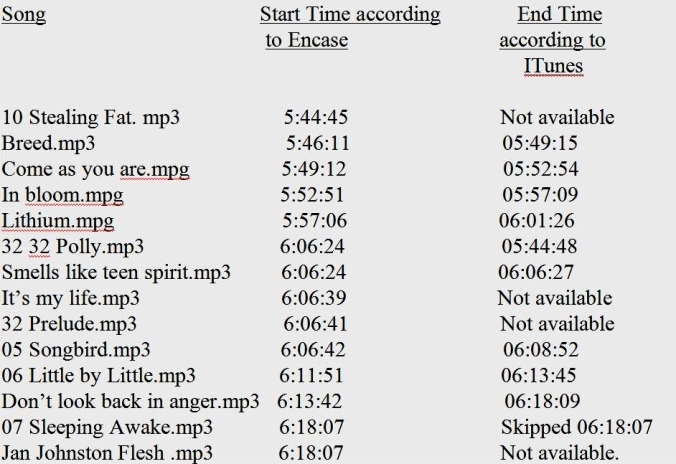
11274

Knox’s MySpace page, in which she refers to herself as Foxy Knoxy, hardly even refers to music amongst her interests.

Picture 35

In a real sense, Meredith was more accomplished in the musical genre than Knox. Meredith had been invited to appear in a well-known music video in Britain.

Also, I doubt Knox found a flyer at her university and gave it to Kercher. More likely it was the other way round. Knox’s job at the bar was to hand out flyers, something she admits in her memoir was a real drag. Also, Knox attended a language school, whereas Kercher was at the far more prestigious and much bigger University of Perugia. The latter had about 20 000 students, while Knox’s school had less than 2000 students enrolled. So it was far more likely that Kercher found a flyer about an Italian classical music show, than that Knox found one in the small confines of a language school where there were mostly foreign kids.

Knox goes all wishy washy and regurgitates the same crap about her blissful romance. What this has to do with Kercher or anything else is anyone’s guess, but it does reinforce this core sense that when it comes to Knox, everything must be about her, and her having what she wants, including how reality must appear when it comes to her story. She must look right, in a story where she’s implicated in someone’s murder. This may seem logical, but it’s not simply someone who wishes to simply clear their name, this is someone who wants to luxuriate in the attention, in the wash and rinse, of the media, speculating about her role in a murder. You’d imagine an innocent person wanting to dispassionately and soberly go through evidence and perhaps make helpful suggestions for the investigators or prosecutors. Instead, she gravitates endlessly into the fickle and fake details of her own narcissism. She tells a fairy tale about herself at the expense of a murdered young woman who she clearly doesn’t give a fuck about.  And that’s the point. It’s narcissism that takes no prisoners. It’s me-me-me at the expense of you.

This level of inadequacy and insecurity, so many years later, versus Meredith’s mature, socialized and more successful integration into the expat life reveals why there might be a motive for murder. Jealousy. Envy. It’s you at my expense and I’m going to reset the scales, and turn the tables.

Knox spends a lot of time describing her puppy-love with Sollecito. Going into detail about smiles and looks, and looking emotionally happy as she goes through it. Oh yeah, meanwhile Kercher left the concert to join her friends. Kercher’s seat is taken by Sollecito, and ten days later, Sollecito’s DNA would be left on Kercher’s bra strap, which was deposited under her bloodied corpse in her bedroom, under a duvet. There’s also some evidence pointing towards the possibility of Knox’s DNA found on the same bra hook.

2:32: I was in puppy love, and we did everything together.

Shakedown: Not quite. They didn’t spend Halloween together; in fact Knox didn’t seem to spend it with anyone. Not with Kercher or her friends, and not with her boyfriend, who was working on his thesis. During the ten days of their romance, Knox also spent at least one day completely apart from Sollecito. Other witnesses, like Filomena, reported that Knox was having second-thoughts about Sollecito, feeling guilty about cheating on her American boyfriend… As for Sollecito, in his memoir he describes being irritated and unable to sleep, because Knox tended to wake up early and play music.

Fullscreen capture 20180506 214913

2:40: Knox is asked: At this time, did you have any inkling, that your life would never be the same? Knox looks down, her one hand wringing in the grasp of the other. Then she slowly says: No.

Shakedown: Still careful, still counting her words on the simplest of questions.

2:45: I felt like I was alone in the world…

Shakedown: Not quite. Knox lived with Sollecito for the next few days after Kercher’s murder. They went out to dinner with friends. When the police called saying they wanted to see Sollecito, he irritably told them when they were done with dinner. Knox and Sollicto were famously caught going lingerie shopping during this same period. While all of Kercher’s friends fled Perugia, Knox wanted to stay on, even completing her homework and handing it in. Handwritten, there wasn’t a single crossed-out word. Knox’s family and friends were calling her constantly, advising her to go to the embassy, while Knox said everything was fine.

I felt like I was alone in the world…

I’m sure that’s how Kercher felt while she was being murdered in her own bedroom.

3:17: I was in a jail cell [leaning forward, looking down], and I did not have access to international news…[blinks, then looks up, to her right]…what I didn’t understand, for a very long time…was that…the courtroom…and the media…were feeding each other. 

Then the interview reveals how the media unfairly stereoptyped Knox as a sexual deviant. The media made-up the fact that Knox was a sexualised nymphet.

3:55: They came up with this whole theory, with a sex game, that I orchestrated, that ended [Knox flicks her head angrily] in Meredith’s murder.

Shakedown: When Knox refers to they, she means the prosecutors. The prosecutors, following the evidence, felt that this wasn’t just a murder, but torture with a sexual dimension to it. Did the prosecutors also pluck this idea out of thin air? Like the staged-burglary, the staged sexual assault had a lot pointing towards it. If the staged-burglary had a broken window [but nothing stolen], the staged-sexual assault had Kercher naked post mortem [her clothes and bra were removed after her throat was cut], her body moved and her legs pulled open. Now, if you wanted police to think someone else killed your roommate, one way was to associate the crime with an intruder breaking in from the outside [as opposed to someone on the inside, committing murder]. Incidentally, the JonBenet Ramsey case, Oscar Pistorius case and the Madeleine McCann case all invoke the idea of windows ushering in phantom intruders who leave no traces of themselves.

The reason the cops suspected a sexual dimension was because the victim was found naked, her thighs propped on a pillow, and covered in blood. Her body was positioned in a way to suggest sexual violation. The only “problem”, if that is the right word, is that like the staged burglary, there was no evidence of an actual sexual attack. No sperm or body fluids. No bruising on the inner thighs. No severe trauma to Meredith’s genitals, no sign of rape.
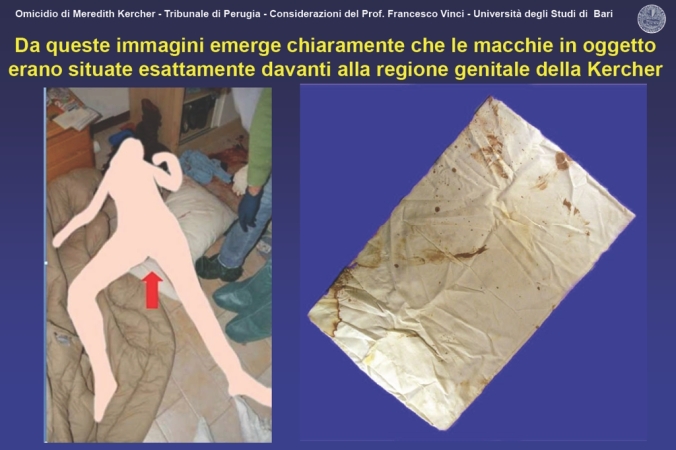
sperma-18

So the court was quite right to look into this aspect, and to investigate it. Obviously, the idea of a sexual attack on Kercher was intended to draw the narrative away from a female attacker, because how many murder-rapists of women are other women? Of course, only the most deceitful, despicable, misleading, manipulative and mendacious scum-of-the-earth criminal would do something like this, to cover their tracks. Only the world’s biggest shitbag would come up with something like this to cover up a crime. Most other criminals would remove the body from the scene and dump it somewhere else. Whoever did this was a brazen liar, someone capable of appearing on camera with the world watching, and lying [almost] straight-faced.

4:15: It didn’t…really…hit me…though…how big…and all-encompassing…the media was [shrugs] until I finally got out.

Shakedown: That’s strange that she didn’t know, because the court room was chock-full of reporters and cameramen each day of the trial. That’s unusual. Most trials don’t have a lot of reporters sitting in on them, let alone a full-house sitting in on everything. There were so many reporters covering Knox’s case, some had to sit in the metal jail cells reserved for especially dangerous criminals standing trial.

The other thing is Knox had a television in her prison cell, and her mother frequently visited her to tell her about the news, what the lawyers were advising, and what the media were saying.

Below is an excerpt from a prison intercept dated November 10th, 2007, just 9 days after Kercher’s murder. Knox is being visited by her mother Edda, in prison.

KNOX: Does he know what’s going on…?

EDDA: Well, the world…the world is making you out to be this…massive killer…monster.

KNOX: Are you serious?

EDDA: Oh yeah, oh yeah. And I have had…our house, everyone in the family, in the German family, have been assaulted by the media. It’s gone CRAZY!

Later in the same intercept from November 2007:

EDDA: …they are bombarded by the media, and they say: hold on! You know, the your friends, and Madison was … they were very warying and she …

KNOX: Why? They talked with Madison?

EDDA: Yes, and she said: “Amanda I know wouldn’t do such a thing”, your friends have said “Impossible 100%”.

KNOX: They talked with my friends?

EDDA: With everyone, Amanda.

KNOX: How did they find my friends?

EDDA:They [the media] traced my cell number, I don’t know how, and “NBC News Twenty Twenty “caught me as I was leaving today from the apartment, the secret apartment that I occupy in Perugia.

KNOX: What?

EDDA: Uh-uh … The lawyers have said something interesting, they said: Amanda found herself involved in something much bigger than her because…This is all a huge crap on an international level.

KNOX: I didn’t do anything…I can speak Italian.

EDDA: My God! What?

KNOX: I speak Italian.

EDDA: Do they know?

Later in the same excerpt, Knox’s mother conveys more speculation in the media, directly to Knox.

KNOX: My fingerprints on her face? I sure hope it isn’t true, because how can it be true? I didn’t do anything.

EDDA: Yes.

KNOX: It’s serious evidence, my prints on her face.

EDDA: I know.

KNOX: How can this be true?

EDDA: I just … I mean, there’s a lot of crap in the papers.

KNOX: This is in the papers; if they tell me that the police have evidence that there are…my fingerprints on your face, I don’t know what to say.

What the police found were at least fifteen bruises in the shape of fingers, all over Kercher’s face. The point of these bruises were to prevent Kercher from being heard while she was restrained, and to keep her mouth closed while her throat was slit. Investigators determined these bruises matched the size of a woman’s fingers; they were too narrow to be that of a man.

We’re around the halfway mark of the video clip; that’s a few minutes, enough of a sample to ask: how much of that looks like honesty?

If this blog garners enough attention and commentary, I’ll do a Part 2.


If Vincent van Gogh didn’t cut off his ear, who did?

24sun3web-master768Some people reckon Vincent van Gogh was the original king of selfies. In Paris, in 1886 he did around eleven self-portraits, the following year [still in Paris], he churned out another seventeen. In Arles, in 1888 and early 1889, he produced just five, two of them with the famous bandage around his severed left ear.

Over the next year, while in the asylum at Saint-Rémy, his selfie output dropped even further, to just three. This is strange, because if there was a time for introspection, it was during those interminable months alone in the madhouse. But unhappy people, like unhappy artists, tend to be camera shy, not so? In the final two months of Vincent’s life, in Arles, he didn’t paint a single self-portrait either. But what does all this have to do with severed ears?

500x0Given the controversy surrounding “the ear incident”, Van Gogh’s 35-or-so self portraits are a valuable archive. Does he paint the side of his face missing the ear after December 1888? Does he see himself as mad? What is he saying?

When we examine the two self-portraits painted within days of losing his ear, we notice a few things different about them. For one, he’s wearing strange headgear – a blue beret – in both post severed ear selfies. In all his self-portraits, there are about eleven where he depicts himself wearing a hat of some kind, in other words, a hat features in a third of of his self-portraits. The hats are invariably yellow straw hats, used by the artist when he was outdoors as a sun shield.

All the Arles selfies are drawn showing Van Gogh’s left side, while all of those painted afterwards [just three], in Saint-Rémy, are painted from the right.

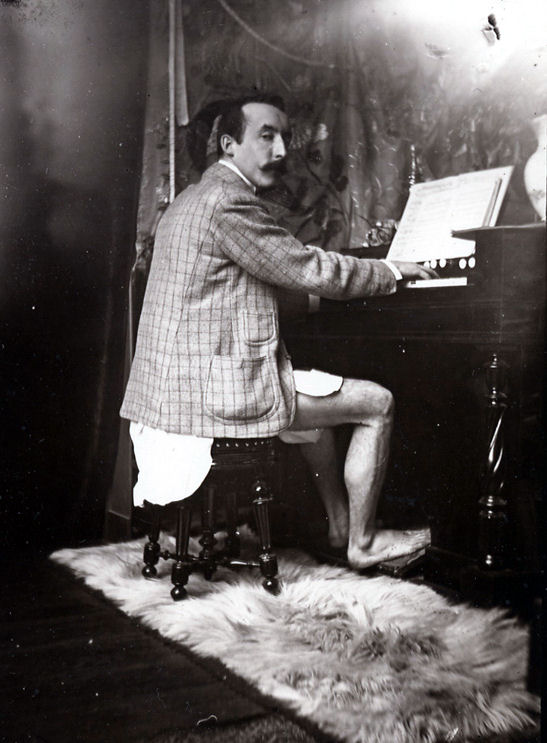
In The Murder of Vincent van Gogh I go into a lot more detail about the circumstances and psychology of Van Gogh leading to the ear incident at Arles, and the aftermath. I won’t be doing much of that here. What I want to highlight here is one fairly obvious fact, and it has to do with Vincent’s housemate in the Yellow House, for just on two months in Arles – Paul Gauguin.

Gauguin_by_Mucha

The whole scenario of the two artists who don’t know each other, suddenly living with one another cheek by jowl in a foreign city, reminds me of Meredith Kercher and Amanda Knox in Perugia. And look how that ended. Kercher was stabbed to death in the throat of her own room, and Knox emerged as a suspect, but ultimately dodged being found guilty of Kercher’s murder.

The time scale is also similiar;  just as Kercher had spent several weeks in Perugia settling down and getting orientated before Knox pitched up, Van Gogh did the same in Arles. Then Knox arrived and within about six weeks Kercher was dead, and the entire villa [a bloodbath] had to be abandoned by everyone. The same happened to the Yellow House. The main difference is Knox wasn’t allowed to leave, while Paul Gauguin did, two days after the ear incident.

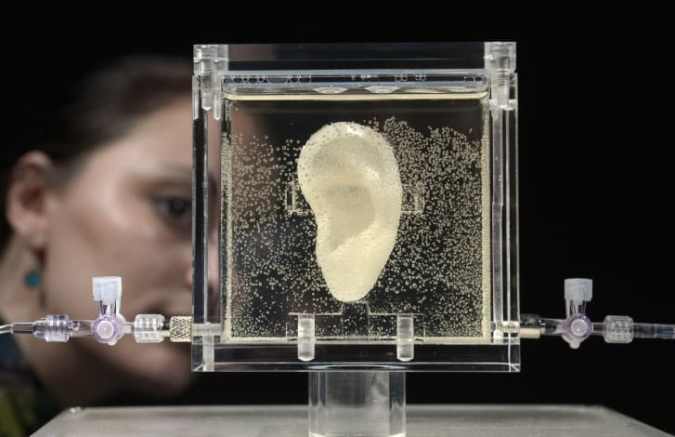
The mainstream narrative holds that Van Gogh cut off his own ear. There’s been some uncertainty about how much ear – the whole ear [meaning he was very mad], a piece of ear [meaning he wasn’t so mad], or someone else carved off the ear with a rapier [meaning he wasn’t mad at all, just horrible to live with].

How mad was #VincentvanGogh?

A post shared by Nick van der Leek (@nickvdleek) on

The best source for what really happened to Van Gogh’s ear, however, is Van Gogh himself. He does write about it, but once again, I dealt with that in detail in The Murder of Vincent van Gogh, including the latest historical evidence related to the ear narrative.

What I will say is there’s a strange arrangement between Gauguin and Van Gogh after the incident, where both artists sort of agree not to talk about it [Gauguin doesn’t honor the agreement and goes behind Van Gogh’s back, telling everyone who will listen what a lunatic his former housemate is…]

There’s also the issue where Gauguin exits the Yellow House and bugs out to Paris taking two of Van Gogh’s most prized paintings – his depictions of sunflowers. [One would later be auctioned for tens of millions of dollars, a new world record in its time, eclipsing the previous record by a factor of 4]. Van Gogh was clearly pissed off by this, which is why he wrote to Gauguin asking for them back, and bitching to Theo about the whole deal. So there’s lots of intrigue, but for the purposes of this post, I want to focus on those self-portraits painted just after the ear incident. It couldn’t have been fun; it was mid-winter and the wound under those bandages was probably still throbbing and oozing blood. An artery had been severed near the top of the pinna, which almost caused the artist to bleed to death.

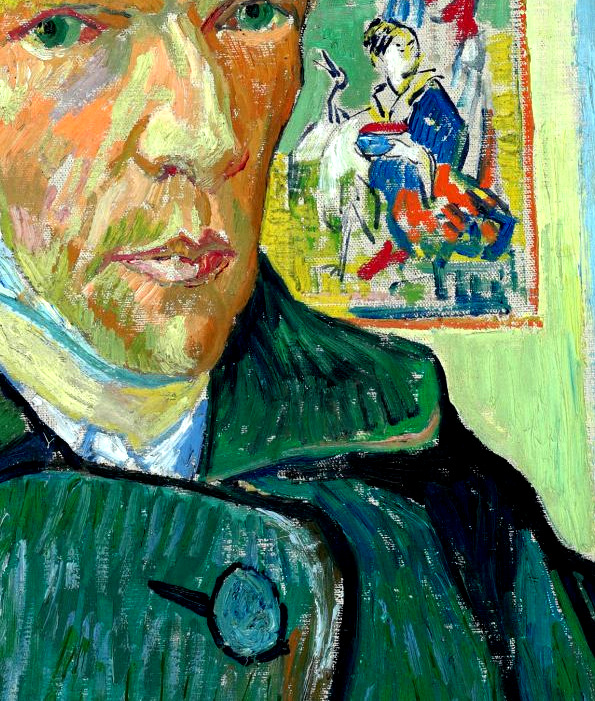
It all seems to be in the eyes, doesn’t it? In the left image, notice how the horizon between red and orange actually directs the viewer to the line of Van Gogh’s eyes, as does the smoke from his pipe. The smoke over the crimson background also seems to be suggesting “things aren’t always what they seem.”

A quote from my latest book The Murder of Vincent van Gogh.

A post shared by Nick van der Leek (@nickvdleek) on

But look closer at the other portrait, and there’s a suggestion in the Japanense picture at the rear, that she is pointing towards the eyes.

P-1948-SC-175-tif-10587-e1468233592690

At this scale it’s clear it’s not the hand or fingers of the Japanese lady at all, but the open beak of bird, perhaps a stalk, crying out in the direction of Van Gogh’s blazing green eyeball. And that’s the other thing – the green.

Going through Van Gogh’s self-portraits, these two have an abundance of green, don’t they. Van Gogh’s actually clothed in it, even the wall behind him and his face, in the second image, is green.

five-color-idioms-part-3-green-voxy-green-with-envy

Could all that green, even the green in the eye of the beholder, have anything to do with that expression: being green with envy? And yes, the English idiom translates to Dutch.*

Er zit iets zwarts in het groen van je oog.///There’s something black in the green part of your eye

Remember, these were two artists living side by side and clearly, not getting along. Van Gogh said as much in his letters to Theo, and Gauguin made no bones about it either.

Did Gauguin and #VincentvanGogh get along in the Yellow House?

A post shared by Nick van der Leek (@nickvdleek) on

So the two artists didn’t get along because Vincent was mad, or was Gauguin mad [angry] because of…well, envy? I’m not the only one casting these aspersions, though…

What pray tell did Gauguin have to be envious about? Well, Van Gogh’s motivation for one. He felt it was becoming a competition, and certainly outputwise, and on the spectrum of inspiration, Van Gogh was streets ahead. Van Gogh also had a patron, in his brother, who basically paid his brother’s way so he could paint to his heart’s content. Interestingly, Gauguin arrived in Arles as another sponsored artist, sponsored by Theo, but falling short perhaps in their eyes, and who knows, perhaps his own too.

Much of this has a mirror dimension in the Meredith Kercher/Amanda Knox case. There has been speculation that Knox was jealous of Kercher, who was a more likable and attractive girl, more settled, more socialized, and had the lion’s share of friends and if she wanted, boyfriends. Knox was later the prime suspect in Kercher’s murder, but was at pains to argue that she and Meredith had been friends to the end. Like Gauguin, Knox wasn’t at home but sleeping somewhere else when the incident in question happened, and both were the “last to know” something had happened.

Here’s the mainstream depiction of Van Gogh cutting off his own ear. It’s preceded, of course, with a row with Gauguin. In Gauguin’s version of events Vincent actually approached him with a razor. Gauguin merely turned around, looked at Vincent, prompting Van Gogh to turn tail, run home and cut off his ear. But does that really ring true?

While researching The Murder of Vincent van Gogh it was easy to get caught up and distracted in the various versions of Van Gogh. In the above depiction the filmmakers seem to have forgotten the events took place just before Christmas in 1888; midwinter in Arles, and a miserable period otherwise, when the Mistral blows through the twisting streets like nobody’s business. So there is no way Van Gogh would be walking around without a shirt on.

Over the past 130 years, there have been countless versions of the ear incident; from art historians, biographers and documentary filmmakers to journalists and authors – everyone has a theory. None of these folks are true crime aficionados though, and none of them are approaching these incidents [the gouged ear and the his death] as criminal incidents. Why not? The French police arrived on the scene on both occasions precisely because a man’s blood was spilled. And even in suicide, it’s important to establish a motive for murder; the murder of the self is still murder, there’s still a motive.

Turning to those self-portraits, what does Van Gogh say about the whole deal? What does he say beyond a look in the eye?

Incredibly, earlier that same month, December 1888, the month of the ear incident, Van Gogh painted two chairs; one symbolizing himself, the other symbolizing Gauguin. This is not in dispute. Van Gogh’s chair is modest, simple and plain [like the man], Gauguin’s is sort of lavish, earthy and has an exotic feel about it. Van Gogh’s chair feels like yellow straw, much of it has a golden vibe about it, Gauguin’s chair [and the wall behind it] is a rich green. It’s important to see the original colors of these art works, because after more than a century, the colors have faded, concealing the original intent, the original code, embedded in the paintings.

Now it’s important to note, the chairs were painted in December before the ear incident, and both chairs were emblematic of the artists. Look at how green Gauguin’s chair is. The seat is a puffy cushion in rich green and gold lint. Behind the chair is a forest green wall.

When Van Gogh painted a portrait of Gauguin, he also used green [on his coat, and the wall] to personify Gauguin. He also has Gauguin turned away from him, preoccupied with his own thoughts, his own world…

Vincent_van_Gogh_-_Paul_Gauguin_(Man_in_a_Red_Beret)

Now look at the self-portraits after the ear incident. For the first time in any of his portraits, Van Gogh is clothed in a really thick, green coat. Look closer and the green coat has specks of gold in it. Van Gogh may have agreed with Gauguin, in their letters, not to talk of the incident, but the self-portraits, when the emotions were still running high, speak volumes. The injured Van Gogh looks out, but how much of his green eyes are Van Gogh’s eyes, and how much are they a reflected green [off the room, and his coat]. In other words, he’s not only clothed in Gauguin’s envy, but how the world sees him, is through Gauguin’s disparaging [and envious] eyes…

If these contentions are true, if Van Gogh didn’t cut off his own ear, if Gauguin sliced it off with one of his swords, then we have to ask: was Van Gogh as mad as he’s been made out to be? Was he even mad to begin with? And if he wasn’t mad, was he suicidal?

//www.instagram.com/embed.js

Unfortunately the clip above cuts off before Van Gogh [played by Andy Serkis] refers to being driven to the heights of his art, by his illness. What did he mean by “illness”? Madness, or something else?

The Murder of Vincent van Gogh is available on Amazon and Kindle Unlimited at this link.

Van Gogh Murder Final

*Van Gogh was a bookworm, and wrote to Theo about enjoying Shakespeare. The “green with envy” idiom originates from Shakespeare’s Othello, a work Van Gogh was undoubtedly familiar with.

 “Beware, my lord, of jealousy; it is the green-eyed monster which doth mock the meat it feeds on.”


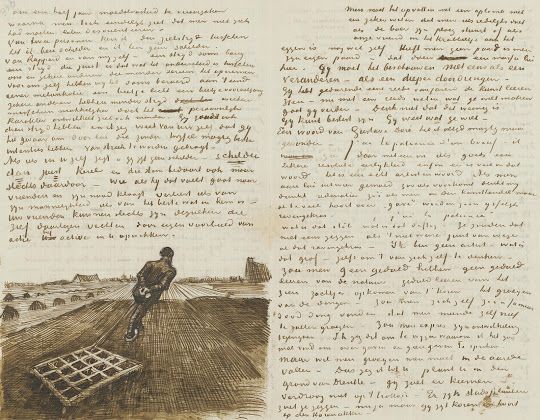
Vincent van Gogh’s letter to Theo, January 1882, outlining his rows with ‘Pa’ and ‘Ma’

You mustn’t think that I’m sending the letter back to insult you, but I find this the quickest way to answer it clearly. And if you didn’t have your letter back, you wouldn’t be able to understand what my answer refers to, whereas now the numbers guide you. I have no time, I’m waiting for a model today.
Because I have only a little time, I knew no better means of answering your letter than to answer one thing and another like this, point by point.
unnamed (1)
(1) I didn’t ‘contrive’ to do it, on the contrary, when Pa was here,1 Mauve, Pa and I talked about my renting a studio in Etten – spending the winter there – coming back to The Hague in the spring. Because of the models and because I’d arranged to work there, and it was beginning to go well.
All the same, I’d have liked to prolong my stay in The Hague a bit, since I was here anyway, but nonetheless I seriously intended continuing my studies of the Brabant peasant types. And when I was crossed in realizing that plan, after M. had been consulted and I had already written to him about the studio in question (a shed which needed some repairs), I couldn’t suppress my anger.
Please remember one of my letters to you in which I wrote to you in broad terms about my plan to continue those studies.2 I mean the letter in which I asked you to say a few heartfelt words to impress upon Pa and Ma how important my work in Etten was to me &c. I remember the words I used: it really would be too bad if a whim of Pa were to make me give up work which is now progressing so well and which I’ve been working on for months. Think about it yourself – despite Mauve’s help, I’m in far more trouble here than at home, and I truly don’t know how I’ll get by.
2) That expression that I contrive to make Pa and Ma’s life miserable is actually not yours, I’ve known it for a long time as one of Pa’s Jesuitisms, and also told Pa and Ma that I considered it a Jesuitism and didn’t take the slightest notice of it.
Pa regularly comes up with some such saying if someone says something to him that he doesn’t know how to answer, and says, among other things, ‘you’ll be the death of me’, while calmly reading the newspaper and smoking his pipe. So I take such expressions at their face value.  1v:3
Or else Pa gets incredibly angry and is used to people being afraid, and it surprises Pa if people don’t give way to his anger.
Pa is very easily hurt and irritable and full of obstinacies in domestic life and is used to getting his way. And the category ‘the conventions and rules of this house’, which I’m supposed to observe, includes literally everything that comes into Pa’s head.
3) ‘Fighting with an old man isn’t difficult &c.’ Because Pais an old man I’ve spared him a hundred times, and tolerated things that are well-nigh intolerable. Well, this time it wasn’t fighting but simply saying ‘enough’, and because he wasn’t listening to reason and common sense I said it outright for once, and it’s very good indeed that Pa has finally heard one thing and another spoken plainly that others sometimes think as well.
4) That it won’t be put to rights quickly. For appearances’ sake I straightened things out by writing again to Pa to say that I’d rented a studio, that I also wished him a happy New Year, that I hoped that in that new year we should no longer fight in that way or in any other manner. I’m not doing any more about it, I don’t have to do any more about it. If this last scene were the only one of its kind, it would be different, but it was preceded by other scenes, when I’d said to Pa, in a calmer yet resolute way, many things that His Hon. systematically brushed aside one by one. So as regards those things I said in anger, I think the same things in a calmer mood, only then I refrain from saying them out of diplomacy or I say them in another way. But all diplomacy abandoned me when I got angry, and, well, now I’ve finally said it. I’m not asking for an apology, and as long as Pa and Ma take this attitude I won’t take any of it back. If, later on, they possibly become a bit more humane and sensitive and fair, then I’ll be glad to take it all back. But I doubt if that will happen.

5) That Pa and Ma can’t stand it if there’s bad blood &c. That’s true inasmuch as they create a desert around themselves and are making their old age miserable, even though it could be good and satisfying. But as to those expressions, ‘I can’t stand it’, ‘this will be the death of me’, ‘my life is a misery’, I no longer take any notice, because it’s only a mannerism. And if they don’t change, I fear, as I already said, that they’re in for many miserable and lonely days.
6) That I’ll regret it &c. Before things got as bad as they are now, I felt a great deal of remorse and sorrow, and tormented myself because things were going so badly between Pa and Maand me. But now that it’s come to this, well, so be it, and to tell you the truth I’m no longer sorry but can’t help feeling relieved. If I realize later that I did the wrong thing, yes, then of course I’ll regret it, but I still don’t exactly see how it would have been possible to act otherwise. When someone tells me in no uncertain terms, ‘leave my house, the sooner the better, within the half-hour rather than the hour’, well, old chap, then I’m out in less than a quarter of an hour, and won’t come back again either. It really is too bad. For financial reasons, and so as not to cause you or anyone else any more trouble, I wouldn’t have left so easily of my own accord, you surely understand that, but now that they and not I said ‘go away’, well, the path I must take is clear enough.  2r:4
dam-images-daily-2014-12-van-gogh-van-gogh-museum-redesign-01-floris-visualisaties
7) As far as Mauve is concerned – yes of course I’m very fond of M., and sympathize with him, I like his work very much – and I consider myself fortunate to learn something from him, but I can’t shut myself up in a system or school any more than Mauve himself can, and in addition to Mauve and Mauve’s work, I also like others who are very different and work very differently. And as far as me and my own work are concerned, perhaps there’s a similarity sometimes, but certainly also a distinct difference. If I love someone or something, then I mean it, and there is definitely passion and fire sometimes, but that doesn’t mean that I systematically find only some people perfect and all the others worthless – God forbid.
8) Free-thinking: actually that’s a word I loathe, though I’m sometimes forced to use it for want of something better.
9) The thing is that I’m doing my best to think things through and try to take reason and common sense into account in what I do. And it would be totally inconsistent with that if one wanted to reduce someone to nothing. So it’s entirely true that I sometimes said to Pa ‘do consider this or that fully’, or ‘this or that doesn’t hold water in my opinion’, but that isn’t trying to reduce someone to nothing. And I’m not Pa’s enemy if I tell him the truth for once, not even when I said it angrily in salty language. Only it didn’t help me at all, and Pa took it badly. Does Pa mean that I said that the morality and religious system of the clergymen and academic notions aren’t worth tuppence to me since I’ve learned many of their tricks, then I certainly won’t take it back, because I really mean it. It’s only in a calm mood that I don’t talk about it, but it’s something else if one tries, for instance, to force me to go to church or to attach value to it, then of course I say it’s absolutely out of the question.images
10) Does Pa’s life count for nothing? I already said that if I hear someone say ‘you’ll be the death of me’, and all the while that man is reading his newspaper and half a minute later starts talking about goodness knows what advertisement, then I find such an expression rather inappropriate and unnecessary and pay no attention to it. As soon as those words or suchlike are repeated to others, who then start to look upon me as something of a murderer or even a parricide, then I say, such calumnies are neither more nor less than Jesuitisms. So there you have it. Besides, now the murderer has left home and so, in a word, I take no notice of it, and I even think it ridiculous.
11) You say ‘I don’t understand you’. Well, that I certainly believe, because writing is actually an awful way to explain things to each other. And it takes a lot of time, and you and I have rather a lot to do. But we must have a bit of patience with one another until we see and speak to one another again. 2v:5
12) Write to me again. Yes of course, but first I have to agree with you on how.
Do you want me to write in a sort of business style, dry and formal and picking and choosing my words and actually saying nothing?
Or do you want me to go on writing just as I’ve been doing recently, telling you everything that pops into my head without being afraid to let fly, without mincing my words or holding back.
I prefer to do the latter, namely write or say plainly what I mean.
And now I’ll end my direct answer to your letter because I still have to speak to you about drawing &c., and I prefer to talk about that. Please bear with me if I pretend for the time being that Pa and Ma don’t exist, it would have been much better if I’d spent this winter in Etten, and it would have been much easier for me, particularly for financial reasons. If I were to think and fret about it, it would make me despondent, so that’s it, it’s over. Now I’m here and I have to manage somehow. If I were to write to Pa about it again, it would be adding fuel to the flames, and I don’t want to get so angry again, and I’m throwing myself with all my might into life and things here, what else can I do? Etten is lost and Het Heike, but I’ll try to regain something else instead.
http_cdn.cnn.comcnnnextdamassets161031103300-02-van-gogh-ear-trnd
Now I thank you very much indeed for what you sent.
I don’t need to tell you that I really have a great many worries besides. Naturally my expenses are more than in Etten and I can’t set to work with half as much energy as I should like and should be able to if I had more at my disposal.
But my studio is turning out well. I wish you could see it, I’ve hung up all my studies, and you must send back the ones you have because they might prove useful to me. They may be unsaleable, and I myself acknowledge all their faults, but they contain something of nature because they were made with a certain passion.  2v:6
And you know that I’m now struggling to make watercolours, and if I become adept at it they’ll become saleable.
But Theo, you can be certain that when I first went to Mauve with my pen drawings and M. said, you should try it with charcoal and chalk and brush and stump, it was damned difficult for me to work with that new material. I was patient and it didn’t seem to help at all, and sometimes I grew so impatient that I trampled on my charcoal and was wholly and utterly discouraged. And yet, a while later I sent you drawings made with chalk and charcoal and the brush,3 and I went back to Mauve with a whole batch of such drawings which of course he criticized, and rightly so, and you too, but all the same I had taken a step forward.
Now I’m going through a similar period of struggle and despondency, of patience and impatience, of hope and desolation. But I must plod on and anyway, after a while I’ll understand more about making watercolours.
If it were that easy, one wouldn’t take any pleasure in it. And it’s exactly the same with painting. Moreover, the weather is bad, and this winter I haven’t yet gone out for pleasure. Still, I enjoy life and, in particular, having my own studio is too wonderful for words. When will you come and have coffee or tea with me? Soon I hope. You can stay here too, if necessary, that would be nice and companionable. And I even have flowers, and a couple of boxes of bulbs. And I’ve also acquired another ornament for my studio, I got a great bargain on some splendid woodcuts from The Graphic, some of them prints not of the clichés but of the blocks themselves. Just what I’ve been wanting for years.
The drawings by Herkomer,4 Frank Holl,5Walker,6 and others. I bought them from Blok, the Jewish bookseller,7 and chose the best from an enormous pile of Graphics and London News for five guilders. Some of them are superb, including the Houseless and homeless by Fildes 2r:7 (poor people waiting outside a night shelter)8 and two large Herkomers and many small ones, and the Irish emigrants by Frank Holl9 and the ‘Old gate’ by Walker.10 And especially a girls’ school by Frank Holl11and also that large Herkomer, the invalids.12
In short, it’s exactly the stuff I need.
And I have such beautiful things with a kind of restfulness in my house because, old chap, even though I’m still a long way from making them so beautifully myself, still, I have a couple of studies of old peasants and so on hanging on the wall that prove that my enthusiasm for those draughtsmen is not mere vanity, but that I’m struggling and striving to make something myself that is realistic and yet done with sentiment. I have around 12 figures of diggers and people working in the potato field,13 and I’m wondering if I couldn’t make something of them, you also have a couple of them, including a man putting potatoes in a sack.14Anyway, I don’t know what yet, but whether it’s now or later, I must do it sometime, because I took a look at it this summer, and here in the dunes I could make a good study of the earth and the sky and then boldly put the figures in. Though I don’t value those studies so very much, and hope of course to make them very differently and better, but the Brabant types are distinctive, and who knows how they might be put to use. If there are some among them you’d like to keep, then by all means, but I’d very much like to have back those you don’t value. By studying new models I’ll automatically become alert to the mistakes in the proportion of my studies of this summer and, taking that into account, they can easily be of use to me. When your letter took so long to arrive (for because it went first to Mauve I got it even later), I had to go to Mr Tersteeg and he gave me 25 guilders to last until I received your letter. Perhaps it would be good if I, with your knowledge, or you, with my knowledge, were to settle a few things with Mr T. Because you understand, Theo, I must know as definitely as possible where I stand, and I have to work it out in advance, and know that I can or cannot do this or that. So you’ll be doing me a great favour by entering into a definite agreement, and I hope you’ll write to me about it soon.
Mauve has promised to recommend me for an associate membership of Pulchri,15 because there I’d be able to draw from a model two evenings a week and would have more contact with artists. Later on I’ll become a regular member as soon as possible. Well, old chap, thanks for what you sent – and believe me, with a handshake,


Ever yours,
Vincent
http_cdn.cnn.comcnnnextdamassets161031103259-01-van-gogh-ear-trnd

3 weeks after supposedly sawing off his own ear, Vincent van Gogh wrote this letter…

Letter from Vincent van Gogh to Theo van Gogh
Arles, 17 January 1889

My dear Theo,

Thanks for your kind letter and also for the 50-franc note it contained. Even though you yourself might be able to answer all the questions at the moment, I do not feel capable of it. I want very much, after consideration, to find some solution, but I must read your letter again, etc.

But, before discussing what I might spend or not spend during a complete year, it might help us to go into the expenses of the current month alone.

It has been altogether lamentable in every way, and I should certainly count myself lucky, if at last you would give some serious attention to the way things are now and have been for a long time.

But what is to be done? It is unfortunately complicated by lots of things, my pictures are valueless, they cost me, it is true, an extraordinary amount, even in blood and brains at times perhaps. I won’t harp on it, and what am I to say to you about it?

Meanwhile, let’s get back to the present month and not talk of anything but money.

On December 23 I still had in hand one louis and 3 sous. The same day I received from you the 100-franc note.

These are the expenses:

Given to Roulin to pay the charwoman for the month of December 20 frs.

The same for the first fortnight in January 10 frs.

Paid to the hospital 21 frs.

Paid to the attendants who dressed the wound 10 frs.

On my return paid for a table, a gas heater, etc, which had been lent me and which I had taken on account 20 frs.

Paid for having all the bedding washed, the bloodstained linen, etc. 12.50 frs.

Various purchases like a dozen brushes, a hat, etc., etc., say 10 frs.

So on the day or the day after I came out of the hospital, we have already arrived at a forced expenditure on my part of 103.50 francs, to which must be added that on that first day I had a joyous dinner with Roulin at the restaurant, quite cheerful and with no dread of renewed suffering.

In short, the result of all this was that by the 8th I was broke. But a day or two later I borrowed 5 francs. That barely takes us to the 10th. I hoped for a letter from you about the 10th, but, this letter did not arrive till today, January 17th, the time between has been a most rigorous fast, the more painful because I cannot recover under such conditions.

I have nevertheless started work again, and I already have three studies in the studio, besides the portrait of Dr. Rey, which I gave him as a keepsake. So there is no worse harm done this time than a little more suffering and its attendant wretchedness. And I keep on hoping. But I feel weak and rather uneasy and frightened. That will pass, I hope, as I get back my strength.

Rey told me that being very impressionable was enough to account for the attack that I had, and that I was really only anaemic, but that I really must feed myself up. But I took the liberty of saying to M. Rey that if the first thing for me was to get back my strength, and if by pure chance or misunderstanding it had just happened that I had had to keep a strict fast for a week – whether he had seen many madman in similar circumstances fairly quiet and able to work; if not, would he then be good enough to remember occasionally that for the moment I am not yet mad.

Now considering that all the house was upset by this occurrence, and all the linen and my clothes soiled, is there anything improper or extravagant or exorbitant in these payments? If I paid what was owing to people almost as poor as myself as soon as I got back, did I do wrong, or could I have been more economical? Now today on the seventeenth I at last received 50 francs. Out of that I am paying first the five francs borrowed from the patron at the café and the ten meals taken on credit during the course of last week, which makes 7.50 francs.

I also have to pay for the linen brought back from the hospital and then for this last week, and for shoe repairs and a pair of trousers, certainly altogether something like 5 frs.

Wood and coal owing for December and to be bought again, not less than 4 frs.

Charwoman, 2nd fortnight in January 10 frs.

______

26.50 frs.

Net amount left me tomorrow morning after settling this bill 23.50 frs.

It is now the seventeenth, there are still thirteen days to go.

Ask yourself how much I can spend in a day? I have to add that you sent 30 francs to Roulin, out of which he paid the 21.50 rent for December.

There, my dear boy, are the accounts for this present month. It is not over.

Now we come to the expenses caused you by Gauguin’s telegram, which I have already expressly reproached him for sending.

Are the expenses thus mistakenly incurred less than 200 francs? Does Gauguin himself claim that it was a brilliant step to take? Look here, I won’t say more about the absurdity of this measure, suppose that I was as wild as anything, then why wasn’t our illustrious partner more collected?

But I shan’t press that point.

I cannot commend you enough for paying Gauguin in such a way that he can only congratulate himself on any dealings he has had with us. Unfortunately there again is another expenditure perhaps greater than it should have been, yet I catch a glimpse of hope in it. Must he not, or at least should he not, begin to see that we were not exploiting him, but on the contrary were anxious to secure him a living, the possibility of work and…and…of decency?

If that does not obtain the heights of the grandiose prospectuses for the association of artists which he proposed, and you know how he clings to it, if it does not attain the heights of his other castles in the air – then why not consider him as not responsible for the trouble and waste which his blindness may have caused both you and me?

If at present this theory seems too bold to you, I do not insist on it, but we shall see.

He has had experience in what he calls “banking in Paris” and thinks himself clever at it. Perhaps you and I are not curious at all in this respect.

In any case this is not altogether in contradiction with some passages in our previous correspondence.

If Gauguin stayed in Paris for a while to examine himself thoroughly, or have himself examined by a specialist, I don’t honestly know what the result might be.

On various occasions I have seen him do things which you and I would not let ourselves do, because we have consciences that feel differently about things. I have heard one or two things said of him, but having seen him at very, very close quarters, I think that he is carried away by his imagination, perhaps by pride, but…practically irresponsible.

This conclusion does not imply that I advise you to pay very much attention to what he says on any occasion. But I see that you have acted with higher ideals in the matter of settling his bill, and so I think that we need not fear that he will involve us in the errors of the “Bank of Paris.”

But as for him…Lord, let him do anything he wants, let him have his independence?? (whatever he means by that) and his opinions, and let him go his own way as soon as he thinks he knows it better than we do.

I think it is rather strange that he claims a picture of sunflowers from me, offering me in exchange, I suppose, or as a gift, some studies he left here. I will send him back his studies which will probably be useful to him, which they certainly won’t be to me.

But for the moment I am keeping my canvases here and I am definitely keeping my sunflowers in question.

He has two of them already, let that hold him.

And if he is not satisfied with the exchange he has made with me, he can take back his little Martinique canvas, and his self-portrait sent me from Brittany, at the same time giving me back both my portrait and the two sunflower canvases which he has taken to Paris. So if he ever broaches this subject again, I’ve told you just how matters stand.

How can Gauguin pretend that he was afraid of upsetting me by his presence, when he can hardly deny that he knew I kept asking for him continually, and that he was told over and over again that I insisted on seeing him at once.

Just to tell him that we should keep it between him and me, without upsetting you. He would not listen.

It worries me to go over all this and recapitulate such things over and over again.

In this letter I have tried to show you the difference between my net expenses, directly my own, and those for which I am less responsible.

I have been miserable because just at this moment you have had this expense, which did no one any good.

Whatever happens, I shall see my strength come back little by little if I can stick it out here. I do so dread a change or move just because of the fresh expense. I have been unable to get a breathing spell for a long time now. I am not giving up work, because there are moments when it is really getting on, and I believe that with patience the goal will at last be reached, that the pictures will pay back the money invested in making them.

Roulin is about to leave, as early as the 21st. He is to be employed in Marseilles. The increase in pay is microscopic, and he will be obliged to leave his wife and children for a time; they will not be able to follow him till much later, because the expenses of a whole family will be heavier in Marseilles.

It is a promotion for him, but it is a poor consolation that the Government gives such an employee after so many years work.

And in point of fact, I believe that both he and his wife are heart broken. Roulin has often kept me company during the last week. I quite agree with you that we mustn’t meddle with medical questions, which do not at all concern us. Just because you wrote a line to M. Rey saying that you would give him introductions in Paris, I understood you to mean Rivet. I did not think I was doing anything to compromise you by telling M. Rey that if he went to Paris, I’d be pleased if he took a picture to M. Rivet as a keepsake from me.

Of course I did not mention anything else, but what I did say was that I myself should always regret not being a doctor, and that those who think painting is beautiful would do well to see nothing in it but a study of nature.

It will always be a pity, in spite of everything, that Gauguin and I were perhaps too quick to give up the question of Rembrandt and light which we had broached. Are De Haan and Isaäcson still there? Don’t let them get discouraged. After my illness my eyes have naturally been very sensitive. I have been looking at that “Croque-mort” [undertaker] of De Haans, which he was good enough to send me the photograph of. Well, it seems to me that there is a real touch of Rembrandt in that figure, which seems to be lit up by the reflection of a light coming from the open tomb in front of which the croque-mort is standing like a sleepwalker.

It is done with great subtlety. I myself do not try to get effects by means of charcoal, and De Haan has taken for his medium this very charcoal, again a colourless substance.

I should like De Haan to see a study of mine of a lighted candle and two novels (one yellow, the other pink) lying on an empty chair (really Gauguin’s chair), a size 30 canvas, in red and green. I have just been working again today on its pendant, my own empty chair, a white deal chair with a pipe and a tobacco pouch. In these two studies, as in others, I have tried for an effect of light by means of clear colour, probably De Haan would understand exactly what I was trying to get if you read to him what I have written on the subject.

Although this letter is already very long, since I have tried to analyse the month’s expenses and complained a bit of the queer phenomenon of Gauguin’s behaviour in choosing not to speak to me again and clearing out, there are still some things that I must add in praise of him.

One good quality he has is the marvellous way he can apportion [divide up and share] expenses from day to day.

While I am often absent-minded, preoccupied with aiming at the goal, he has far more money sense for each separate day than I have. But his weakness is that by a sudden freak or animal impulse he upsets everything he has arranged.

Now do you stay at your post once you have taken it, or do you desert it? I do not judge anyone in this, hoping not to be condemned myself in cases when my strength might fail me, but if Gauguin has so much real virtue, and such capacity for charity, how is he going to employ himself?

As for me, I have ceased to be able to follow his actions, and I give it up in silence, but with a questioning note all the same.

From time to time he and I have exchanged ideas about French art, and impressionism…

It seems to me impossible, or at least pretty improbable, that impressionism will organize and steady itself now.

Why shouldn’t what happened in England at the time of the Pre-Raphaelites happen here?

The union broke up.

Perhaps I take all these things too much to heart and perhaps they sadden me too much. Has Gauguin ever read Tartarin in the Alps, and does he remember Tartarin’s illustrious companion from Tarascon, who had such imagination that he imagined in a flash a complete imaginary Switzerland?

Does he remember the knot in a rope found high up in the Alps after the fall?

And you who want to know how things happened, have you read Tartarin all the way through? That will teach you to know your Gauguin pretty well.

I am really serious in urging you to look at this passage in Daudet’s book again.

At the time of your visit here, were you able to notice the study I painted of the Tarascon diligence, which as you know is mentioned in Tartarin the lion hunter?

And can you remember Bompard in Numa Roumestan and his happy imagination?

That is what it is, though in another way. Gauguin has a fine, free and absolutely complete imaginary conception of the South, and with that imagination he is going to work in the North! My word, we may see some queer results yet.

And now, dissecting the situation in all boldness, there is nothing to prevent our seeing him as the little Bonaparte tiger of impressionism as far as…I don’t quite know how to say it, his vanishing, say, from Arles would be comparable or analogous to the return from Egypt of the aforesaid Little Corporal, who also presented himself in Paris afterward and who always left the armies in the lurch.

Fortunately Gauguin and I and other painters are not yet armed with machine guns and other very destructive implements of war. I for one am quite decided to go on being armed with nothing but my brush and my pen.

But with a good deal of clatter, Gauguin has nonetheless demanded in his last letter “his masks and fencing gloves” hidden in the little closet in my little yellow house.

I shall hasten to send him his toys by parcel post. Hoping that he will never use more serious weapons.

He is physically stronger than we are, so his passions must be much stronger than ours. Then he is a father, he has a wife and children in Denmark, and at the same time he wants to go to the other end of the earth, to Martinique. It is frightful, all the welter of incompatible desires and needs which this must cause them. I took the liberty of assuring him that if he had kept quiet here with us, working here at Arles without wasting money, and earning, since you were looking after his pictures, his wife would certainly have written to him, and would have approved of his stability. There is more besides; he had been in pain and seriously ill, and the thing was to discover the disease and the remedy. Now here his pains had already ceased.

That’s enough for today. If you have the address of Laval, Gauguin’s friend, you can tell Laval that I am very much surprised that his friend Gauguin did not take a portrait of myself, which I had intended for him, away with him to be handed over. I have another new one for you too.

Thank you again for your letter, please do try to realise that it will be really impossible to live thirteen days on the 23.50 francs which I shall have left; if you could send 20 francs next week, I would try to manage.

With a handshake, I will read your letter again and will write you soon about the other things.

Yours, Vincent

Christina Giscombe reviews SLAUGHTER

This is a blockbuster of a book covering:

  • Adam Lanza (Sandy Hook)
  • Stephen Paddock (Life is Beautiful Concert, Las Vegas)
  • Tsarnaev brothers (Boston Marathon Bombings)
  • Seung-Hui Cho (Virginia Tech)
  • Nikolas Cruz (Parkland, Florida)
  • James Holmes (‘Dark Knight Rises’, Aurora movie theatre, Colorado)
  • Matti Saari (Kauhajoki College, Finland)
  • Beslan school siege, Chechnya

john-hinckley-jr-from-ardmore-oklahoma1

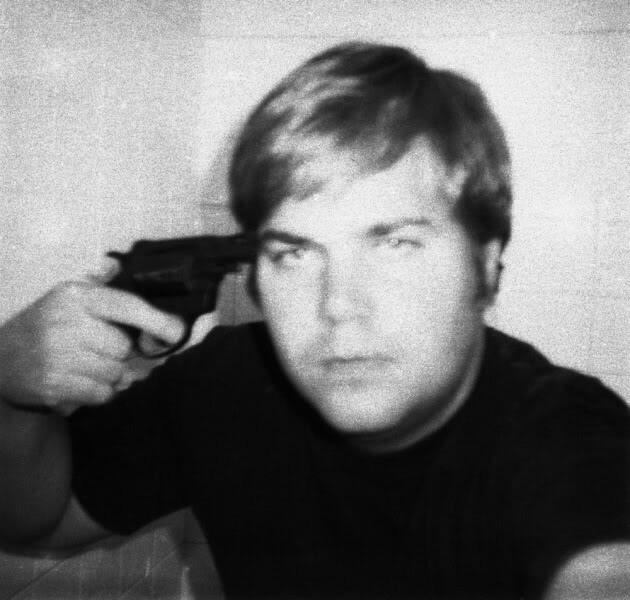
There is also a detailed reference to John Hinckley Jr, would-be assassin of Ronald Reagan in Washington DC, as an example of the use of the ‘insanity’ plea, which James Holmes attempted to emulate by acting ‘crazy’ in court at his trial, with his bright orange hair and faux staring eyes.

nikolas-cruz-mug-shot-credit-broward-sheriff-office-and-instagram-v1We tend to look at these killers as monsters.  The callous disregard and lack of empathy for their victims makes our blood run cold.  The sadism and cruelty involved in the senseless slaughter of innocent concert-goers, high school pupils or cinema goers is incomprehensible to us.

The Columbine killers, Klebold and Harris, not content with planting over 99 bombs, lay in wait for their prey to come running out of the school doors so they could shoot down the fleeing teenagers as they believed they were escaping.  This shows a sang-froid, in that there is an element of deliberate torture rather than a straightforward ‘revenge for all the bullying’.

The Columbine killings happened eighteen years ago, amongst the first high school massacres of modern times, yet still it provides a blueprint for copycat killers today, the most recent being Nikolas Cruz in Florida.  What is it about Columbine that leads to this phenomenon?

Nick Van der Leek gets under the skin of what this is all about, behind the lurid headlines.  Police psychologists at the time claimed it was not possible to draw up a profile of a high school killers from the Columbine incident.  However, many mass murders and school massacres later, Van der Leek would dispute this view, as his intricate analysis of each event, his thorough examination of the psychological, philosophical and moral issues involved, has enabled him to formulate a clear profile.  He sets out a conclusion of what each of the killers has in common with the others.

The author identifies several common factors, which includes the Freudian concept of anal fixation which holds that a person whose development is arrested at this early unconscious level will be obsessed with detail, routine and accuracy to a near unreasonable degree.

There isn’t any psychoanalysis involved in the book, but the term ‘anal’ is a useful shorthand description by Nick of the salient personality trait.  Another is high anxiety levels.  Social anxiety can be particularly acute in adolescence, when rejection by one’s peers can tip an already fragile teen over the edge.  As a society, we have winners, so there are ipso facto ‘losers’.  Van der Leek shows how being a ‘loser’ as all of his examples are, militates as a simmering resentment in the sufferer, like a steaming pressure cooker about to blow its lid,  culminating in a murderous desire to wreak revenge on the perceived popular, successful, happy peers, who are blamed in the loser’s mind for the loser’s ‘reject’ status.

paddock1-ht-ml-171009_v12x5_4x3_992

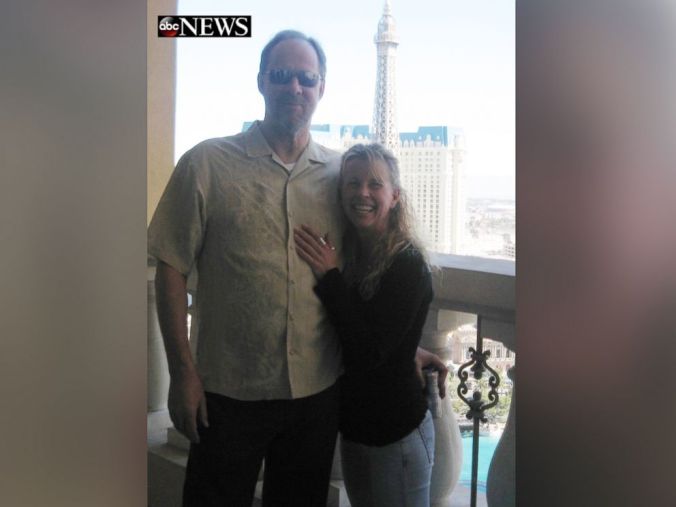
Stephen Paddock in Vegas.

Whilst Van der Leek rejects a genetic factor – Lanza’s features seem to show a congenital problem and Stephen Paddock had a sociopathic ‘most wanted’ bank robber father – seeing this as the easy explanation, instead he tries to pinpoint why each of the most notorious killers has such an apparent lack of humanity. Where does it come from, this cool regard for others as objects that can be picked off like sitting ducks, like a swarm of ants going about their busy lives that can be extinguished with just one stamp of the foot, as it were.  From whence does this cruel brutality emanate?

Van der Leek can supply some answers to these questions by looking at the common memes, the symbology, the ‘manifestos’, stories, videos, texts, social media and wargaming software of the virtual world of outgunning your adversaries online and how the lines blur between fantasy and reality.

We meet Lanza’s dysfunctional mother (whom he shot dead first, before advancing onto the elementary school in Connecticut to commit one of the worst school shootings known).  There is the surreal casino world of the ever-disintegrating inner life of Paddock, who picked off 53 concertgoers from a hotel window in Chicago.

z13795125IER,Przeszukiwanie-lodzi-w-prywatnym-ogrodzie-w-Watert

The pious but feral Tsarnaev brothers and their amazing police chase and shoot-out across Boston, a few days after the bombings.  Cho, Cruz and Saari are all shooters considered weird by their contemporaries, and we examine their cowardice, their adolescent quasi-Nietzschean nihilism, through their manifestos, contacts with extreme ideologies and their professed sense of alienation from their fellows.

columbine

There is the wealthy Holmes and Hinckley and how their parents try to buy their killer offspring off their murder raps (or attempted murder in Hinckley’s case).  This is underscored by the appalling tragedy of Beslan where hundreds of young children were killed all for the sake of ideological and political terrorism.  Yet, for all the claimed high-mindedness of the hostage takers, Van der Leek identifies the same type of anal-sadism driving the cruel brutal behaviour towards fellow human beings, especially women and children who are innocent civilians in all this.

This book is unique, as I am not aware of another book that has gone into so much depth, outside of the Manson killings or Columbine ones.  If you want to know what makes these ‘monsters’ tick and understand the profile of what personality traits they are most likely to exhibit before they commit their atrocities, or even if you just want a jolly good ‘true crime’ read, this is the perfect interactive Kindle publication for you.

Slaughter can purchased on Amazon at this link.

61XwFJ0pn2L


“Nobody knows Stephen Paddock’s motive 6 months after Las Vegas.” Really?

security-mandalay-bay-678x381

Why is motive so hard these days?

I was so astonished at the chorus of ignorance immediately following the Las Vegas shooting, the deadliest to date in America, I penned a blog. I had very little information to go on just two days after the slaughter, but in another sense, I had more than enough.

In the blog I pieced together a rough identity and provided a motive using a psychological technique known as thin-slicing. Almost six months later, I wrote a 522 page book, and with a lot more research, the first motive described in that blog hardly budged. There were a few nuances to it, especially based around Paddock’s experience of childhood, but otherwise the thin slice held up.

In the case of mass shooters, the massacre itself – the scale, the scope, the weapons, the entire theatricality of it, is a massive clue into what message the shooter is trying to send to the world. When the shooter meticulously plans his massacre, kills many people and then kills himself, his motive is obvious. The identity of the shooter in this case was also blindingly obvious, he was a gambler, he was wealthy, and he was the son of a bank robber. The final ingredient was that Paddock was a taciturn loner, with no close friends or family to speak of. That provided all the ingredients for mass murder right there, and yet no one seemed able to see it.

In a sense that’s good. If we could all see into the psychology immediately, that would mean it resonated with many of us [Paddock’s bitter loneliness], and that wouldn’t be good. But the fact that we can’t acknowledge Paddock’s motive is also bad, because it means society can’t see itself, or more pertinently elements of itself, and if we fail to recognize these symptoms, we’re doomed to suffer the same deadly consequences again. So best we do figure this out.

Amazingly, America cast about for days, then weeks, then months, in lieu of no suicide note, no definite link to ISIS, no browser history, unable to put Paddock’s psychology together. Why did Paddock kill so many people at random?

No one seemed to know. The part that I couldn’t believe was that with so many huge pieces of the puzzle on a silver platter, no one was putting them together. A child could put it together!

Four days after the Las Vegas shootings, as everyone bleated in unison about there being NO MOTIVE, I wrote another blog post. Despite having just as little [or as much information] as everyone else, there were already those chiding the public not to think about motive [and not to think at all]. Leave the thinking to the experts, they said. I encouraged folks to think for themselves. Most left the thinking to experts and the experts can up with exactly fuck all.

Three weeks later America still seemed in the dark about motive. I went to some trouble – not a lot – to deal with the fallacy of motive again.  Six months later, the FBI, mainstream media’s so-called “senior reporters” and swathes of the American public still don’t know. CNN doesn’t know. It’s still officially a fucking mystery. Stephen Paddock’s brain didn’t show up a tumor or a fortune cookie with a small suicide scrawled there either, and so, no one could say why he committed mass murder.

9378632_web1_mandalayapweb

A long-time editor, reading my thoughts on the topic, suggested I write a book entirely dedicated to profiling mass murderers, including Stephen Paddock. Thinking about the blog posts I’d already written, I imagined a quick-study, eight meaty chapters dedicated to 8 of the worst mass murderers in America, including Paddock, Adam Lanza, Seung-Hui Cho, James Holmes and the Tsarnaev brothers.

Fullscreen capture 20180401 185014

Instead, I was in way over my head. I ended up writing 140 000 words, over 522 pages. I wrote a bible on psychological profiling, and once again, a pattern emerged in the profiles.

In true crime, the crime scene tends to be a fairly prescribed space, and the premeditation phase tends to be fairly prescribed as well. Not so with mass shooters. They stew in their juices for months, and plot and scheme and weaponize for years. The cauldron of evidence one has to pick through is gargantuan.  And yet when they commit mass murder, there is a sense of randomness about it. Really? You meticulously plan something, to the finest detail, and it happened by accident? Just happened to have a bad day…? Maybe just psycho – that’s the explanation?

Besides the enormous scale of each and every one of these profiles, as well as the huge scale of their crime scenes [the Tsarnaev brothers arguably had five separate crime scenes, and that’s besides their individual residences], many of these shooters leave behind exhaustive manifestos. Incredibly, even when they do leave their motives on paper, as Cho and the Columbine Killers did, society seems dismissive of them.  The media disregards them. Books are written debunking the reasons given by the shooters themselves. The FBI writes reports which minimizes the reasons given by the shooters.

Those who don’t write manifestos leave bread crumbs, either in terms of browser histories [Paddock’s has since been made available] or online residues across social media. Ask yourself, if you were abducted by aliens, what sort of information would your browser history give about you, without you to speak for yourself? A pretty good idea, right?

The real mystery isn’t the motive of Stephen Paddock, it’s knowing what we know, and then coming up with the stupefying possibility that we don’t know what the motive is.

3QDZ2XGRB5B4RFVV4YG7HRD3UU

“‘Walk Up, Not Out’ is a campaign of cowardice, promoted by adults who want there to be a solution to school shootings that asks literally nothing of us”

On March 25th, Kylie Cheung wrote an article for Salem. It was titled:

The sexist, racist implications of the “Walk up, not out” movement: Walk Up demands nothing of the policymakers who are actually in positions to make change

Cheung’s righteous indignation resonated with Emma Gonzalez’s equally spirited dissatisfaction.

Cheung seems to be a magazine journalist who gravitates towards woman’s abuse issues.  That’s fine, but mass shootings are a serious problem in America,  deserve serious solutions, and serious contemplation.

180325115047-01-march-for-our-lives-wisconsin-0325-exlarge-169So, in that spirit, here’s a serious thought. As impressive as the numbers were in the various marches around America, what’s changed? As moving as the various speeches were from many stages dedicated to the gun change cause, what’s changed? As common sensical as it is to make the changes that are being proposed, what changes have been implemented?

Before dealing with Cheung’s article directly, let’s look at what policies are being looked at and/or implemented. Let’s look at what those policymakers that are being asked and entrusted with these changes are actually doing. Let’s start at the top of the list. The banning of semi-automatic weapons, via the Guardian’s coverage:

The short answer to what’s being done about semi-automatic weapons is nothing.

ct-1522194116-5dotx6uq0q-snap-image

How about raising the age limit? There’s a practical way to put the direct acquisition [via purchasing] of weapons beyond the age range of school kids.

The Florida governor, Rick Scott, last week proposed a rise in the minimum age – from 18 to 21 – for purchasing semi-automatic weapons such as the AR-15. Three Republican senators have signaled support for the idea. The proposal was seen as out of character for Scott, a Republican with a top rating from the NRA. He made no comparable call for gun control after the 2016 shooting at the Pulse nightclub in Orlando that killed 49 and wounded 58. But the NRA vehemently opposes changing the national minimum age for purchases of so-called long guns, and Cornyn, the Texas senator, recently dismissed the idea, making passage in the Senate anytime soon unlikely.

The short answer to what’s being done about changing the age limit seems more promising, but from a practical results-perspective, the status is the same. Nothing is happening.

What about background checks?

A strong majority of Americans support stricter background checks for gun purchases. And a piece of bipartisan legislation currently before Congress, the Fix Nics 2017 Act, could start to tighten the country’s background checks system. (Nics stands for the National Instant Background Checks System.) Trump has signaled his support for better background checks…

But as the Guardian’s correspondent on gun violence, Lois Beckett, has explained, the “Fix Nics” legislation, which has been endorsed by the powerful gun lobby group the National Rifle Association (NRA), is very far from universal background checks for gun buyers:

The bipartisan Fix Nics Act that Trump is now supporting does not change the categories of who is barred from buying a gun, or even require all gun buyers to pass a background check before they can purchase a firearm …

Instead, it simply provides federal agencies with a few more incentives to submit records to the background check system – something they are already required by law to do.

The short answer to what’s happening with regard to improving and implementing background checks appears to be very little or nothing.

15-bump-stock.w710.h473What about bump stocks? Didn’t the president put his weight around getting rid of those?

A bill to ban bump stocks sponsored by the California senator Dianne Feinstein after the accessory was used in the country’s deadliest mass shooting, last year in Las Vegas, stalled out in Congress but could be revived.

In Chicago, recently, these bills were revived only to be shot down – vetoed – by the governor of Illinois. The short answer to whether bump stocks will be banned is not now.

With that perspective in mind, let’s come back to Cheung’s shallow rhetoric.

Walk Up demands nothing of the policymakers who are actually in positions to make change

Obviously Americans want to see policy change, but you have to be crazy to bang on the front door all day and not try the backdoor, the windows, or sneaking in through the doggy door. Cheung’s all or nothing approach feels good, feels right, but risks coming away with nothing, as was this case following Sandy Hook.

One must work smart, adapt and learn in order to make real progress. Sometimes, often, progress is measured in a number of small steps that add up. This is particularly true when one’s opponent is organized, well-connected and moneyed as the NRA lobby obviously is.

Given that immediate results in terms of gun control isn’t on the cards, what is? According to Cheung:

The “Walk Up, Not Out” movement is led by parents who believe more “kindness” among students, rather than gun control legislation, will end gun violence. Those at the helm of Walk Up have shared ideas such as increased school security measures that would effectively transform schools into prisons and could have negative consequences for students of color. They have also expressed support for mental health resources while ignoring how scapegoating the mentally ill fails to address the real problem. The real problem is guns and insufficient regulation of gun owners who have access to weapons that kill hundreds in minutes (the mentally ill are far more likely to be victims than perpetrators of gun violence).

slaughter1-001I’ve recently researched a 140 000 word book called slaughter, profiling 8 mass and school shooters and mass shooters. The book took several weeks to research and write, arguably far longer than Cheung’s 1200 stab at the issue. In sheer numerical terms, it’s about 140 times the size of Cheung’s diatribe. That puts me in a position, I dare say, to call bullshit on the idea that “the real problem is guns”. Guns are a problem, and taking them away and controlling them is necessary, but there’s a far bigger problem than guns. We see it in the lawmakers who refuse to change gun laws, and governors who oppose implementing them. These are symptoms of a society that is incentivized to be sick with avarice and self-interest.

But the malaise in society doesn’t end there. Cheung’s assessment is also way off. As part of her “assessment” she cites a Facebook post as part of her research into the motives [the psychology] of school shooters.

One viral Facebook post shared last Thursday by psychologist Rebecca Wald explores this in depth:

“The myth that school shooters are outcasts fighting back against bullies dates back to Columbine. At the time it was widely reported that Harris and Klebold were social rejects, and much was made of the meanness of popular kids. But the FBI concluded that . . . kids didn’t like the boys because they did creepy things like walking around giving the Nazi salute. ‘Walk Up, Not Out’ is a campaign of cowardice, promoted by adults who want there to be a solution to school shootings that asks literally nothing of us. No tough choices, no exercise of political will, no speaking out to power — just lecturing kids on how to do better.”

In the previous blog I provided unambiguous evidence that the Columbine killers were bullied. Books and articles on CNN and viral Facebook posts notwithstanding, the killers themselves said they were bullied and alienated, and so did their friends. Despite PR to the contrary, it turned out Columbine had a culture of exclusion, a jock culture, something that is true in many high schools in America.

In the above post the FBI, who also claim it’s not possible to profile school shooters, seemed to indicate the shooters were creepy and deserved to be ostracized. As such, the idea of having classmates approach creepy kids puts the “normal” kids in danger, and as Walkd says, requires nothing from “us”.  I’m not sure who us is.  Is it the policymakers?  If so, nothing is happening anyway.

Fullscreen capture 20180323 144902Wald seems to see it as cowardice to “lecture kids on how to do better”. I disagree. It’s cowardice not to. In all the school shooters I profiled in Slaughter [and I mean all, without a single exception], what was missing was one or both parental figures. Typically the father was out of the picture, or else both parents. These left the shooter-in-the-making more exposed than usual during the adolescent phase to ridicule.

It’s clear that warm, genuine parenting could have prevented all eight of the shootings profiled, and it’s likely that a community who could have rallied around the more vulnerable outcasts would have made a difference.  Despite popular public opinion, shooters aren’t born overnight, their hatred and disaffection is a process spanning several years.  Their disturbed fixations come about through years of systematic humiliation.

xxx-_rd332--4_3If we live in a sick society in terms of our political leaders, and if our media and social media is equally sick and distorted, then perhaps the last bastion of reliance is ourselves, and our communities. If we can’t ask things from our country, or if our demands go unanswered, isn’t it time to ask more from ourselves? Not Facebook communities, or five minute watercooler communities spawning around a hashtag, but real people engaging with one another in the real world, around real mutual interests.
Incredibly, we find ourselves in 2018 sniffing with contempt when someone suggests more kindness to one another. Somehow being kind is called sexism and racism. It was once know as the golden thread – treat others as you wish to be treated, be kind. Today such sentiment is seen as ridiculous. Well, is it any wonder that in such a cruel, heartless society, cruel and heartless players find their way to the stage?

The Walk Up movement is meaningful because it demands more from us, rather than shifting blame and requiring action from others. It’s that anal fixation on them versus us that’s the root of the problem. Why can’t society’s require more from themselves? What’s wrong with that?

The real cowardice at work here is a failure to think. The fact that the mainstream, the FBI and the media haven’t provided so much as a motive for the Vegas slaughter, for Sandy Hook or for Columbine tells you all you need to know about the ongoing incapacity of society to interrogate these shooters.

We have no idea who these people are or why they did their bloody deeds, and we don’t know because we don’t really care. We don’t even know ourselves any more. We think we do, because we think our reptilian responsiveness to social media illustrates our enlightenment. In fact, it illustrates our poisonous narcissism, nothing more.

Our incapacity to interrogate these unconscionable massacres mirrors our incapacity, of late, to interrogate ourselves. Slaughter pioneers the authentic thinking that’s required to heal our increasingly fractured tribalism. As such, it is both terrifying and extremely sad, who we are and where we are today. The first step on the journey to restoring our true and better selves is acknowledgement, isn’t it?

afp-516076589-4_3

Sadism in High Schools and School Shooters: 5 Reasons why Isabelle Robinson’s Op-Ed is flat wrong

gun-protests-04.w710.h473I care about gun control. It cuts very close to home for me. My mother killed herself using my father’s revolver. I was seventeen years old and about to write my final exams at school.

I’m very aware of both sides of the coin – the disaster of having deadly weapons at arm’s reach, and the deteriorating mental health of a person. But there’s also a third dimension to all this. Beyond both sides of the coin, there is also society, in my case, family, that can serve as a soothing or healing agent, or can aggravate the anxiety of those slipping towards their rock bottom.

We tend to fixate on the guns, and we should, but not at the expense of the who and the why. If getting rid of guns won’t get rid of the misery that’s there, or the murderous intent, what will?

After researching and publishing my latest book Slaughter, which profiles 8 high-profile mass murderers and school shooters [including Nikolas Cruz], I’ve been appalled and alarmed at the ignorance and hypocrisy surrounding this latest shooting. Now, to make matters worse, conspiracy theories are popping up like poisonous mushrooms.

Among them, Emma Gonzalez bullied Cruz, and Cruz is being framed for the shooting. The braindead subscribe to these theories, and the motive behind them is clear: there are enemies out there that want you to not trust your government and institutions. The more Americans are divided against themselves, the better these catastrophes in American schools will remain misunderstood, and society will be remain unable to fix itself, let alone be able to diagnose what’s wrong.

Doesn’t Why Matter?

Conspiracies aside, nobody seems to know or care why Cruz perpetrated one of the deadliest mass shootings in America. In fact, instead of caring about what happened, droves of teenage girls and mothers have sent Cruz fanmail.

Somewhere between these extremes of a society gone mad, the same theme echoes through the ether, just as it did after Columbine, Sandy Hook, Virginia Tech and the Las Vegas shootings.

It’s all about guns. That’s how the narrative starts. Then it’s about the victims. Then the shooter’s identity is drowned in a deluge of rumor and conspiracy in the run up to some official report which can’t pin down a motive, or any easy answers.

No one seems to want answers in terms of where the murderous intent comes from.  There seems to be a terror involved in opening the door to the most obvious issue of all: firstly why these shooters develop an abiding hatred for society, so much so they spend months, sometimes years planning and fantasizing on getting payback. Secondly, how and why these shooters are invariably society’s discarded and unpopular losers. They are loathed or passed over to such an extent they soon develop a destructive, often suicidal self-loathing. Does that happen by accident? Does it happen spontaneously or through a long process?24march-maine-portland-lives-master1050

The fact that no one cares about discussing how these shooters emerge out of a patently sick society says something about how careless and distracted we as a society have become. Do we value one another or do we only care about our own value?

Anality & Sadism

In Slaughter I touch upon the relationship between anality and sadism.

Being anal, in the psychological sense, is about an oppressive level of meticulousness or fixation. The more anal one is, the more one is deprived of the spontaneous, surprising, natural goodness of life and people. One’s sadism is directly proportional to one’s anality – the more one is stuck in repetitive man-made fixations [computer games, porn, social media], the more sadistic we become in terms of taking pleasure at the expense of others. To be clear, all of us are at risk if we allow our anality to take over.

ppBybIuIn Slaughter I wrote:

“A fixation on gun laws, let’s face it, is both essential and anal.  The insistence not to pay any heed to Lanza, or his family, in the Newtown documentary, is both understandable and anal.  If we fixate on lobbying for gun control, but refuse to figure out the psychology of these school shooters and mass killers, we’re doomed to see these catastrophes repeat themselves until we do understand.”

On twitter, this anality is reflected in wildly divergent and conflicting narratives at these hashtags: #Marchforourlives versus #Walkupnotout versus #Nikolasneedsourhelp

Sadism is taking pleasure, or benefiting in some way, in the misfortune of others. High school, as we all know, is a popularity contest. The flip side of popularity is humiliation and isolation.  For the winners, it’s great. High school is a popularity contest with a captive audience.

Authentic Change or Reactionary Populism?

In all the popular rhetoric flooding out of Parkland, a bunch of seniors are emerging as a tribe of heroes. Emma González arguably the face of a new movement for change, joined twitter in February 2018. Today Gonzalez has almost 1.5 million followers on twitter. She’s not done with high school yet, so the popularity contest continues.

Emma GonzalezMy  impression of Gonzalez is that her every appearance is like a carefully crafted circus act. It’s almost Trumpian in its conception. It’s very compelling, very emotional, very popular, it plays wonderfully on twitter but somehow [like a circus act] it’s invariably very forgettable.

Other seniors are also actively appearing on national television and various media stages across the nation, confidently identifying themselves as shining beacons of hope and yes, popular sentiment. Are these the heroes of the future, or flashes in the pan of a high school popularity contest WRIT LARGE?

hc-pictures-adam-lanza-nancy-lanza-001

For the losers, whether in or out of high school, whether on or off social media, life is very different.Losers are insignificant. Invisible. They have no voice, no power. Life sucks. What makes being a loser in high school harder than anywhere else, is if you can’t stand the heat, tough, you’re stuck in the kitchen.  There’s no getting out for the foreseeable future. The cool kids and the losers are stuck with each other, which is another way of saying, the losers are stuck – for years – with their oppressors.

In high school, inevitably, popularity contests often go too far. Sometimes the cool kids get too caught up in their own popularity, other times the losers get too bogged down in a downward spiral of humiliation.

When a school shooting occurs, these forces come to a violent nexus. The tribal forces that were in place to begin with, remain in place after the shooting, except that the tables are temporarily turned in terms of the victimology. For the brief minutes of the shooting, the shooter – for once – gains the upper hand. The shooter is the dominant social force, the shooter determines fates – who lives, who dies. For a fleeting, terrible passage of time, they hold the keys to social power and social death.

merlin_135961674_ad687b5d-b2f1-42a0-9a9e-74f4cc00af0d-master1050Afterwards, when the school is asked to account for the shooting, no one can remember bullying, isolating, or ostracizing the shooter, but everyone is crystal clear that something was seriously wrong with the shooter.

This selective amnesia applies to the students and teachers. Any student who remembers picking on the shooter, anyone putting up his or her hand,  courts the whirlwind of social blame. Oh so this is your fault? It’s because of you that X snapped? Further inquiry may lead to that person implicating others, and that can’t be tolerated either. And so the tribes that were in place before the shooting remain locked in their loyalties after as well.

This amnesia goes back to Columbine in 1999. Almost 20 years later, no one is sure whether the shooters were bullied. On twitter recently, someone told me bullying at Columbine was a myth. She couldn’t say what the motive was, but she was clear that it had nothing to do with bullying.  I’d show you the tweet but it’s been deleted.

Reality Check

Curiously, few people go to the source to find out why they committed mass murder. Invariably, these loners do a lot of writing, so there’s plenty of firsthand material available if one takes the time to go through it. Like this from Colorado Springs shooter Matthew Murray:

So many people don’t have any clue about The Nightmare we’ve grown up in. I mean, it’s not my fault I was raised in homeschool for 12 f***ing years and that I’m not able to “socialize normally.” How am I supposed to socialize and make new friends when I’m always left out of everything, and always made to be the outcast? I’m nice, I’m considerate, a lot of people tell me I’m intelligent and kind….so why the f*** must everyone think they have some right to abuse and reject me?

I hate you people for leaving me out of so many fun things. Never inviting me to all your fun parties, never inviting me to hang out. And no, don’t say, ‘Well, that’s your fault’ because it isn’t. You people had my phone number, and I asked and all, but no no no no no don’t let the weird kid come along, oooh f***ing nooo

Far from the jock/bullying culture being a myth at Columbine, in fact, the jock culture was so well known at Columbine,  it was an institution honored by the entire school,. it was even color coded. Jocks, for example, wore white caps as part of a “uniform” to identify themselves. In the Columbine yearbook, images of athletes were in color, the rest relegated to black and white.

Despite the Columbine killers shooting video of themselves at school being bullied, despite writing manifestos for why they did what they did, the public still can’t seem to remember.

Here’s a reminder.

CY9MjQ0WsAArtqO

In Eric Harris’s journal, he also wrote that “Whatever I do people make fun of me, and sometimes directly to my face. I’ll get revenge soon enough”

Here’s a counter narrative.

Book: Columbine shooters mentally ill, not bullied

Wikipedia’s not too clear either. Eric Harris’ motive according to Wikipedia is due to “multiple factors”: bullyingpsychopathysadism. That’s not a motive, it’s a laundry list.

I’ll wager if you asked any shooter what their motive was, they’d give a straight, simple answer. It would be a single word, like payback, or revenge.

Payback for what?

Ryan Klebold’s motive for committing mass murder? The same as Harris’ more or less. Due to “multiple factors”:  bullyingdepression, revenge.

Was Nikolas Cruz bullied?

In the Wikipedia post for Nikolas Cruz, no motive is listed.  It’s simply not an issue.

Strangely enough, there is one person who can remember bullying Cruz. His younger brother Zachary, and Zachary’s friends.

When Emma Gonzalez made her first impassioned speech, she let slip that they’d ostracized Cruz. She volunteered the word, and defended it, screaming: “YOU DIDN’T KNOW THIS KID!” That’s fair, but we also still don’t know what the ostracizing involved. How long did it go on for? Who was involved? What did it involve?

We know there’s a video of Cruz fighting with other kids.

This seems to suggest other kids saw Cruz’s situation as entertainment. I doubt whether he did. That’s not unusual, and the whole high school spiel is the same the world over. It’s not fun for the majority of kids though, is my point. And so with that element – the isolating, the humiliation – missing, no one is sure what the motive was. Was it computer games, or antidepressants? Did the shooter get out of the wrong side of bed that morning?

stressed-studentMeanwhile, who cares about motive, while the popularity contest goes on unabated. Seniors at Marjory Stoneman Douglas High School are in a race to gain as much popularity as they can, and to discredit their peers on their way to popular glory.

We see evidence of this in two students from the same school, where one sabotages the other in the name of “decency”, but what it really is is a sadistic effort to opportunistically put oneself ahead at the other’s expense.

A Parkland high school student who agreed to a live debate over his conflicting views over gun reform with fellow Marjory Stoneman Douglas student Kyle Kashuv has pulled out of the deal. Cameron Kasky, an organizer of the pro-gun control March for Our Lives movement, tweeted Monday night that he won’t debate Kashuv, a pro-Second Amendment voice, following a tweet Kashuv seemingly disapproved of. 

“Kyle, I’ve enjoyed my discussion about gun laws with you so far, but after seeing this, I think I’m out. For personal reasons,” Kasky said, adding that while he “disagree[s] on certain policies with some family members of some victims,” he would “never go after them, especially not like this. This is low.”

The Unacknowledged Narrative

In the same way that school shooters take sadistic pleasure in murdering their peers, the big chunk of unacknowledged narrative is the sadistic pleasure popular high school kids get out of maligning their peers.  This might be because someone lacks social etiquette, isn’t good looking, walks funny or wears braces. There’s evidence of this denial, and the degree to which it is unacknowledged, in the #Walkupnotout hashtag. The idea of reaching out to these losers is absolute anathema not only to those high schoolers involved, but seemingly to society as well.  So much so, Isabelle Robinson, a senior at Marjory Stoneman Douglas High School, penned an open ed for the New York Times along these very lines, saying:

…students should not be expected to cure the ills of our genuinely troubled classmates, or even our friends, because we first and foremost go to school to learn. The implication that Mr. Cruz’s mental health problems could have been solved if only he had been loved more by his fellow students is both a gross misunderstanding of how these diseases work and a dangerous suggestion that puts children on the front line.

Robinson’s right. Students shouldn’t be expected to “cure the ills” of troubled classmates. What Robinson neatly sidesteps here is that students tend to expose the ills of troubled classmates, almost as a default setting. Once exposed, classmates are hounded so that their inferiority is made abundantly clear. So while no one should “expect” students to cure their classmates, they should also not be expected to worsen the troubles of their peers, either.

xxx-_rd324--4_3

Robinson adds that kids go to high school to learn. Really? Is that the only reason kids are in high school? They’re not there to make friends, to join clubs, to perform in plays and sports, to become class presidents?

School isn’t an individual game, like Survivor, it’s a social game, and it’s all about alliances and achieving social superiority.  High school is also about the ability to attract a popular and attractive mate. The community has a lot of say, and to say, in this process. The idea Robinson suggests here, that you go to school in a vacuum, is the same heresy as saying Survivor is an individual game. It’s not, even if you do your damnedest to play it that way, one way or the other, you are part of a tribe, even if your tribe puts you on the bottom as part of an explicit group of discardable rejects.

As for putting children on the “front lines”, it’s an odd thing to say. Kids at school are not so much on the front lines, as they are the front lines. So the idea that one can be in class and not be responsible in some way for the harmony or misery of that class, is asinine.

It is not the obligation of children to befriend classmates who have demonstrated aggressive, unpredictable or violent tendencies. It is the responsibility of the school administration and guidance department to seek out those students and get them the help that they need, even if it is extremely specialized attention that cannot be provided at the same institution.

Robinson’s right again, it’s not the obligation of children to befriend anyone, let alone classmates who are less than friendly. On the other hand, isolating an unpopular child isn’t a solution either. So if it’s not the prerogative of classmates who are stuck with each other to be nice to each other, then the school should deal with them? Wrong.

merlin_135982677_ff6d0c79-c598-4726-ad14-cccb55896e3a-master1050The school did deal with Nikolas Cruz. He was expelled. It didn’t change the original situation, it aggravated it. Yes, it’s not the obligation for anyone to befriend or be nice to anyone, but as America stands today, a loser who develops an abiding hatred for his peers, has the capacity to access military grade weapons and execute on that murderous intent. It seems to me, that given the choice between maligning someone to such an extent that they fall out of a school system entirely, who may then come back and shoot you, and being less unkind and unfriendly than you and your peer group feel you need to be, the second is the lesser of two evils.

No amount of kindness or compassion alone would have changed the person that Nikolas Cruz is and was, or the horrendous actions he perpetrated. That is a weak excuse for the failures of our school system, our government and our gun laws.

I’m not sure that’s true. High school is a temporary prison for losers, which means any gesture that might make it less humiliating, or might make it easier, for the more unhinged and unstable student, may allow them to better endure the heat in the kitchen.

Put conversely, would it be fair to say that no amount of cruelty or humiliation would have changed the person X was in school…Alienation at a young age has a massive impact on young, vulnerable psyches that are ill-equipped to deal with the unknown hinterlands of adolescence and the emotional shitstorm that accompanies growing up.

I think those influences during the formative years [and Robinson writes about being a young teenager, the most formative of the formative years] are extremely formative.

5 Reasons why Isabelle Robinson’s Op-Ed is flat wrong

  1. First off, Robinson claims she tried to “befriend” Nikolas Cruz when she was thirteen years old, and assigned to ‘tutor’ him. She describes feeling creeped out by the hour-long discomfort of counselling him , something she took seriously and regarded as her first adult responsibility. Performing her duty was by no means reaching out, and even less befriending of any sort, which makes the headline to her open ed disingenuous.
  2. Robinson refers to Cruz’s sadism directly as a “sick twisted joy” as he watched her cry. She can’t remember whether Cruz was confronted over his actions, and yet she can remember him leering at her chest, and feeling proud about sorting out his binder. This is also disingenuous. What this is isn’t confronting, but ostracizing. It’s easier to freeze someone out than deal with them, and so that’s what she did. That too is a cowardly form of confrontation. It’s confrontation via exclusion, done behind the person’s back.
  3. “I am not writing this piece to malign Nikolas Cruz any more than he already has been. I have faith that history will condemn him for his crimes.” But isn’t that precisely the same non-confrontational attitude that allowed the shooting in the first place? If you were there, and you can’t account or condemn someone for his crimes, who will?
  4. Robinson’s main gripe is against anyone who has the temerity to suggest students should have been kinder to Cruz as a potential preventative measure. One wonders, if one could put an algorithm together in an Artificial Intelligence machine, and the machine said, if five people smiled at Cruz on these five days, it would have been enough to dissuade him from doing what he did, how would they respond? One suspects the mere idea of being nice to a loser is too repugnant to even countenance.
  5. “The idea that we are to blame, even implicitly, for the murders of our friends and teachers is a slap in the face to all Stoneman Douglas victims and survivors.” It’s an interesting expression. If we are to blame, even implicitly, then the entire tribe have been slapped in the face. In other words, even the slightest chance that bullying might have aggravated the situation, even the mere mention of that, is a slap in the face of everyone else. It’s a visceral sense of humiliation, is it? This is a great recipe for exceptionalism, where we say: the problem was Cruz and guns, and had nothing to do with us. That may be true, but if it is, why are there school shootings twice a month in America? Because if only American kids are mentally unstable, do they become that way in a vacuum?

Eric Harris blamed society for creating violent outcasts, but that’s no right either. It’s not right for the shooter to blame society, but this is the pertinent point, or for society [and especially the school community] to blame the shooter. Or guns. It’s not just one or the other; it’s not that simple or clear cut.

121218083637-newtown-back-to-school-horizontal-large-gallery5 Reasons why Isabelle Robinson’s Op-Ed is on the right track

  1. It is a “deeply dangerous sentiment” to imply that “it takes a village to raise a child”.  In other words, if a child rampages against the village, something is wrong with the village [and the child].
  2. When Robinson writes of being forced to endure Cruz, that’s what bullying and humiliation feels like. I suspect any school that is able to curb [not eradicate, just mitigate] bullying and humiliation, will curb [not eradicate, just mitigate] the overall anxiety of its school society. Less anxiety = less anality. Less anality = less sadism.
  3.  “I would have done almost anything to win the approval of my teachers.” Losers feel the same way, except they may feel their case is hopeless, especially if they’re not smart, talented or good looking.
  4. “This is not to say that children should reject their more socially awkward or isolated peers — not at all…I strongly believe in and have seen the benefits of reaching out to those who need kindness most.” Yes, reaching out to isolated kids can be beneficial.
  5. “But students should not be expected to cure the ills of our genuinely troubled classmates…” This is both true and untrue. Students should not be expected to cure anyone, just as most kids aren’t expected to win Olympic gold medals one day. If they can, or if they try, super. The question isn’t who shouldn’t, but who should be expected to cure the ills of troubled members of society? The FBI? The school boards? Neither worked in this case. The best answer to this is the family and close friends of the loser. Well, what if the loser has no family or friends, as was the case with Cruz? Then the question that someone in class should be expected to deal with an isolated kid becomes more critical, doesn’t it?

 Whenever a school shooting occurs in America [on average once every two weeks], the response tends to be the same:

  1. The shooter is regarded with unbridled contempt
  2. No one is surprised.

And then two more weeks go by and there’s another shooting.

In the context of school shootings, it’s easy to forgot what high school is fundamentally: a popularity contest.  It’s also one you can’t escape. There’s that saying, if you can’t stand the heat, get out of the kitchen.  Well when the heat is on in high school, there’s no getting out, not for several years anyway. That’s good for the winners, and shit for the losers. When guns are at arms reach as they currently are in America, it makes sense to not make life more miserable for the losers than it has to be. In other words, cool kids, curb your sadism.

God-smite


The Marvelous Infinity War: Untying Mysteries the PR Campaign Won’t Touch [PSYCHOLOGICAL SPOILERS]

I write about true crime full time, so I’ve found the teasing done by Marvel across 18 films compelling, fun and psychologically sound. Marvel are masters at coherent intercontextuality, and in Infinity War, due out next month, it’s going to go up a notch. We know that, what we don’t know is how.

Like many other fans of this franchise, I’ve followed the accessories to the Marvel juggernaut, as they educate and prepare audiences for what’s to come. Ridley Scott seemed to be one of the progenitors of this, providing a series of informative previews and reveals on YouTube that stood alongside Prometheus, but weren’t trailers per se. Marvel and Star Wars have taken up the cudgel since, seeding their content with easter eggs, post credit scenes and plenty of social media discussions – audiences [and true crimes writers] are loving it.

But these ‘explanations’ within the films and in the PR accessories [toys, interviews etc] are still teasers. What are they leaving out?  I’m not going to spoil it, because I can’t – I haven’t seen the film myself. But it’s fun to speculate beyond the mainstream speculations, so here, more specifically are my 2 cents.

robert-downy-jr-iron-man

  1. A lot of Marvel characters are going to die. There’s some speculation that it may be Iron Man, could be Captain America, and as for Vision, he already appears to have lost some color in the trailers. More likely, a bunch of characters will be culled, especially the old ones [Ironman, Captain America, Thor, the Hulk Black Widow etc]. avengers-infinity-war-trailer-vision-human-form-1061753
  2. DC beat Marvel to the same punch, but executed badly. In Justice League we saw Superman come back from the dead, but in a less than satisfying way. Many expected to see a darker Superman in a different suit, a black suit. The way DC did it there wasn’t really a punch-in-the-gut reaction to Superman’s death, nor the let’s-do-cartwheels when he was resurrected. DC rushed and botched the job, in a bid to stay in the race with Marvel. They should have stuck to their own pace and gone their own way. What audiences can expect though is for Marvel characters to die, but “die” in inverted commas. Thor-Ragnarok-Tv-Spot-Odin-Anthony-Hopkins
  3. Look to Odin, people. We’ve seen some of the alternate universe stuff already in Odin making appearances in alternate possibilities for Asgard from beyond the grave, similar to Star Wars ghosts but without the ghostly halo.  Thor, Captain America and Hulk have started that process of alternate characters occupying – wait for it – alternate universes. When this happens, characters look different, and sometimes seem different. They might have longer or shorter hair, they may have one eye instead of two, they may have lost a shield or gained a new piece of equipment. They may be angrier or have memory problems. In the trailer for Infinity War Thor has an eye patch at one point, and look carefully, he seems to be missing one somewhere else.tumblr_p3itv4IJNe1tlgqkgo3_r1_500
  4. Expect more character differentiation. We’ve already seen Thor, Captain America and Spider-Man starting to look different, but it’s happening throughout the franchise – from Groot to Loki to Hulk. Iron Man actually started the whole thing off with his upgrades, and in the modern world, it makes sense that stories have inbuilt capacities to modernize and recontextualise.
  5. Iron Man and Spiderman ended up on another world together…Joining the dots, Spider-Man ends up swooshing onto Thanos’ wormhole maker, but as it departs back into space, Iron Man has to rocket-boost to the rescue. Probably both of them get sucked into another dimension where they first encounter Thanos, and my guess is, that’s where Iron Man buys it, resulting in Spider-Man getting a massive Stark-tech upgrade.

When the last Infinity War trailer opens, it starts with a weird upside-down rotation of the city. No one is talking about that. A lot of nuance is buried in the first three frames of the new trailer, and no one seems to be talking about it. The upside down view is a metaphor for an alternate universe.

The next frame shows Bruce Banner, Natasha Romanov and Iron Man War Machine. It’s shot from above the three appear to be standing on a strange grid. Each of the three occupy a quadrant on the grid. Bruce Banner is the only one with a leg sort of drifting into a fourth quadrant, the others are neatly inside their own clearly delineated grid. Reading too deeply? It may be, and this is a random guess, that these three characters may guide us separately into the alternate universes to come. Natasha Romanoff on Earth, Bruce Banner in some other dimension [as he’s already done in Thor] and Iron Man War Machine is in a third dimension, perhaps a second Earth, or a second Asgard, or somewhere else. Each may take a few characters with them to battle in different places and times – hence Infinity War.

avengers-infinitywar-trailerbreakdown-widow-bruce-rhodey-700x290

In the third scene we see a meteorite falling across the sanctum window in New York. The sanctum windows are both emblematic of gateways, and in terms of the sanctums themselves, actual gateways. So the meteor passing across the gateway is HUGE psychological fodder. You with me?

When Thanos’ favorite daughter, the green-skinned Gamoa refers to Thanos’ dream of wiping out half the universe, one has to wonder – why half? What about the other half? That’s exactly it, one half tends to mirror the other half. So the half that’s missing isn’t really missing, it’s not destroyed but mirrored in another dimension. How?

Magic.

tumblr_inline_p5p2wafGZa1ul2csj_540

Why are Marvel doing this? For at least two good reasons. Firstly, many of the big stars’ contracts are coming to an end. Robert Downey Junior anchors the franchise, but he also costs a fortune. Marvel is bleeding new talent, with the new Spider-Man widely seen to be the new Iron Man. I’m not sure if that’s a great move, but then I’m not Marvel’s core target market.avengers-infinitywar-trailerbreakdown-spiderman-strange-700x289

Secondly, alternate universes allow for flexibility. In the narrative sense, character arcs can go one way, and if Marvel decide to redeploy Iron Man, or Captain America, they can bring him back in an alternate reality looking different [including older], without disturbing some of the main story arcs.

Makes sense, right?

As mentioned above, this is likely to happen through the manipulation of Dr. Strange. Remember, Dr. Strange has a green infinity stone that can be used to manipulate time. To unlock the time stone maybe Thanos uses the Vision’s mind stone to control Dr. Strange’s mind…?

avengers-infinitywar-trailerbreakdown-doctorstrange-needles-face-700x289

From then on, the Marvel universe is likely to become strange and expansive, and perhaps strangely unfamiliar. After 18 films Marvel have held it together, but it’s going to get a lot harder and more complicated to hold it together going forward. In a sense the alternate universe thing is about letting go, but that ushers in unfamiliar territory. Guardians of the Galaxy prove Marvel are up to the task. Black Panther proves not everyone is going to love it. DC should slow down and learn from Marvel’s mistakes, assuming they make any.

Adam Lanza provides motive for Chimp Attack – and his own

From schoolshooters.info:

On 20 December 2011, Adam Lanza called in to a talk radio program, AnarchyRadio, broadcasted on KWVA 88.1 FM out of the University of Oregon. The show is hosted by John Zerzan, a writer described by The Atlantic as “an intellectual leader of the anarcho-primitivist movement, an ideology that regards technology as a destroyer of human communities.” The reason for Lanza’s interest in Zerzan’s writings is plainly evident in the call itself; Lanza calls to share a story about “Travis the Chimp,” a domesticated chimpanzee that in 2009 “snapped,” and viciously attacked 55-year-old Charla Nash, a friend of the chimp’s owner. The attack was seemingly random, nearly cost the victim her life, and ended when the chimp was shot by police. Lanza outlines how the chimp’s violent episode can be explained by his upbringing “as if he were a [human] child,” and argues that Travis’s “civilized” upbringing was what led to his attack.

LANZA: Because, uh, he brings up questions about this whole process of child-raising.

HOST: Yeah.

LANZA: Civilization isn’t something which just happens to gently exist without us having to do anything, because every newborn child — human child — is born in a chimp-like state, and civilization is only sustained by conditioning them for years on end, so that they’ll accept it for what it is, and since we’ve gone through this conditioning, we can observe a human family raising a human child –and I’m sure that even you have trouble intuitively seeing it as something unnatural– but when we see a chimp in that position, we immediately know that there’s something profoundly wrong with the situation. And it’s easy to say there’s something wrong with it simply because it’s a chimp, but what’s the real difference between us and our closest relatives?

Travis wasn’t an untamed monster at all. Um, he wasn’t just feigning  domestication, he was civilized. Um, he was able to integrate into society, he was a chimp actor when he was younger, and his owner drove him around the city frequently in association with her towing business, where he met many different people, and got along with everyone. If Travis had been some nasty monster all his life, it would have been widely reported. But, to the contrary, it seems like everyone who knew him said how shocked they were that Travis had been so savage, because they knew him as a sweet child, and… there were two isolated incidents early in his life where he acted aggressively, but… summarizing them would take too long, so basically I’ll just say that he didn’t really any differently than a human child would, and the people who would use that as an indictment against having chimps live as humans do wouldn’t apply the same thing to humans, so it’s just kind of irrelevant.

HOST: Uh-huh.

LANZA: But anyway, look what civilization did to him: it had the same exact effect on him as it has on humans. He was profoundly sick, in every sense of the term, and he had to resort to these surrogate activities like watching baseball, and looking at pictures on a computer screen, and taking Xanax. He was a complete mess.

HOST: Mmm-hmm.

LANZA: And his attack wasn’t simply because he was a senselessly violent, impulsive chimp. Uhm, which was how his behavior was universally portrayed. Um, immediately before the attack, he had desperately been wanting his owner to drive him somewhere, and the best reason I can think of for why he would want that, looking at his entire life, would be that… some little thing he experienced was the last straw, and he was overwhelmed at the life that he had, and he wanted to get out of it by changing his environment, and the best way that he knew how to deal with that was getting his owner to drive him somewhere else.

HOST: Yeah.

LANZA: And when his owner’s… owner’s friend, arrived, he knew that she was trying to coax him back into his place of domestication, and he couldn’t handle that, so he attacked her, and anyone else who approached them. And dismissing his attack as simply being the senseless violence and impulsiveness of a chimp, instead of a human, is wishful thinking at best.

HOST: Mmm-hmm.

LANZA: His attack can be seen entirely parallel to the attacks and random acts of violence that you bring up on your show every week, committed by humans, which the mainstream also has no explanation for-and-

HOST: No.

LANZA: –and, actual humans… I just- just don’t think it would be such a stretch to say that he very well could have been a teenage mall shooter or something like that.

HOST: Yeah. Yeah.

LANZA: And—

HOST: Wow. Thank you, Greg.

LANZA: Yeah.

HOST: That’s quite a story. That’s, uh, really apropos, isn’t it? Travis the chimp.

LANZA: It’s just that I’m a little surprised that I haven’t heard you bring it up all because… (laughs) maybe I’m just seeing connections where there aren’t any, but—

HOST: Not at, I uh, think not. No, I just… I didn’t catch that one. I didn’t uh… maybe I was out of the country  or something, I don’t know, but I missed that it. Thanks very much, man.

LANZA: Thank you. Bye.

HOST: Take care.

(Lanza hangs up)