True Crime, Why Journalists Must Remain Neutral, and What It Means

“As a journalist we have to give up the right to have a public opinion about things…it’s not my job to judge…”

This was Zora Stephenson’s take on her exclusive interview with Chris Watts, the Colorado man who confessed to murdering his pregnant wife and two young daughters earlier this month.

Obviously Watts was addressing a phalanx of reporters simultaneously when he gave that infamous interview, not Stephenson directly, but regardless, getting Watts to talk when he did, and how he did, and for as long as he did, was a major scoop. Probably the recording will be fielded in a criminal trial as evidence.

Because the interview went viral, many wanted to know what the reporter’s thoughts were, standing there, getting a direct, firsthand impression of Watts. The public were disappointed to hear Stephenson wouldn’t give them her personal opinion because she couldn’t.

It wasn’t that she didn’t have an opinion. As soon as you sign up as a journalist, your opinion becomes a public opinion, and represents whichever media employs you. In a journalist’s contract, everything you say and write is owned – through copyright – by your employer. As such, they can also be sued if you express an opinion, especially one that’s subjectively accurate or even true, but not legally defensible.

For this reason it’s drilled into journos heads that they may not have an opinion. That the highest journalistic ethic is to remain neutral, kinda like Lady Justice herself.

Many in the public admire this, and think it’s admirable. It’s not. Being able to think for oneself, and think independently, is a sign of intelligence. Being able to speculate, especially in important matters that rock society like crime, is a sign of a healthy, self-aware community. Being restricted from expressing an opinion when you have firsthand knowledge is a kind of common commercial censure.

Many in the public take the lead from journalists, thinking it’s immoral and unChristian “to judge”. Only God and a court Judge can do that.

Okay, well, when you get married, who decides whether your partner is right for you, and trustworthy, and vice versa? Do you want to go to court and have a Judge decide? Well, many marriages do end there, in divorce court with a Judge telling each side how to split the marriage pile. In the real world, we do have to think for ourselves, we do have to reason, we do have to have an opinion about the quality of virtually everything, from the vegetables we buy to the air that we breathe. Those who give up this right become sheep, and sheep are led like lambs to the slaughter.

If true crime teaches us anything, it’s not to be a sheep. It’s to think.

So how do journalists and media companies get around the pitfalls of not being able to comment on true crime, even when they’re right there, covering it? Well, that’s why they’re always interviewing experts.

Just as experts are brought into court rooms to provide their “objective” assessments of a set of facts [even though these are often competing opinions with some supporting evidence], the media are allowed to “objectively” comment on interviews such as the one Watts gave, through experts. I often find these “expert” commentaries quite comical. It’s not as though these experts dedicate themselves to one case when the media asks for comment; they’re by their very nature true crime butterflies, jumping from flower to flower, and trying to get to as many as they can. In this sense the experts are like the journalists, jumping around from case to case, story to story, but not really sticking around to absorb one case for any length of time to really extract the marrow out of it.

That does happen when an expert becomes part of a defense team, someone like Dr. Henri Lee the forensic scientist, or a DNA specialist like Barry Scheck. But experts that are not part of a defense team that appear on air amount to little more than a circus act, expressing an opinion while holding up a CV and calling it truth.

After the Watts interview the media were desperate to do something with it, but because of legal perils and pitfalls, they had to have experts weigh in. And so they wheeled in their circus acts – the expert body language consultant, the ex-FBI profiler [who looks like someone’s granny], the professional lie detector etc.

It gets absurd when these experts are leaders in the field of pseudosciences – stuff like handwriting analysis, body language, lie detection, and the rest of it. Although there are groups who make a study of these areas, it’s hardly scientific. Although there are professional bodies that accredit one another, they’re hardly authoritative outside of these groups and clubs.

That’s not to say there isn’t merit in examining handwriting, or human behaviour, or that there aren’t patterns, or that plenty can’t be revealed, it’s just that one “expert” can easily be debunked by another “expert” interpreting exactly the same information in a different way.

A good example of Expert Wars in a court room is the handwriting analysis done in the Ramsey Ransom Note. 78 samples were taken, but only Patsy Ramsey’s handwriting was singled out as a possible match. Team Ramsey’s experts scored Patsy as a 4.5/5 for being the author of the note where 1 is certain and 5 is uncertain. Whever Patsy was interviewed she’d recite these numbers over and over again, like gospel. The prosecution handwriting experts – about half a dozen of them – either called her handwriting a 100% match for the Ransom Note, or extremely certain.

Which set of experts were right?

During the Wolf case, when the handwriting narrative was discussed as evidence, Lin Wood, the Ramsey’s defense lawyer managed to have all the prosecution’s handwriting analysts thrown out of court. He was able to demonstrate they didn’t belong to a particular professional body, and thus weren’t experts according to a particular standard.

With them gone, he could then field his own experts, and so it was no surprise when Judge Carnes accepted his version, that Patsy Ramsey wasn’t the author of the Ramsey Ransom Note.

Many of the experts courted by the media to prognosticate on court cases tend to be guns for hire either by prosecution teams, or by defense teams. It’s usually one side or the other. So a coroner or a polygrapher or a handwriting specialist or an ex-FBI profiler may make themselves available – at a fee – to testify in court, usually in support of a prosecution narrative, or to bolster a defense case.

They’re only too happy to talk to the media, it’s good for business, and so when they do, it’s all under the guise of “being objective”. But is it?

You’re only going to get a truly objective view of a true crime case from someone with no horse in the race. That’s not going to be an expert, and typically, it’s not going to be a journalist. There are a few journalists out there that have gone freelance, and cut themselves loose of their contracts [like me], who are allowed to do independent research and speculate, as long as they do so without defaming, or making absolute statements of guilt.

Media personalities who express their opinion well can become very wealthy and powerful, especially when they take their curated followings with them. Think about Oprah, Dr. Phil and Nancy Grace.

Nancy Grace is a special case. She’s empowered to comment and speculate because she’s an expert journalist in her own right; she’s a journalist with a law degree, and some experience in the Atlanta, Georgia courtroom as a prosecutor for the DA’s office. She’s smart enough to know how to speculate, or express an opinion in public that may be controversial or even inflammatory, but also legally sound. Many lawyers who field high-profile cases quit lawyering and become media pundits, like Marcia Clark. Legal commentary is a more fun gig, and if they’re compelling and charming in their coverage for the big networks, it pays well too.

Journalists who write books about criminals are also still beholden to their employers to toe the line, and be very careful about what they say or speculate on. A team of media lawyers will go through their narrative and make sure it reads like reporting, so that it’s just a recounting of dry facts and isn’t too subjective.

Lawyers sometimes write books too, but lawyers aren’t the best journalists, and constructing legal narratives doesn’t always translate to compelling prose on the page. That said, some do spectacularly well, especially when they hire ghost writers. Juan Martinez’ book on Jodi Arias for example is a major bestselling blockbuster, with well over 1000 reviews. It’s compelling stuff because of the prosecutor’s intimate knowledge of the case, and his many firsthand impressions and experiences with that particular murderess. This gives the reader a real sense of voyeurism, of being right there.

The bottomline when it comes to true crime is that you’re unlikely to get the authentic narrative from the media, just as you’re unlikely to get the actual story in court. What you will from the court and the media echo that follows, is opposing versions jostling for a legal stamp of approval. One version is the PR Apologia favouring an accused [where the family share their feelings of sympathy etc], the other version involves the sanitized neutral reporting on the objective facts [this person died at that time on Avenue X].

What the public really wants to know is why. They want motive. The media often tease their audience that they’re going to go there and expose these deepest of deep insights, they’re going to reveal all, that the accused is going to say why…and when you watch the documentaries, it’s actually about the accused denying they committed a crime. The media don’t talk about motive because they can’t. Even if they did, the accused wouldn’t want to be associated with a production than condemns them. So invariably, any media reporting that involves a criminal tends to be sympathetic to his case, otherwise he wouldn’t participate.

The media like to pretend to be biased, but they never are, and usually they’re biased towards the very criminals the public are outraged about. They have to be, because how the law works, if you say someone is innocent in public and they’re guilty, or possibly guilty, that’s okay, but if you say they’re guilty and you can’t prove it, then you’re guilty. In this way the media narrative always favours the defense narrative.

The public want to know what really happened, the thought processes that were involved, the whole dynamic. They want to see what is hidden. They want to speculate on the possibilities. Who is going to tell that story, because this is the hallowed ground of true crime?

It’s only the one with no horse in the race that’s going to deliver on that story.

Fullscreen capture 20180820 112500


Based on Botha’s Arguments, will Judge Desai Grant Convicted Triple Axe Murderer an Appeal? Should he? ANALYSIS

When I first heard Advocate Botha’s arguments in his bid to win leave to appeal I was very underwhelmed. I didn’t get a sense that Botha was volunteering anything new on behalf of his notorious client. There were no game-changers. There was nothing that stopped one in one’s tracks and went, wow, I never thought of that, this could change everything.

After further analysis Botha’s arguments do have a little merit. He starts off challenging the state and the court a quo on the “premeditation” findings.  In the first three minutes of the hearing Botha emphasised precisely this aspect.

Let’s review the transcript.

BOTHA: Even if the court confirms the guilty finding, on counts 1 to 3, there’s a reasonable prospect the court of appeal may find that the state failed to prove beyond reasonable doubt that the applicant planned the murders, or that the murders were premeditated. Of course in that premise [clears throat], in that event, the charges – if a court of appeal agrees with us on that aspect – the mandatory life sentences fall away. And the court will then consider [correcting himself] will then be free to consider afresh, a sentence without the uh-uh…provisions of section 51 B…the Criminal Law Amendment Act being applicable

In theory this is a reasonable argument. It worked in the Oscar Pistorius case. Premeditation is often very difficult to prove, especially in circumstantial evidence cases.

In the Oscar Pistorius case, had Oscar shot Reeva with his prosthetic limbs on, the court would have had a strong case for premeditated murder. Why? How? Because in Oscar’s own version he was asleep with his legs off. If he had the presence of mind to put on his prosthetic limbs and arm himself [an activity that took time, perhaps half a minute] and rather than flee the scene, approach the danger and shoot, well that creates a mosaic of premeditated action doesn’t it? When Oscar was putting his limbs on, had he formed an intention in his mind?

As it turned out, Oscar wasn’t on this prosthetic limbs when he fired the shots, which was a huge early miscalculation and embarrassment to the state and the state’s case.

Personally I believe Oscar was guilty of premeditated murder, because he heard Reeva screaming [I believe], because he approached the screaming cubicle, because he fired four shots into it, and because each shot’s trajectory differed markedly from the other, which means he was tracking his target who was unsighted,  using sound. Using her screams to see her.

3 of the 4 shots were on target, despite the fact that Reeva was moving behind the door, and the last shot was a head shot. The sound she made when she received this wound, was falling on the wooden magazine rack. This sound would have told the shooter exactly where Reeva was.

I covered a lot of this in my book Justice Eventualis, cross-referencing expert testimony with ballistics angles and measurements. I even reconstructed a to-scale scene in my garage with a real door.

Ultimately though, despite a fairly good palette of evidence, the state failed to prove premeditated murder, and ultimately failed to prove that Oscar murdered Reeva.

In the end Oscar was only found guilty [Dolus Eventualis] of indirect intent, in the sense that he murdered an unarmed intruder, not Reeva. Indirect intent, such as throwing a hand grenade into a crowd may be an indirect way of killing specific people, but it’s intent nevertheless. You might not know who you’re killing, but you clearly intend to kill nonetheless. I cover this intention in detail in Slaughter, my book on mass murderers.

It’s difficult to see more premeditation and a clearer motive in mass murderers, and yet the media and even the FBI often are unable to say why these mass murders happen. They can’t say why the Vegas shooter Stephen Paddock killed a record number of Americans. Ditto Newtown’s Adam Lanza, Virginia Tech’s Seung Hui Cho or the JThe Dark Knight cinema shooting in Aurora by James Holmes.

Because of the state’s failure to prove premeditation and direct intent, technically and legally, Oscar is only guilty of murdering someone, not of murdering Reeva. Wherever Reeva is right now, I’m sure she’s not happy with that. If you were murdered, would you be?

Fullscreen capture 20180814 102645

In any event, not all cases are born equal, and the Van Breda case – in terms of intent –  is a lot simpler than the Pistorius case. Obviously where there are four victims, three of whom are bludgeoned to death, and the fourth also bludgeoned but miraculously survived, you have clear premeditation. Just in the act of successively murdering one, then another, then another, and then attempting to murder a fourth, you have an assailant who has a very clear intention. In an axe murder death isn’t instantaneous. It requires several blows to the head and neck, and in this case, all four received blows to the head and neck. Henri is the only family member who didn’t.

One sees this intent reinforced by the fact that Henri also didn’t come to the aid of any of his family members after they were attacked.

Even though he knew his brother and sister were alive, struggling to stay alive for at least two hours, he didn’t come to the aid of either of his siblings, or even comfort them. In fact, there’s some reason to believe Henri laughed while he massacred his family. In his own version he described the axe murderer laughing while hacking his father to death. This isn’t premeditation, but it suggests if he wanted his family dead, after killing two family members, he was prepared to still let nature take its course.

424ebeb57ea34f199f760a3cdd2405a9

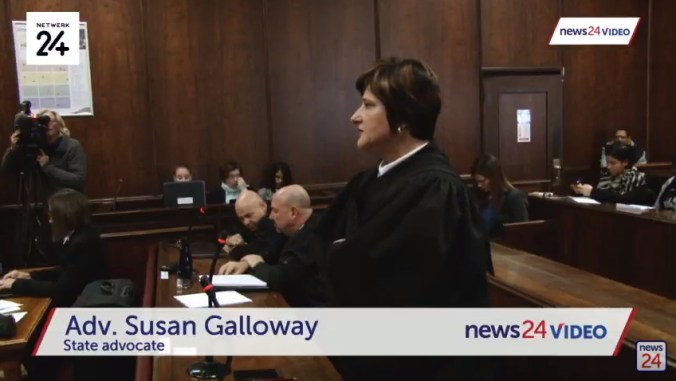
In my books on Van Breda I’ve gone into some detail why the second axe murder – of his father – is clearly premeditated. Galloway skillfully avoids getting her hands dirty in these arguments by simply stating that if the family members were all upstairs, and the axe was downstairs, it required Henri [who claimed he was also upstairs], to go downstairs in the middle of the night when everyone was asleep, collect the axe and then head upstairs and carry out the slaughter he had in mind.

I agree that this implies premeditation, just as the fact that the crime occurred when it did, at about 03:00, about three hours after a neighbour heard the sounds of raised male voices arguing.

I also feel this ought to be sufficient, except we see a mirror image of this scenario in the Oscar case. It’s not a 100% reflection, but it is similar. In Oscar’s story he got out of bed, went to the balcony door to close the curtains, heard a sound, went to retrieve his gun from under the bed [right where Reeva was supposed to be sleeping, but blanketed in impenetrable darkness].

Oscar claimed he either spoke to Reeva in a low tone, or whispered to her. In this schema he spoke to her too softly for her to hear, that’s why she didn’t answer, but in the reality of the story, Reeva wasn’t there to begin with, she was already in the toilet, and had locked the door.

The point is, like Van Breda, Oscar also had to retrieve his weapon from somewhere else, and then approach his target. Instead of a stairway, he went along a hallway, was presented with an empty bathroom, and someone inside a locked room. Oscar’s story that he’d communicated with Reeva throughout waves the flag that he’d warned her he was armed, and this was in a sense a warning shot. In Oscar’ version, Reeva’s failure to acknowledge herself cost her her life. Oscar was justified in being afraid and trigger happy, and Reeva died because she failed to raise her voice and identify herself. That’s his explanation.

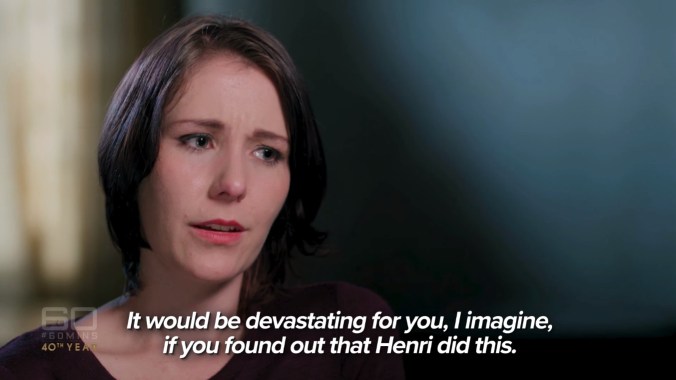
I don’t wish to conflate the two cases more than that, other than to point out Henri’s girlfriend invoked Oscar’s testimony and how Oscar was blamed when he showed emotion, and blamed when he didn’t. Danielle said in her exclusive interview with 60 Minutes that Henri was trying very hard not to fall into the same trap. But what she seems to have missed is that Oscar was found guilty of murder. It’s not as if he was innocent and his emotions were wrongly found to be inappropriate by the media. He was guilty and thus his inappropriate emotions made sense. The same applies to Henri, doesn’t it?

At face value then, Botha’s argument that the premeditation narrative is a little shaky holds some water. But for anyone familiar with this case, and applying the logic that premeditation is implicit in multiple serial killings, then Botha’s arguments are very shaky indeed. The Van Breda axe murders are almost at the scale to meet the classification for mass murder. If Marli had died, Henri would officially be regarded as a mass murderer. Even worse, a mass murderer exclusively of his own family members.

In terms of Judge Desai, he was combative and interrupting throughout Botha’s arguments. He was also scornful straight off the bat when Botha said this was merely a “circumstantial evidence” case.

The Judge is correct that most criminal cases are circumstantial evidence cases. In criminal cases, direct evidence tends to be lacking, often because the perpetrators conduct their crimes in secret, and tend to remove the direct evidence implicating them.

Examples of direct evidence are eye witnesses. A fingerprint isn’t direct evidence. In a circumstantial evidence case, a court must draw inferences based on the mosaic of information provided.

Fullscreen capture 20180814 104124

My favorite moment during the 28-minute hearing was when Galloway accused Botha of nit-picking the circumstantial evidence, causing him to miss the wood for the trees. That’s exactly what he’s done.

Fullscreen capture 20180814 104132

If I had to bet, I’d say the Judge won’t grant an appeal, because this would be little more than giving further opportunity for further fruitless nit-picking. If that happens, Botha can apply to the Supreme Court of Appeal [SCA] directly, just as Gerrie Nel did when Judge Masipa denied him leave to appeal her “shockingly light” sentence.

If the SCA refuse to grant an appeal, and they tend to be very strict in the cases they do grant leave to, Botha can apply to the Constitutional Court. Oscar did this when the SCA ruled against him. The Constitutional Court rarely rule on criminal matters, and it’s virtually inconceivable that they’d want to hear this case.

We have seen that Judge Desai has been somewhat sympathetic towards Henri. That said, he has been exceedingly patient hearing Botha’s case, even when it’s been hours and hours of much ado about nothing. Prior to sentencing, Desai repeatedly offered Botha the chance to provide evidence in mitigation of sentence. Botha and his client spurned this offer, a decision both may rue for the foreseeable future.

If Desai refuses leave, it’s also possible that in future another application may be lodged, fielding a new set of evidence. The Drugs Narrative, in my opinion, may yet be out there, but I wouldn’t count on those chickens before they hatch.

WATCH: Henri van Breda’s application for leave to appeal

Shakedown will provide an analysis of the legal arguments made here in more detail at the end of the week, prior to Judge Desai’s decision on the matter on Monday August 20th.

The Axe Murder Appeal: Rumor Control and what to expect?

Over the weekend, some media reported that Henri’s “appeal” resumes today, Monday. It doesn’t. A hearing where the Judge will decide whether to grant Henri leave to appeal will be heard tomorrow, Tuesday August 14th.  This date was agreed upon on June 25th, two weeks after Henri was sentenced to three life sentences on June 7th.

Judge Siraj Desai will hear arguments from both counsel on why his findings ought to be appealed. If the defence are able to field a reasonable amount of “new information”, and if the Judge feels there’s a reasonable prospect of success, or a reasonable case to be heard, then he’ll grant an appeal. What the court wants to avoid is simply rehearing the same case, retrying Henri effectively.

In America this is known as Double Jeopardy. According to Wikipedia’s description:

Double jeopardy is a procedural defence that prevents an accused person from being tried again on the same (or similar) charges and on the same facts, following a valid acquittal or conviction. As described by the U.S. Supreme Court in its unanimous decision one of its earliest cases dealing with double jeopardy, “the prohibition is not against being twice punished, but against being twice put in jeopardy; and the accused, whether convicted or acquitted, is equally put in jeopardy at the first trial.”

In the Oscar Pistorius case the Judge granted an appeal on her verdict of culpable homicide, the Supreme Court of Appeal [SCA] then came to a different outcome, Dolus Eventualis [murder with indirect intent]. The SCA sent the case back to the court a quo for sentencing on their verdict. Masipa then sentenced Oscar to a “light sentence”. The state again asked for leave to appeal – just the sentence – but in the second instance, Masipa refused to grant leave. So the state took the case directly to the SCA. The SCA decided to grant the appeal, heard it, and sentenced Oscar accordingly – an effective prison term of 15 years for murder.

In my view, Desai will grant the defence an appeal simply in the interests of hearing a case “to completion”. To his credit, Desai’s trial exhausted very many avenues of legal argument though, so an appeal, if it happens will be very limited in scope.

So what new evidence, and perhaps new witnesses, will the defence bring forth? We’ve already seen one of them:

Another potential witness might be Henri’s girlfriend Danielle Janse van Rensburg. Remember it was Danielle who effectively introduced the Epilepsy Narrative. She apparently was talking to Henri when he had a seizure, she then called her father, a GP, and the next thing the court was informed that Henri had epilepsy. All of this happened right at the end of the trial in November, when Desai was hoping to pronounce his verdict.

Advocate Pieter Botha left the court and the public with this cliffhanger to ponder on over the holiday season when the courts went into recess.

So the Epilepsy Narrative is likely to be fielded, I believe, as new evidence. As I tweeted in May, I believe this evidence was intentionally withheld as a defence strategy, allowing them a back door – a legal loophole – to take the case to trial. It was clear throughout most of this trial that Botha was losing this case for his client.

What do the defence hope to gain through the Epilepsy Narrative? It’s unclear. According to Henri, he blacked out after the crimes were committed. If the defense can persuade the court that epilepsy was there to begin with [something I’ve maintained throughout my book series], then this may have an impact of his memory and theoretically on his culpability.

It’s a weak defence in my view, but who knows, the court may feel curious in the face of “no motive” to find out more. Personally I think this would be a poor reason to rehear the case, but legalities aside, more might be revealed.

image

What’s interesting to note, over the past few weeks and days leading up to the leave for appeal hearing, we’ve seen a PR Narrative emerge. We’ve seen a Twitter account pop up “Support For Henri”, although if anything, this account shows how little support Henri has amongst the public. To date Henri’s support on Twitter stands at a meagre 17 souls.

We’ve seen a big effort to get the “Henri’s Innocent” narrative into the media, via Henri’s key Apologists, his aunt Leenta Nel [the sister of the murdered mother, Teresa van Breda] and Henri’s girlfriend.

According to Danielle, and what she told 60 Minutes Australia, Henri told her “everything”. Well, then why didn’t she testify in his defence at trial? Why is she talking to the international media instead? But rather than eye-opening insights during the 60 Minutes “world exclusive”, all Danielle basically did was stand by her man. She didn’t field a detailed, evidentiary argument about why he was innocent, except to use sentiment, saying the Henri she knew didn’t like to cause pain to anything. Well, his entertainment choices seemed to suggest otherwise.

Or she simply used words to say she didn’t agree with certain findings, but wasn’t able to provide real insight as to why it made sense that her knowledge was more authoritative or credible.

We also know that Stefan van der Westhuizen, his former best friend, described Henri taking him at the throat when he told Henri Marli was having second thoughts about Henri’s innocence [prior to the trial].

Stefan van der Westhuizen, who cried in court when Henri was convicted on all charges,  has gotten engaged in the meantime.

Missing from the roll is Marli. If Marli testified in Henri’s appeal, that would be something, especially if she testified as part of his defence. That Marli hasn’t participated, and all indications are that she will not, speaks volumes. Think about the credibility of a girlfriend testifying in support of her beau, while a close family member who was not only at the scene of the crime, but the only survivor of the axe attack, maintains her silence. All this while millions hang in the balance.

The Drug Narrative is unlikely to be fielded in an appeal, not by the defence at any rate. Conceivably, it could be introduced as a mitigating factor, but also as an aggravating factor. Curiously, some journalists have accepted Danielle’s “rumor control” that Henri’s drug use is all a myth [and throw in a giggle for good measure]. If Danielle says it, it must be true, right?

The Drug Narrative might be fielded by the prosecution, in the event that Desai grants the appeal. Personally I wasn’t surprised, I was shocked when the Drug Narrative was completely excised out of the court case. The fact that Henri and Danielle were arrested on drugs, Henri spent the night in jail as a result, and attended a court hearing on drugs, and yet despite this, never a word about this was whispered in court beggars belief.

Interestingly, Danielle also plays a key role in this area. When the two were arrested for dagga possession, Danielle took the rap for it. The drugs were hers, she said.

I entered into a discussion with Anthony Molyneaux about the Drug Narrative on Twitter, but I see he’s muted/removed it. Molyneaux was effectively calling the entire drug story a myth, simply because Danielle [on the eve of the leave to appeal hearing] said so.

http_prod.static9.net.au_media201807260230180725_vanbreda

To be fair, there’s not a lot of absolutely clear and verifiable evidence that Henri was a drug addict, not beyond a few tabloid articles, rumors and suggestions that he attended a drug rehab in Bellville. No drugs were found in Henri’s blood sample either, nor alcohol.

But is the absence of evidence an absence of evidence? Sometimes, often, the absence of evidence is evidence.

I’ve dealt with this aspect in detail in my books about the case. The Drug Narrative being so neatly excised from the trial narrative raises red flags, but even if Henri used dagga, that doesn’t make him a druggie. Of course, it doesn’t mean he isn’t one either. One might say, in light of “no evidence” there is no evidence.  Again, that’s the lazy approach to this case.

The Amanda Knox case also involved an extremely brutal and bloody murder inside her home, a burglar narrative, and so on. The Drugs Narrative was also neatly excised from that case, even though it was well-known Knox was using marijuana regularly, and Perugia was a hotbed for much harder drugs, like heroin and coke. In Knox’s memoir she wrote about sleeping with a coke dealer on her first train trip into Perugia.

Coming back to Van Breda, what we know is he was expelled from university, he wasn’t on a Gap Year quite as voluntarily as he claimed. We also know that because of his record, he couldn’t get into local universities either. Julian Jansen in his book refers to Henri’s university mates nicknaming him “Druggie” [page 61]. If this information wasn’t credible, the Van Breda’s could theoretically sue Jansen/Naspers for defamation. So why haven’t they? On the contrary, the Van Breda brothers are in regular and close contact with Jansen, often granting him and Media24 exclusives. If they disputed Jansen’s knowledge, some of which cites “anonymous family sources” or friends of family, surely they’d cut him off and not grant further interviews.

And yet they haven’t.

Fullscreen capture 20180813 142054

And why would anyone come up with a rumor like that in the first place? Creative license?

According to Jansen Henri “clashed repeatedly with authorities” [in Mebourne, Australia] over drug use. The drugs appeared to be the reason Henri was sent home. Jansen also cites “great discord” in the Van Breda household over drug use. What else could cause severe discord in a wealthy family? Why else would university studies be permanently suspended for an otherwise intelligent kid from a well-to-do family?

In my own family, I had a close relative who was a junkie. This person stole some of my personal possessions. You can see from the way I’ve written this, that I’d rather not identify this person, or reveal whether it’s a he or a she. Why? Because there’ a huge stigma around it, and because of our family relationship, I’d rather not worsen things for this person. So there’s a reason drug use is difficult to see; there’s a collective effort to hide it away. Family are complicit in this. Do I have evidence that this person close to me was a junkie? Like Henri, this person also spent a single night as I recall in jail when this person was caught for possession. This person also used a lot of a dagga in public, and heroin in private. This person eventually had a near death experience due to a heroin overdose; I know because I saw the tubes down the throat, and the ventilator firsthand.

As much as Molyneaux disparages the “tabloid media”, in the September 22 2016 edition of YOU magazine, reporters photographed a donkey cart driver interacting with Henri in front of Henri’s digs. This was just nine months after the incident, and prior to his arrest. When they interviewed him, the man admitted to supplying Henri with dagga on a few occasions. Here he was coming to the guy’s house in broad daylight! The tabloid admitted the man may have been lying.

But why would a tabloid purposefully make up a rumor like that, complete with a photo, in the first place? Creative license?

Some of those renting out accommodation to Henri said the rooms looked like a pigsty.

Fullscreen capture 20180813 142806

But why would the Weekend Argus purposefully make up a rumor like that, complete with a photo, in the first place? Creative license?

For me the clearest signs of the Drug Narrative are from Henri himself. Like the family member I mentioned, Henri smokes a lot of cigarettes, and in his own version, drinks a fair amount of alcohol. In his version of the crime, he has himself drinking and staying up until 03:00 while everyone else is asleep.

After the crime he chain smokes three cigarettes, he has a beer at a friend’s home, and later on asks for his father’s whisky when his uncle chaperones him through the crime scene.

The cops on the scene say Henri smelled of alcohol.

While none of this is evidence, it’s clear that even as a young 20-year-old, Henri was particularly fond of substances, including addictive substances. This isn’t absolute evidence, but it’s getting there.

I interviewed a few people who said they had witnessed Henri’s erratic behavior. He apparently removed his clothes in a parking lot, and was singing in a mall. He appeared high or intoxicated to the people who saw him. According to Molyneaux, this is hearsay I guess.

I also discussed the impacts of various drugs on criminality. I’d done similar research in the Knox case. Because I have limited experience with drugs, I wanted to know which drugs were more or less likely to cause criminal behaviour. The sources I spoke to said dagga is the least likely to spark criminal action because of its “mellowing” effect. Alcohol was cited as a good candidate, especially for it’s tendency to remove inhibitions and compromise judgement. Cocaine was seen to be another possibility, especially if mixed with alcohol, thereby inducing paranoia, but also an extraordinary clearheaded arrogance that once the crime had been committed, it could be “handled”.

It might be hearsay and speculation, but sometimes when you dig, more is revealed. Sometimes when you dig, it goes nowhere and you quickly encounter contrary evidence, such as an interest in sport, or healthy eating, or healthy relationships with clean living folks, or an affirming approach etc. You don’t get that here. You have a pattern. Drug addicts are also notorious and habitual liars. Drug addicts are used to living a lie. We saw that in the Knox case too.

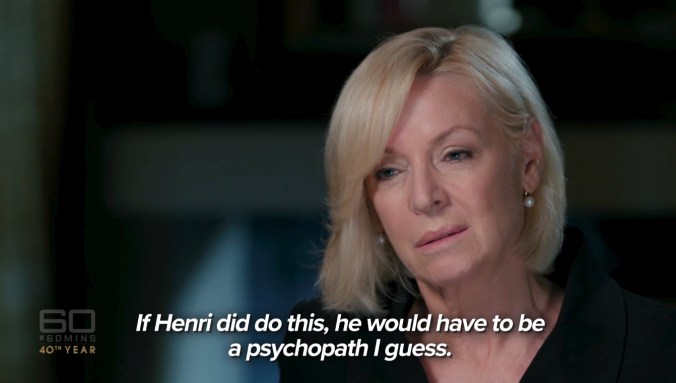
If the Drug Narrative mirrors the Epilepsy Narrative, then there’s also the Psychopath Narrative. This disturbs Danielle the most – the impression that Henri is emotionless. I think there’s a reason Henri tries so hard to hide his emotions. It’s because those same emotions empower the Drug Narrative. Some hole has to be soothed*, and so, having committed a crime, those giveaway emotions must be hidden or the real Henri will be exposed. This is why there is not one Henri in this case, but two. The Henri we see, and the Henri we don’t see.

van-breda-sentencing-3

Henri himself intuits two axe murderers, two phantoms, in his version of what happened. One he sees, and one he doesn’t see. These psychological breadcrumbs speak volumes. People who know true crime through and through, know the gold isn’t to be found at the level of what’s visible, but what’s hidden.

Perhaps an appeal will expose some of that.


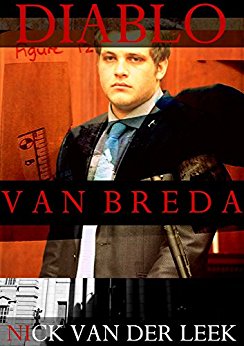
*I describe the source of Henri’s pain in Diablo, available here.

51R5jbZXt0L._SY346_

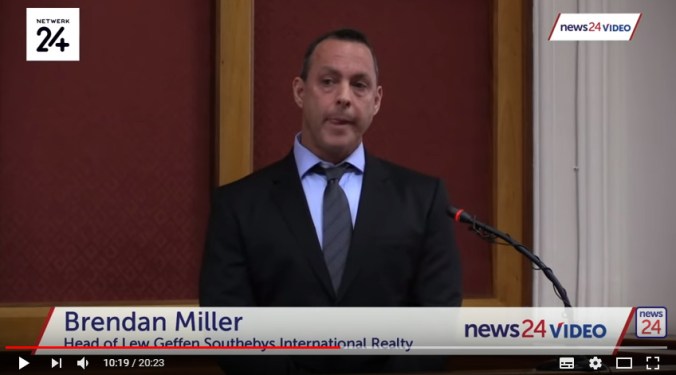
According to Brendan Miller, Susan Rohde was “calm” shortly before her death

In fairness to the prosecutor, he does challenge Miller’s version during cross-examination. Watch that moment here, transcript below.

VAN NIEKERK: The tone of voice of the late Susan Rohde, you said in your evidence this morning, ‘she was calm’. 

MILLER: Correct. It wasn’t screaming or screeching or… 

VAN NIEKERK: But…we’ve also heard the evidence from Miss Ameermia that she was agitated. Could that have been correct…?

MILLER: Could be.

Now although the prosecutor highlights – rightly – the “calm” comment from Miller, he seems to go down the wrong tangent. Isn’t it less likely that Susan would commit suicide if she was calm than if she was agitated or worse, overwrought?

Isn’t it less likely that if Susan was calm inside the hotel room, in other words, able to control herself in front of others, that she wouldn’t be able to control herself in private?

For me the observation that Susan was calm is something you’d want to reinforce, not undermine, and yet Van Niekerk does this by referring to how many drinks Miller drank and how his recollection might not be accurate.

There is so much to mine from a firsthand encounter with someone who dies shortly after, and yet all we get from this is that she wore a bathrobe, and according to Miller, approached Jason coming “halfway” down the hall.

unnamed

Farrah Ameermia was another eyewitness in Miller’s hotel room that night. She’s an attractive woman, so is Alterskye. Some of the head honchos have gathered together in the room very late at night, along with their office colleagues, very attractive women. Was this all polite, innocent fun, all round? All work, no play?

In any event, this is the version Farrah Ameermia’s gave the court in April 2018:

AMEERMIA: [Susan] called [Jason’s] name repeatedly. She was agitated; then she walked into the room‚ took him by the arm. The two left and after a while we heard a commotion outside. It seemed the two were having an argument.

What we have in this version is Susan holding herself back in terms of what she says to Jason. Jason is obstinate. He refuses to leave. Susan then walks right up to Jason, take his arm and basically makes it clear that she’s not going to let him remain in the room. And so, his hand forced, Jason leaves.

As soon as they’re out of sight, there’s an audible commotion. Jason won’t argue in front of his employees, and expects his wife, like his employees, to allow him to do as he pleases. But she won’t. And so, when forced by her to deal with him directly, he does.

Ameermia also provides further insight into Jason’s conduct in her police statement:

AMEERMIA: The door opened and it was Jason Rohde‚ quite drunk‚ entering the room. He sat on the end of the first single bed with his arms crossed. Sue Rohde‚ Jason’s wife‚ opened the door and started calling his name. She sounded agitated and wanted him to get out of the room. Jason refused and shook his head.

Susan running after Jason and Jason refusing – initially – to return to their hotel room paints a very clear scenario:

  1. Rather than being defeated or depressed, Susan is activated, fighting, fighting for her husband, fighting for her family.
  2. Susan isn’t afraid to confront Jason, but she’s still controlled enough to do so politely, inhibiting herself, and not shouting at him and making a spectacle.
  3. Jason, clearly, doesn’t want to be bossed around, doesn’t wish to be controlled, but in this situation he is forced to abide by his wife.
  4. If Jason is angry he doesn’t show it [he has his arms folded].
  5. What is more likely – that Jason, wanting to party and leave his wife in the lurch down the hall, and being denied this by his wife, kills her, perhaps while intoxicated, or that Jason willingly leaves the party and in the room makes a reasonable case that the two get divorced, his wife accepts this, goes to sleep and then quietly [leaving no note], kills herself, also careful not to wake him while she does so?

The best predictor of behavior is past behavior, and the most recent behavior we see here is Jason not wishing to acknowledge his wife. She calls his name and he refuses to move, refuses to answer. He’s immovable, despite her emotional pleas.

In her statement Ameermia claims she heard Jason and Susan arguing for 25 minutes. And yet Miller claims he didn’t hear “screaming” or “screeching”. Didn’t he? Not even loud voices?

AMEERMIA: Then the arguing stopped‚ and we all mentioned how intense it was and we all went to bed. I went to my room‚ I presume Jolene went back to hers…

This doesn’t sound like Susan was calm, but more importantly, it doesn’t sound like Jason was calm either. What’s important here is Jolene Alterskye, the mistress. Susan was trying to get Jason away from her, and succeeded. In this, she would have been calmer and more in control.

On the other hand, if Alterskye was the cause of the divorce, and the divorce was finalised that night in a civilized, reasonmable conversation, then theoretically Jason could have left his room and begun his new lease on life right then and there – with Jolene.

Perhaps he wanted to, but clearly, Susan was at the Spier hotel to physically restrain her husband, to physically hold onto him. We don’t know what Jason felt by being denied his guilty pleasure with Alterskye, but we know simply being apart from his mistress in general, let alone late at night after a few drinks, made him mad with frustration:

“All I can think of is you. I want to scream with frustration. I don’t want anything more in my life than to be with you.”

We know that on July 23rd, the day before Susan died, Jason and Jolene left the following messages:

Alterskye 10:02: “My penguin forever.”

Jason 10:47.36: “I absolutely hate it. I just want it to end.”

Jason 10:49: “Having you close is driving me crazy. Sue is driving me nuts!!!!! She follows me around like a f***ing shadow.”

Look at those words, and consider them in the context of murder as opposed to suicide:

my penguin forever

hate it

want it to end

you close driving me crazy

[Sue] a fucking shadow

#Rohde What did “Drama, but OK” actually mean?

The purpose of a court case is to get absolute clarity on evidence. The accused testifies, and then various witnesses, including experts, are ushered into court to corroborate or challenge a particular version. When all the evidence has been tested and studied to exhaustion, when everything that can be set out and clarified has been, then the court must decide on what really happened, and pronounce a verdict. Guilty, based on damning evidence, or not guilty, based either on evidence, doubt or a lack of evidence.

It’s the job of the Judge, prosecutor and defence advocate to be explicit in either making evidence absolutely clear or debunking it. Naturally there’s also an area, especially for the defence team, to murk certain issues in order to create doubt. An easy way to create doubt is to confuse or contradict a particular version, or simply to undermine it.

Van der Spuy did that by invoking the “whisky” narrative. That the officer drank whisky in the morning while taking a statement does undermine his integrity somewhat, although I’m not sure how it changes the schema of this case, or the crime scene. Brendan Miller is hardly a key witness, and it’s only because he’s testified that the whisky narrative even becomes relevant. If Miller didn’t testified, it wouldn’t have mattered what sergeant Appollis drank or didn’t drink when he took Miller’s statement.

Even so, it’s a point scored by Rhode’s defence team, and that’s a team in dire need of scoring points.

But I’d like to elucidate an area in which – I feel – everyone failed. The court failed. It occurred around the testimony Rohde’s colleague gave within hours of Susan’s death. I’ve provided a link below which opens at 9:30 into Brendan Miller’s very brief but very important testimony. The transcript is provided below the clip.

VAN DER SPUY: She [Susan] requested him [Miller’s eyes dart to Jason Rohde] to come with her as I understand it.

MILLER: Correct.

Miller sticks his tongue out very quickly as he answers this, then looks down. I don’t understand why the Judge and prosecutor didn’t challenge Miller on this aspect, or seek clarity on it. In Miller’s version, Susan arrives at his hotel room almost simultaneously with Jason, and then says his name repeatedly. But that’s not what Jason testified.

VAN DER SPUY: Are you able to comment on her [Susan’s]…condition?

MILLER: No…[speaking quietly]…she was calm, just said: “Jason…Jason…Jason…”

JUDGE: She was sorry- I didn’t hear that. She was what?

See, it’s precisely because Miller said this part quickly and under his breath that the Judge couldn’t hear him. Good for her, she interjects and asks him to clarify.

MILLER: She…just…repeated his name.

But that’s not what he said. He said:

SHE WAS CALM.

When Van Der Spuy asks the question, he uses a weird word to ask how Susan appeared: condition. It’s the word we might subconsciously associate with mental illness. The proper word to use in this instance is demeanor.  Irrespective, Miller answers – he tells the court, he shares a crucial piece of information regarding the last impression other people have of Susan. Is she shouting, is she hysterical?

SHE WAS CALM.

Now, according to Jason, she’s wasn’t calm. She was shouting at him. She was also shouting in the hallway outside the room. So why not get clarity on this? Why not read to Miller Jason’s testimony and get Miller to confirm or contradict it.

What happens here is the Judge asks for clarity and on this vital point, something that slipped out in court is left out. It’s unfortunate the prosecutor didn’t assist the court in this. One wonders whether and how often the Judge might review the livefeed herself, and perhaps get a stronger sense of what she missed during the first go round. Sort of like the action replay and television refereeing in sports. That said, the whole point of the court process is to get the information there and then, that’s why everyone has gone to the trouble to be there – to field evidence, to examine it, to test it, but none of that can happen if it’s not heard, or misheard in the first place.

Now, Miller inadvertently confirms Jason’s version, that he sat on the bed beside Alterskye, because he could only “get up” to leave if he was sat down. Interestingly, in Miller’s version, he doesn’t explicitly mention that Jason and Jolene Alterskye are sitting together on the bed. Perhaps that’s because the murder accused is sitting directly opposite from the dock, and Miller is careful to avoid eye contact during his testimony with his former boss.

Miller is also adamant that he had no idea Jason and Jolene were having an affair, but later admits he was aware, at the conference, that Jason and Susan were patching things together, and that he shared an office with Jolene Alterskye. It seems a little odd. The boss is invited to a very late night nightcap by his colleague, and who is there, his mistress. Didn’t Miller know about it, and if Jason was patching things up, and Susan, was there, wasn’t it a really bad idea to have the drinking in the room setup setup in the first place?

It’s possible Miller had no choice in the matter – at that stage Jason was the boss, and both he and Jolene were Jason’s employees. Perhaps Jason had asked a few of them to set up the afterparty, and they simply did as they were told. Since Susan arrived on the scene in a bathrobe, one can assume Jason slipped out just as Susan was about to take a bath, or have a shower.

It’s unfortunate Miller wasn’t questioned on whether he noticed Susan’s hair, or their ends, were slightly wet or not.  In any event, if Jason wished to escape the hotel room even for a few minutes, while Susan was in the bathroom was perhaps his best chance. When this tiny perk was denied him, did he do a nuclear flip?

Returning to the transcript:

VAN DER SPUY: And did he [Jason] say anything to her?

MILLER: No, he just got up and left.

VAN DER SPUY: You had offered him a drink, you said?

MILLER: Correct.

VAN DER SPUY: Did you pour him a drink; did he accept a drink?

MILLER: No, he left before I could pour.

This is quite ironic. Jason doesn’t have a drink, and thus leaves the hotel room sober and clear-headed. The policeman does have a drink, and thus leaves Miller’s home compromised, along with his statement.

The fact that Jason left the room as quickly as he did suggests Susan didn’t just say his name, but told him to return to their room. Would she have screamed at him, or, having come out of the bathroom almost the second she went him, and having followed Jason not to Alterskye’s room, but another room, all that was necessary was to show herself, and Jason knew the game was up.

At 11:23:35 the previous morning, Susan had WhatsApped Jason her unambiguous feelings:

“You are a devious f***ing bastard!!!!!”

VAN DER SPUY: Once they left, what happened then?

MILLER: Then…[glances down]…they-they-they left and…I think Farrow looked outside the door to see if they were still outside, or if they’d left [sticks tongue out, glances quickly at Jason]…that they were not there. And [shake head] we just carried on chatting.

Fullscreen capture 20180809 134959Fullscreen capture 20180703 204802Fullscreen capture 20180809 134936

Fullscreen capture 20180703 204809Fullscreen capture 20180809 135011

I’m not sure what the sucking in of the lips means, but it seems to be associated with someone wanting information and a sort of facial shrug, as if to say, “Sorry, can’t help you.” [But maybe I’m not so sorry.]

VAN DER SPUY: Um…how would you describe the atmosphere? 

MILLER: A little bit tense…um…everyone was just very quiet.

But that’s not how Jason described it. Jason described it as “very, very” tense, and besides that “awkward” and “embarrassing”.

The “intensity” of the day prior to her death, and the last time others saw her alive, is another vital area to get to grips with. Exactly how intense was it? Why would it be tense? One reason is Susan arriving at a room where everyone is dressed, and everyone is an employee of her husband’s, ought to provide some depth to this sense, but then flesh it out.

The texts between Jason, Susan and Jolene also provide crucial insight into just how fraught the situation was between them. I also believe Jason selectively deleted some messages sent by his wife, and some of his own, leaving behind a slightly distorted picture.

Fullscreen capture 20180809 140424

Van der Spuy asks whether anyone opened the door to check whether Jason and Susan were there. Miller’s not sure. Strange. He’s just said “I think she looked out the door”.

VAN DER SPUY: Did you do anything after that?

MILLER: No, a little while later…after they left…I sent…um…Mr Rohde an SMS  to ask if he was okay.

During the later half of this sentence, someone coughs loudly so it’s hard to make out what Miller said, or who coughed.

VAN DER SPUY: Okay, you sent him an SMS. What did you say in the SMS?

MILLER: I [looks down]…I think I said ‘all okay?’ or ‘are you okay’?

VAN DER SPUY: Right. Did you get a reply?

MILLER: The next morning, after seven.

VAN DER SPUY: I think it’s common cause that you got a reply. Can you remember what he said in the reply.

MILLER [Glances at the prosecutor]: Drama [shakes head], but okay.

I haven’t been able to establish exactly when Miller sent his message to Jason, but it was clearly around 02:00 or 03:00. I haven’t been able to establish when Jason responded, other than that it was roughly after 07:00. Again, it’s frustrating that the Judge and prosecutor can’t nail down these absolutely crucial details.

This is why. Let’s engage a in a brief thought experiment. In Version 1, Jason heads to his room like a good boy, he tells Susan he wants to get a divorce when they go back to Joburg, both sleep soundly and then the next morning, around the time Susan is killing herself, he texts Miller:

Drama, but okay.

In Version 2, Jason heads to his room like a bad boy, and he decides to get a divorce from Susan then and there. He’s been embarrassed in public by her for the last time. The texts sent between the two suggest [from Susan] that only hours earlier Jason had threatened Susan in some way.

Fullscreen capture 20180809 140424-001

All those exclamation marks suggest it was a threat way beyond “I’m going to divorce you”. Prior to that text, almost ninety minutes prior in fact, is another text where Susan is already clear that they’re getting divorced.

Fullscreen capture 20180809 141919

Jason’s response then, if anything, is to calm her down, walk her back on the idea of divorce. He’s certainly not confirming or reinforcing the statement. Later he tells her to pack her bags, but it’s still not about divorce. I think one reason for this may be because their home in Johannesburg [worth over $10 million] was in Susan’s name. If he divorced Susan he might lose a sizable asset.

It’s also worth noting Miller’s own body language when he testifies “drama” [shakes his head] but okay.

In Version 2 there’s the possibility that while Jason’s blood was up, he acted on his feelings, and took them out on Susan. While doing so, Miller sent him a message. Jason only answered this message several hours later. Either Jason was busy murdering Susan when this message was sent [which is why when it was sent matters], or he was asleep.

If Jason was murdering Susan while the message arrived on his phone, and if there was a lot of frantic staging and covering up afterwards, including deleting messages off her and his phone [I explained how he could do this in another blog post] and even Alterskye’s phone, then we can understand how, once it was all done, he might say:

DRAMA, BUT OK

In other words, what were the chances Jason sent that message after Susan was dead, and thought of her murder as drama, but also okay.

The alternative is that Jason’s version is true. The couple argued, even exchanged blows, Jason then went to sleep, got up, cleaned himself up, and then – unbeknownst to him Susan had committed suicide hours after their argument [not in the heat of the moment] – and Jason understood the whole situation as drama, but okay.

But it wasn’t okay, Susan was dead.

In Version 2, we can see how Jason knowing Susan was dead could be “okay” now. It was done, but everything was prepared, and from now on things would be better. Or okay. In Version 1, which is Jason’s version, there was just drama, even though he’d told his wife they were definitely getting divorced. If that was the case, why would things be “okay”? Why not say, “not great”, or “Susan’s very upset about last night” and we’re getting a divorce?

How could things be okay?

Miller’s testimony is doubtful because in the same breath that he says Jason [and Jason and Susan] were A little bit tense…um…everyone was just very quiet he’s also concerned enough to send a very late night message. We don’t know exactly when it was, but probably close to 03:00. Miller had to be fairly familiar with Jason to do this, and risk waking him up.

A little bit tense

everyone was just very quiet

DRAMA, BUT OK

Van Breda on 60 Minutes: Screengrabs of the Crime Scene

Fullscreen capture 20180730 030858Fullscreen capture 20180730 031348Fullscreen capture 20180730 031401Fullscreen capture 20180730 031413Fullscreen capture 20180730 031439Fullscreen capture 20180730 031444Fullscreen capture 20180730 031457Fullscreen capture 20180730 031522Fullscreen capture 20180730 031544Fullscreen capture 20180730 031614Fullscreen capture 20180730 031619Fullscreen capture 20180730 031632Fullscreen capture 20180730 031642Fullscreen capture 20180730 031651Fullscreen capture 20180730 031704Fullscreen capture 20180730 031749Fullscreen capture 20180730 031800Fullscreen capture 20180730 031838Fullscreen capture 20180730 031851Fullscreen capture 20180730 031853Fullscreen capture 20180730 031902Fullscreen capture 20180730 031905Fullscreen capture 20180730 031914Fullscreen capture 20180730 031920Fullscreen capture 20180730 031923Fullscreen capture 20180730 032009

I reached out to a few friends in Australia to ask them to watch the show. 60 Minutes also put some footage on their Facebook page [see links below].

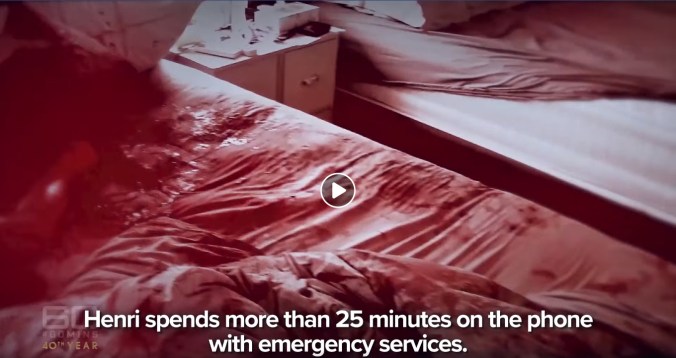
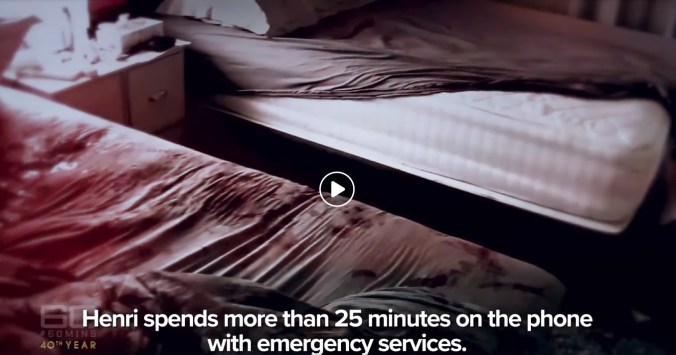
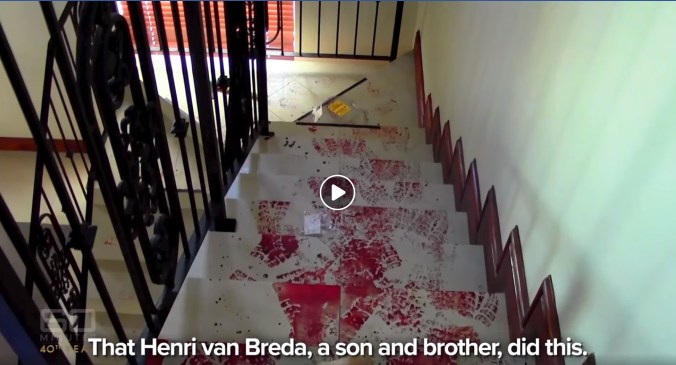
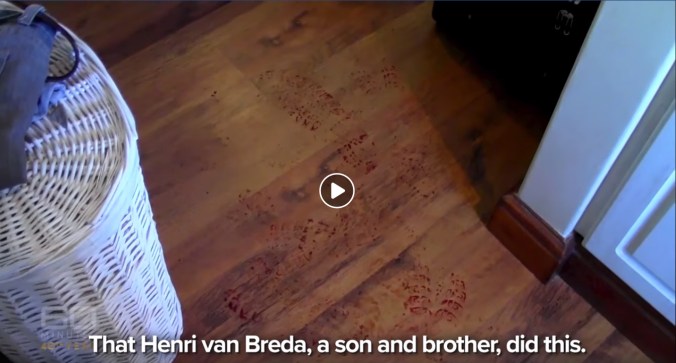
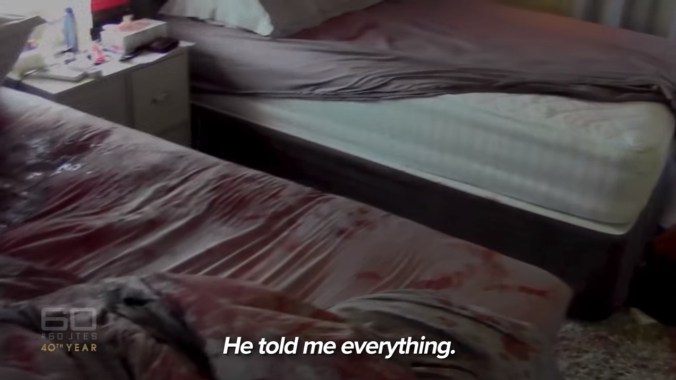
This is the first time the South African public have had access to the crime scene footage. Personally I was surprised by how pink the blood appears in the footage. When I saw the previews, my photographer’s eye wondered whether this was a staged crime scene meant to resemble the real one, for drammatic purposes. But it’s the real thing.

When I sat in court Sergeant Apollis [who is interviewed by 60 Minutes] scrolled through the crime scene images on his laptop. I saw these images over his shoulder from about 2 metres away. From where I was sitting I was surprised by the lack of blood. Although the boy’s bedroom is very bloody, the staircase isn’t nearly as slick as I imagined it, and certainly doesn’t conjure the paramedic’s description of a “waterfall of blood” coming down the stairs.

The amount of contaminated boot-prints on the scene is also shocking, but it goes to show, if the cops left bloodied shoe-prints everywhere, why wouldn’t Henri leave any footprints, even if he was innocent?

The brown shoes at the bottom of the stairs had blood on them too. When Henri was asked to explain how the blood landed on his shoes, he said they may have dripped off the stairs. From the images this hardly seems possible.

The blood on the axe also looks very pink compared to some of crime scene images of the axe that have been released.

In terms of Danielle, Henri’s girlfriend, I can’t say I’m surprised to hear her punting the epilepsy narrative. In court one senses this was purposefully held back in order to give it a proper go round in an appeal. If that’s the best the defence case has going for it, they’re in deep trouble.

Danielle’s rebuff of the defensive wounds wasn’t very convincing either.

The aunt, Leenta Nel whose sister was murdered in the attack, has been an apologist for her nephew since day one. Nel basically says it all when she says “I can’t think”. She says “it’s too terrible to contemplate” and refers to there being “no motive in her mind”. That’s the problem though, isn’t it? It’s the failure to think about it, also because you won’t think about it. And since you won’t think, can’t think, you solve the problem by inventing an easy solution that makes even less sense. He’s not guilty. But if he’s not guilty, someone else is. What’s the explanation for that? There isn’t one, but who cares.

The “no motive” narrative was a weakness of the state’s case, and also a weakness of the media narrative. The Judge raised this as a key problem with the trial narrative. That’s why in my 5 part series, I focused entirely on this apparently unknown and supposedly inexplicable aspect. It’s hardly unknown or unknowable when one begins to dig into Henri’s identity, his personality, his backstory, and the family dynamics. It helps to think in order to understand. Of course, money can muddle the mind, especially when one’s “support” might be rewarded, where one’s failure to think critically can make you rich.

https://www.facebook.com/plugins/video.php?href=https%3A%2F%2Fwww.facebook.com%2F60Minutes9%2Fvideos%2F1712053872197254%2F&show_text=0&width=560

https://www.facebook.com/plugins/video.php?href=https%3A%2F%2Fwww.facebook.com%2F60Minutes9%2Fvideos%2F1712293978839910%2F&show_text=0&width=560

Visit and purchase Indefensible at this link.

C1JQ5yGYbSS._SL250_FMpng_

The Media as a Co-Conspirator in the Van Breda case

Henri van Breda’s appeal was originally scheduled for late June 2018. It was then postponed to August 14th, 2018. Two weeks before that day, just long enough for the media message to soak in, Australia’s 60 minutes will do what they called a “world exclusive” on the story.

Australia’s Liz Hayes has, they say,  been given unprecedented access to the Henri van Breda murder files. That’s interesting because when I went to the registrar of the Western Cape High Court in person and with a fellow researcher, on more than one occasion including in late June, we were denied access. When I called, we were told the files were sealed until after the appeal. Only a few days ago, when I mentioned the status of the court files to another senior journalist covering the case, who has also written a book on the case, he’d experienced the same thing. The court files – unusually – still aren’t available for public consumption.

Which is why this is so weird:

60 Minutes reporter Liz Hayes is given unprecedented access to the Henri van Breda murder files…

f9c3a6d396144615be5f0d795044d35f

Now I know the media were allowed a brief peek at the files while the court case was underway. No photos or video cameras were allowed. The media were allowed a few minutes to page through the file in court. So the suggestion that overseas media got “unprecedented” and privileged access to the court feels like grammatical license, or something worse.

60 minutes is clever in the way they suck the viewer into the premise. They pretend to be showing the gory crime scene in all its detail for the first time and then pretend they’re going to be asking why Henri committed the crimes.

I haven’t seen the documentary, but I wonder what footage they have? As part of my research for Indefensible, I contacted Warrant Officer Andrè Hitchcock, the police videographer who took the video inside the crime scene, and also discussed this footage with the prosecutor. I wasn’t allowed to see it until it was officially released by the court. This footage was shown in court last year in June, early on when the state pled their case and fielded their evidence. But it remains in the care and custody of the court.

More likely, in my opinion, they’ll use the little footage there is of the axe from police evidence, but the real story is this: not why Henri did it, but why he didn’t.

According to 9News.com.au:

On 60 Minutes, Hayes also speaks exclusively with van Breda’s girlfriend Danielle Janse van Rensburg, and his aunt Leenta Nell. They explain why they refuse to believe Henri is guilty.

All of this has been a carefully contrived and plotted dance between the media and the mass murderer – and his affilitates, in order to gain maximum traction just before the appeal trial. The idea is to sow seeds of sympathy with an international audience, and obviously, local media will cover the “revelations” as well.

Interestingly, neither Henri’s girlfriend nor his aunt testified at trial, not even in mitigation of sentence. So one has to wonder, why should the “exclusive” media narrative now be better, more convincing, or less biased than the evidence led in court?

It’s an influence campaign, aided and abetted by the media, to make the sentimental case that “the Henri I know would never do this…” Then who did? The Henri they didn’t know? The hardcore Henri that Henri’s hidden away?

http_prod.static9.net.au_media201807260230180725_vanbreda4

The 60 minutes exclusive on Sunday 29th July will nevertheless be interesting to watch to see how Henri’s closest family rationalise his crimes – if not to court, and perhaps not even to themselves, but to a media made to appear credible on the facts of the case.

The most reviewed and in-depth narrative on the Van Breda is available on Amazon.com.

C1JQ5yGYbSS._SL250_FMpng_

JonBenet Ramsey: The Polygraph Ploy

How does a lawyer go about reining in the media?  Well, by giving a press conference and telling the Ramsey’s polygraph story in his own words.

From cnn.com:

And I retained the services of an individual who was represented to me to be competent, qualified and fair: a gentleman by the name of Jerry Toriello, T-O-R-I-E-L-L-O, of Clifton, New Jersey. Jerry Toriello is not able to be here today. He had a minor surgical procedure on Friday and is not able to travel until the end of this week. Otherwise, Jerry Toriello would have been here.

Consistent with their honesty and their candor, I will tell you that John and Patsy Ramsey, when tested by Jerry Toriello, ran what is referred to in the field as inconclusive charts, inconclusive examinations. Jerry Toriello recommended that John and Patsy be retested.

For those familiar with our prior trilogies, the excerpts Wood touches on will ring a bell.  It’s important to rehash them in the sense of providing the complete transcript, simply so one can see the subtlety within the full context.

From cnn.com:

Former Boulder Detective Steve Thomas stated: “John, one of the things, as you know better than anybody, at some point, if you’re not involved in this, we’ve got to take you out of the bucket. And you’ve been in it for four months and you certainly know why you’re in that bucket, is you’re in the house, and I don’t need to say anything more than that. But — and I asked this question of Patsy and where it might come out as, but I’ll ask it. And I’m not asking you to take one, but if you were to take a polygraph, how would you do?”

John Ramsey stated in April of 1997: “Well, what I’ve been told is that — and I felt tremendous guilt after we lost JonBenét because I had not protected her, like I failed as a parent, and was told that that kind of emotion, you shouldn’t take a lie detector test because you did not — because you did have that guilt feeling. So I don’t know about the test, but I did not kill my daughter, if that’s what you want to ask me. She was the most precious thing to me in the world. So if the lie detector test is correct, and if it is done correct, I’d pass it 100 percent.”

Steve Thomas went on to say, “Well, I’ll ask you point blank: At some point in this, would you take a polygraph?”

John Ramsey answered, “I would be insulted if you asked me to take a polygraph test, frankly. I mean, if you haven’t talked to enough people, we’re telling you what kind of people we are. You guys — I mean, I’ll do whatever these guys recommend to me to do. We are not the kind of people you’re trying to make us out to be.”

 That’s an official transcript of the questions that were asked of John Ramsey with respect to a lie detector or polygraph exam in April of 1997.

Patsy Ramsey was asked the following question: Patsy said, first: “What does it take to move past me?”  Steve Thomas said, “Well, let me ask you this. And I know Pat Burke who was there – Patsy’s lawyer – “going to jump all over me. And I know — well, let me ask you this way. I’m not asking you to take one, but, hypothetically, if you took a polygraph, how would you do?”

Patsy Ramsey stated: “I’m telling you the truth. I would — I mean, I don’t know how those things work, but if they tell the truth, I’m telling the truth. I’ve never, ever given anybody a reason to think otherwise. I want to find out who did this, period.”

Steve Thomas: “Does that mean, yes, you’d pass it?”

Patsy Ramsey said, “Yes, I would pass it. I’ll take 10 of them. I don’t care. You know, do whatever you want.”

In June of 1998, John and Patsy Ramsey again spent time asking — questions with Boulder authorities. They again voluntarily agreed to answer questions, this time for three full days each. Interrogation for three full days in June of 1998 and not one word was asked, not one mention was made about a polygraph examination. In fact, from April of 1997 when they were interrogated by former Detective Thomas, until April of 2000, three years later, not one mention, not one request, no discussion from the Boulder Police or the Boulder D.A. about a lie detector or polygraph examination.

I’m not sure if that’s entirely accurate.  Thomas refers to a Team Ramsey lawyer that was “going to jump all over him” if he asked about lie detector tests, and John said he was insulted by the question.  Thomas asked them anyway.  Why would it be necessary to cover the same ground a second time in a follow-up interview, particularly if it was such a contentious subject?

As it turns out in a press conference with media on May 1st 1997 the polygraph question came up.

From acandyrose.com:

REPORTER: John, what do you say to people who raise questions and criticize and say no amount of advice from any number of attorneys would have kept me from talking and telling them every bit of information I had … this criticism came from Polly Klaas’s father … that you wouldn’t take a lie detector test, that you would have …

JOHN:  We have spoken to the police, we spoke with the police approximately eight hours on the 26th, another two hours on the 27th (and) have supplied them with every piece of information we have, so the question that we haven’t spoken to the police is totally false. What we have but what has been delayed, has been this formal interrogation of us as suspects. And frankly, we, we were as you might imagine, insulted that we would even be considered suspects in the death of our daughter and felt that an interrogation of us was a waste of our time and a waste of the police’s time. But because we have to do this, we had to do it. But not under any circumstance that was presented to us.

Does John even mention a lie detector test in his answer? He mentions being insulted to be considered suspects and the delay of a formal interrogation but nothing about willingness or unwillingness to take a lie detector test.  He simply avoids answering the question altogether.

Back to Lin Wood.

From cnn.com:

In March of this year [2000], John and Patsy had their book published, “The Death of Innocence,” and they agreed to and undertook to, engaged in media interviews. And just as they had done back in April of 1997 and in June of 1998, they answered every question, and they answered every question honestly.

And in defiance of their lawyers’ advice to avoid getting embroiled in the polygraph controversy, counseled against it, but relying on their innocence and their honesty, John and Patsy Ramsey said in response to the media inquiries — if asked, would you take a polygraph examination? — they said, yes. Their only condition was that it be fair, that it be conducted by an examiner independent from the Boulder Police Department and its investigation, and that the results, whatever they may be, would be made public.

The condition is actually broader than that; that the test not be administered by the FBI, which was what the Boulder police wanted but the Ramseys would not abide.

From cnn.com:

So that there is no future misunderstanding about this fact, John and Patsy Ramsey, at the time they made those statements on national television, had never taken a polygraph examination. They did not even have a basic understanding of how such an examination worked.

Why is it necessary to say that?  Why would you need to know how a polygraph worked if one were innocent and are trying to confirm one’s innocence?

From cnn.com:

On April the 11th of this year [2000], I learned from several phone calls from the media that the Boulder Police Department had apparently issued a press release, that Chief Mark Beckner had issued a press statement saying that he was going to accept the Ramseys’ offer and wanted them to appear by a date certain to submit themselves to an FBI polygraph examination.

That’s funny, I thought Lin Wood issued a press statement and an answer.  The way Wood phrases it, it sounds like the Boulder police went behind his back and issued an unexpected press release.  This makes the Boulder police seem disingenuous because the communication is indirect, and thus – potentially – strategic.  But isn’t that precisely how Team Ramsey played it?  Via the media?

From cnn.com:

I actually thought when I received the letter — despite the fact that it was publicized before I got it, I actually thought that perhaps Chief Beckner would, with some discussions and negotiations, actually be willing to allow John and Patsy Ramsey to take a truly fair and independent polygraph examination. And I did at that time what had not been done before, but what I believe any good attorney would do, and I then arranged for John and Patsy to be privately tested.

Again, Wood’s making subtle and not so subtle aspersions about Chief Beckner’s integrity.

From CNN:

 I called Dr. Gelb [again] and asked if, in fact, he would be retained by me to perform the polygraph examinations. I also upon, his agreement, retained Cleve Baxter from San Diego, California. I had been told that if you want the best quality control review of a polygraph examination in the United States call Cleve Baxter. Cleve Baxter is the originator of the Baxter Zone Comparison Technique, and the originator of the numerical scoring system for polygraph examinations, both of which are now standard protocol in the field of polygraphy. This is the gentleman thought to be, literally, the father of the modern polygraph testing techniques, Cleve Baxter. He agreed to do to quality control of Dr. Gelb’s test.

In other words, Gelb and Baxter were like Homer and Marge Simspon, and the FBI was like Bart in the hierarchical superstructure of lie detection?

From CNN:

John and Patsy Ramsey made a commitment to the public. They made a public commitment to take a fair and independent polygraph examination and to make the results public. They had hoped and we tried to get the Boulder Police Department to participate in a truly fair and independent examination.

If it was truly fair, wouldn’t you simply have the police conduct a test?  If not the Boulder police, then the police at some other precinct?  Why this whole private affair with lawyers brokering the whole process, and then at the appropriate time private becomes public?  Why not do it on live television if it’s so transparent, and so public?

From CNN:

We offered for the examination to be conducted by a non-FBI examiner with FBI oversight of the entire process. That offer was rejected. We offered to have the FBI polygraph group come up with a list of non-FBI polygraph examiners that they felt were reliable, qualified, and trustworthy, and we would pick one of those examiners, and we would take the test, and that offer was rejected.

At least Lin Wood admits – right at the end of his spiel – how the FBI were selectively excluded.  What the fuck is a non-FBI polygraph examiner?  Seriously.  How does anyone offer the FBI an opportunity to select a non-FBI polygraph examiner, and call that credible in any universe?

From CNN:

My belief has been from very early on in this process that Boulder Police Department never intended to allow John and Patsy Ramsey to take a truly fair and independent polygraph examination in which they would participate. And my belief was confirmed May 16, when Mark Beckner rejected the offer of the American Polygraph Association to provide an examiner and a test that would be fair to both sides.

John and Patsy Ramsey are here today to honor their commitment. I would now like to ask Dr. Gelb to address for you the test that was performed by him and the results of those tests — Dr. Gelb.

I deal with the questions and results of those tests in the next instalment of the Black Star series.


Is there a link between Stephany Flores Ramirez’s death and Natalie Holloway’s?

On the five-year anniversary of Holloway’s [likely] death, Stephany Flores Ramirez, a 21-year-old, was bludgeoned in a hotel room in Lima, Peru.  A week after Ramirez’s murder, van der Sloot confessed to the crime, and subsequently retracted his confession.

From Wikipedia:

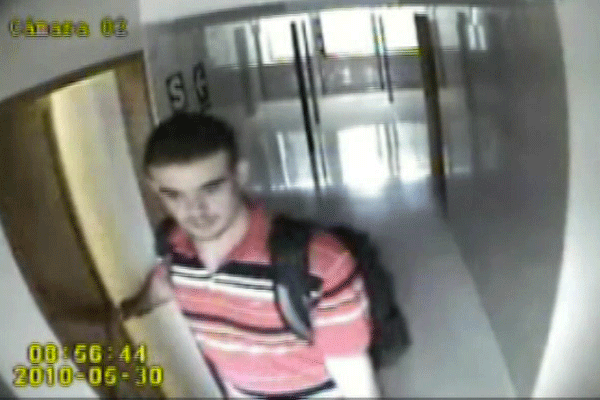
[Two days after her murder] on 2 June [2010], a hotel employee found her beaten body in Room 309, which had been registered in van der Sloot’s name. He had departed from the hotel without returning the room key and left the television running. A tennis racquet, identified by the coroner as a possible homicide weapon, was recovered from the room. A hotel guest and an employee came forward to say they saw van der Sloot and the victim entering the hotel room together, and the police obtained video of the two playing cards at the same table the night before at the Atlantic City Casino in Lima. Van der Sloot [a gambler] had entered Peru via Colombia on 14 May 2010 to attend the Latin American Poker Tour.

So…did the fact that Ramirez was found dead in van der Sloot’s hotel room suggest in any way that van der Sloot may have been involved?  Of course it fucking did!

From Wikipedia:

Flores Ramírez was a business student less than a year from graduation at the University of Lima. She was the daughter of Ricardo Flores, a former president of the Peruvian Automobile Club and winner of the “Caminos del Inca” rally in 1991. A prominent businessman and entertainment organizer, he ran for vice president in 2001 and for president five years later on fringe tickets.

In other words, he was a big deal, and he was wealthy.

From Wikipedia:

Flores said that police found date rape drugs in his daughter’s car, parked about 50 blocks from the hotel where she died. Her jewelry, money, ID and credit cards were missing, including about $1,000 her father had given her to purchase a laptop, and over $10,000 she had won earlier at the casino. Stephany reportedly kept this money in her car, but a police search found no money in it.

What was van der Sloot – a gambler’s – motive?  Was it sex?  Was that why he murdered Holloway?  Or was it something else?  Holloway’s stepfather [Beth Twitty’s second husband] was a prominent Alabama businessman.  Why target Natalee as opposed to the other 124 students and seven chaperones that were visiting Aruba then? One possibility could be the clothing and jewelry the teenager sported may have attracted a greedy predator.  Accounts from friends also suggested Holloway was drunk when she left the bar, Carlos n Charlies, provoking perhaps a similar circumstance and fate for the American as befell Birna Brjansdottir, the recently murdered 20 year old Icelandic sales assistant*.

If surveillance footage was mysteriously missing in the Aruba case, no such luck for van der Sloot in Peru five years later.

From Wikipedia:

After Flores Ramírez’s family reported her missing, police retrieved the hotel surveillance tape and obtained van der Sloot’s name and national identification number. Her brother’s wife discovered van der Sloot’s background in a Google search about an hour before her body was found.

Peruvian officials named Van der Sloot as the lone suspect in the homicide investigation… On 3 June, Van der Sloot was arrested near Curacaví by the Investigations Police of Chile while traveling in a rented taxi on Highway 68 between the coastal city of Viña del Mar and the capital Santiago.  He was found with a laptop, foreign currency, a business card case, detailed charts of ocean currents around Lima, and bloody clothes. His phone’s SIM card was missing, which made mobile phone tracking of his location impossible. He told Chilean police that unidentified armed robbers hid in the hotel room and killed Flores Ramírez when she disobeyed their order to be quiet.

This was van der Sloot’s “intruder narrative.”  Unfortunately for van der Sloot, the hotel’s surveillance footage left little room to dodge.

From Wikipedia:

Surveillance video from the Atlantic City Casino recorded Flores Ramírez winning $10,000 at a baccarat table area on 25 May 2010, while accompanied by a male friend who was not Van der Sloot. According to casino spokesperson Luis Laos, she also won $237 playing poker on 29 May and it was common for people to know the identities of big winners. Laos stated that van der Sloot did not win any money that night. At 3:00 a.m. on 30 May, Flores Ramírez was recorded entering the casino alone and walking to a poker table where Van der Sloot was sitting. Van der Sloot had not registered for the Latin American Poker Tour. The deadline to pay the $2,700 entry fee for the 2 June event at the casino was 30 May.

Without knowing it, Flores Ramirez had wandered into a psychological labyrinth.  On the fifth anniversary of Holloway’s death/disappearance [if van der Sloot was guilty he must have seen it as a feather in his cap on that night of all nights].  Desperate to enter the Poker Tour but down on his luck, van der Sloot was trying to gamble up the entry fee.  Flores Ramirez presented herself and perhaps her reputation preceded her, or she confided in van der Sloot directly, thus sealing her fate.

From Wikipedia:

Police released hotel security video showing Van der Sloot and Flores Ramírez entering the Hotel TAC together at about 5:00 a.m. on 30 May. At about 8:10 a.m., [van der Sloot] is shown walking across the street to a supermarket and returning with bread and two cups of coffee. Around 8:45 a.m., he is seen leaving the hotel alone with his bags.

An autopsy ruled that Flores Ramírez did not have sexual intercourse before her death and that she was not under the influence of enough alcohol to prevent her from resisting an attack. She suffered blunt force trauma to her head, causing a brain hemorrhage, cranial fracture, and breaking her neck. She also suffered significant injuries to her face and showed signs of asphyxiation, according to court documents.

*Birna Brjansdottir was murdered by two sailors from Greenland.