Modelling Reeva’s Fall Behind the Door

Here’s the proof! Reeva Steenkamp fell to her left as she was shot, and what it means changes everything…by Nick van der Leek

When an eye doctor asks you to look at a chart, it’s first with one eye covered, then the other eye covered.  This is to make sure your vision is 20/20 in both eyes. The danger in seeing with both eyes at the same time, is that one might fill in details that aren’t actually there, but you think they are.

That’s what happened in this case. The analogy for looking at the chart of letters with both eyes is the crime scene, with Reeva’s blood explicitly dripping all over the toilet.

893204223

The message, in scarlet letters is simple and obvious: Reeva died while sitting on the toilet/Reeva was found dead lying slumped over the toilet.

Fullscreen capture 20180124 122502

Reeva Steenkamp [Toni Garrn] after being shot inside the cubicle, as presented in the 2017 film Blade Runner Killer.

In the analysis below, I cover one “eye” of the narrative, and then the other “eye”, before revealing an extraordinary new truth, and one that changes everything.

MUCH ADO ABOUT FLAWED “TWO-EYED” RECONSTRUCTIONS

Channel 7 did the first fully-fledged reconstruction of the entire crime scene when their exclusive documentary premiered on Australian television on Sunday July 6th, 2014. I remember that day because it was the coldest night of the year in South Africa, and I was recording a radio interview on my research into the Pistorius case that Sunday evening with OFM’s Johrne van Huysteen.

But Channel 7’s was hardly the only reconstruction. The first reconstruction wasn’t done by Channel 7, who got it from The Evidence Room [hired by Team Pistorius in October 2013].

The first reconstruction was done by the police.

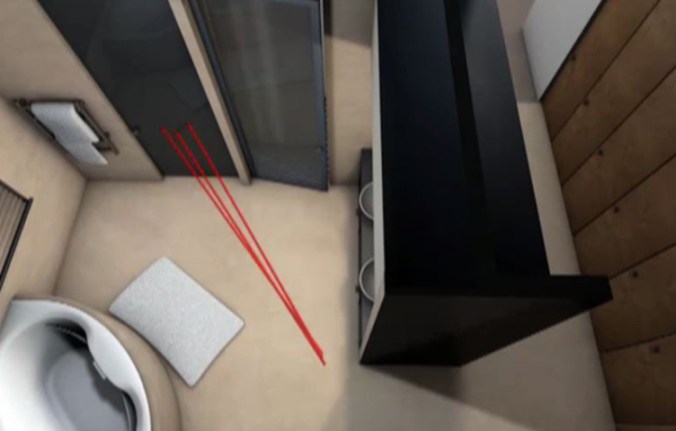
ss-140325-pistorius-bathroom-laser.nbcnews-ux-1024-900

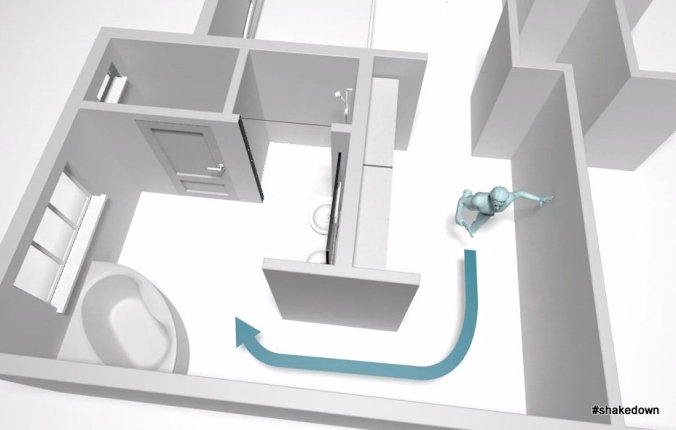
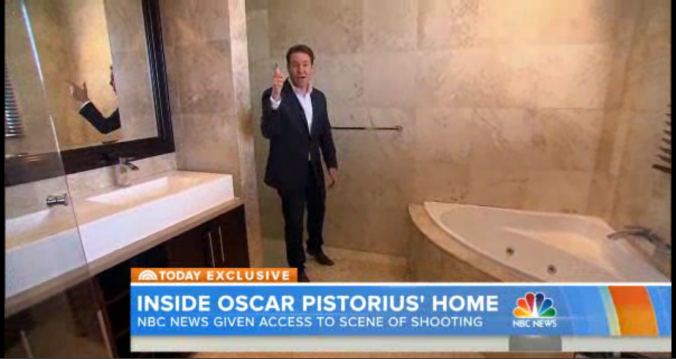
Note the toilet  door has been pieced together with the blood evidence still in place. The window blinds are down and the slats closed in this in situ reconstruction. The toilet cubicle light didn’t work. The lazer scanner is positioned approximately hip height, right beside the entrance wall to the bathroom. From this perspective, with the door open, the angle of the bullet through the door is difficult to appreciate.

In hindsight, we may not think much of it, but if the cops didn’t salvage the door, the planks, the detritus and fragments, if they didn’t confiscate the door and reassemble it, we might never have found out what really happened to Reeva behind the door.

If the cops accepted Oscar’s tears and his bullshit story, if they didn’t suspect Oscar to begin with, [and let’s face it, he was a beloved South African celebrity at the time] the precise mathematics recorded when 4 bullets zipped through those fibres may have been lost forever.

Arguably, the official Dolus Eventualis verdict handed down by the Supreme Court of Appeal in December 2015 confirms that we’re still in the dark not only about what happened and why, but we’re still no closer to knowing how Reeva was shot.

ANIMATION THE “HOLY GRAIL”

Through various narratives and lines of inquiry I’ve followed, I’ve endeavoured to change that, and I’m satisfied I’ve made progress in terms of providing insight into the why and the what of this case.

For some time, however, I’ve maintained that the Holy Grail in this case was to animate the scene using the precise mathematics – the geometry of angles and trajectories – and matching these to the autopsy evidence, and allowing the science of gravity and falling bodies to colour in the rest.

room-rot

An authentic, high quality render would reveal the pace of the shots, and precisely how Reeva reacted to them and where she came to rest in the cubicle.

Intuitively I’ve always felt Reeva did not land with her head on the toilet, as per Oscar’s and Mangena’s versions.
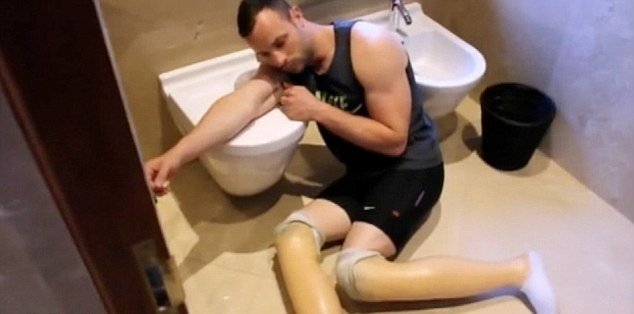
oscar-pistorius

“Intuitively” may sound wishy washy, but it’s that same instinctive “gut-feel” that drove the cops to remove the door from its hinges, collect the planks and splinters, and test the evidence against Oscar’s version of events.  They could just as easily have taken Oscar’s word for it, just as Masipa did. So don’t be too quick to dismiss intuition.

Despite my intuitions, and despite sketching the scene, researching the trajectories, and making a few forays into hiring animators, I never finalised my research into this area.  I thought I would deal with it, finally, once Oscar’s sentence was finalised prompting the final narrative [Justice Eventualis]. And I guess that’s ultimately what’s happened.  I have tested these intuitions to completion within the context of the Justice Eventualis story. But I was offered, serendipitously, a new angle on these issues via a completely different trial playing out while the Pistorius case was coming to its end.

FRESH IMPETUS FROM THE VAN BREDA CASE

It was while sitting in on the Van Breda case in November 2017 that a fresh idea took root. I was watching the 23-year-old triple murder accused modelling his testimony in court, on a man the prosecutor claimed was about the same height as Henri’s phantom.

That’s when the thought occurred to me: why not do the same thing in the Pistorius case?  Why stop at the door and the trajectories when the most important part of the scene – Reeva – isn’t there. Everything about the Pistorius case is about trying to re-envision Reeva, so why not do so in the most critical part of the crime scene – the cubicle?  Why not have a real person, a model of similar height, stand in behind the door for the murdered model? Why not use the cosmos of angles and lines and see how they lined up not only with the impressions on the opposite wall of the cubicle, but the wounds as per the autopsy?

One may say that Mangena already did that. Yes he did, through description. I want to do that through a practical demonstration, much as Galloway did with Henri and her model. The difference is, Galloway wished to discredit Henri’s phantom, whereas I wish to turn Pistorius’ nameless and shapeless burglar back into 29-year-old Reeva Steenkamp. She was, after all, behind the door, and she died, not some burglar.

Besides lining up the trajectories with Reeva’s injuries as they appear in the autopsy photos, I want to probe an area that’s missing from Pistorius’ story, from the state’s case and from the SCA’s judgment. How did Reeva fall, behind the door? What was the kinetics of it? What did the motion look and feel like – to her?

Does it matter? My intuition tells me that Reeva needed to move in order for her wounds to be inflicted where they were. And so, what does that mean?  I’m not sure, but I suspect it means something. Will this exercise dislodge any new insights, will any new secrets stubbornly hidden in the murk be revealed? All I can do is try and see…

SETTING UP THE CRIME SCENE

Again, taking impetus out of the Van Breda case, I decided to set up the crime scene in my garage. I’d already compiled a scaled blueprint of the crime scene in order to figure out exactly where Oscar was standing. Using measurements provided by police ballistics expert Chris Mangena, and using the Mollett’s research as a reference, I bought a standard door, I traced the dimensions of the cubicle 1.4 metres x 1.3 metres] on the garage floor, and I measured out bullets A, B, C and D on the door.

1-IMG_6274

Wooden door with scaled printout of bullet holes attached.

In order to be as accurate as possible:

  1. I made a colour print out of the most verisimilar photograph of the door, and scaled it up to real size. When I placed this photo over the door, I placed a small piece of wood the size of a pencil through the cubicle size of the door and noted where it punctured on the bathroom side of the door. The holes already drilled into the wood as per crime scene measurements perfectly matched the holes in the image.1-IMG_6282
  2. The angle of the holes through the 4 centimetre wide door had to be accurate as well. These angles were verified using data from the laser scanner used by the state, Oscar height on his stumps while holding a gun and his arms outstretched, and linking the holes in the door to the appropriate muzzle height at a distance of approximately 220 centimetres.
  3. Throughout the setup crime scene images were referenced in order to follow the “spirit” of the crime scene. Beside the downward and obtuse angle of the trajectory, the door is also located at the precise dimensions as it did in the toilet cubicle.

In terms of the 4 bullet holes I used the following data sets.
Fullscreen capture 20171213 021306 PM

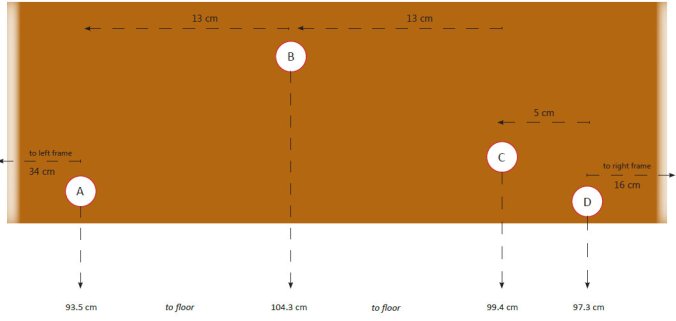
Precise measurements of ballistics through the toilet door. Image courtesy Calvin and Thomas Mollett, Oscar vs The Truth.

A is the lowest of the 4 shots, at 93.5 centimetres from the ground, and 34 cm to the right of the left edge of the door. A hit Reeva in her right hip. A is the only bullet of the 3 that struck Reeva to be completely absorbed by Reeva’s body.

B is the highest of the 4 shots, at 104.3cm from the ground, and 13 cm to the right of A, or 47 centimetres from the left edge of the door. B was the only bullet of the 4 to miss Reeva completely and smash into the tiled wall and ricochet into the opposite wall. The damage to the wall inflicted by bullet B is used as a background image for the cover of Justice Eventualis.

C is lower than B, at 99.4 centimetres from the ground, but slightly higher than A. C is spaced equidistant from B as B is from A [.i.e. 13 centimetres]. C struck Reeva on the front of her right forearm, slightly above the elbow area.

A fragment of C sliced clean through the right side of Reeva’s black shirt yet missed her torso underneath. 3 fragments – presumably from C – were all found in the area of the magazine rack, where the talons separated as they tore through Reeva’s arm.

Given the volcanic opening on the back side of Reeva’s right arm, one would expect an eruption of flesh, a spray of tissue and meat, to paint the rear wall of the cubicle behind her arm. Yet there is no blood spatter directly behind her indicative of this.

Oscar-bullets-copy

Fullscreen capture 20160715 093316 PM

Notice the absence of any blood spatter from the bullet wounds to the arm on the wall above the magazine rack [brown rectangle]. There are only three possibilities to account for this: either the splatter was wiped away, or the arm was in front of the body causing the blood spatter to land on the vest [but still allow the bullet fragment to pass through without penetrating the torso – unlikely, or a combination of both.

D appears to be a minor variation of C, since it is just 5 centimetres to the right [B is to the right of A, C to the right of B and D to the right of C]. D is 97.3 centimetres from the ground, and 16 centimentres from the right edge of the door frame.  Of the 3 bullets, D is the closest bullet in height to A, but still slightly higher. D sliced through Reeva’s left hand, near the index finger, and then penetrated and exited her skull.  A fragment of bullet D remained in Reeva’s skull while another smashed through the other side. No spray of brain fragments – of the volume one would expect – is evident on the ball behind D either.

In effect, after wounding Reeva at A, the lowest shot of the 4, all subsequent shots were higher, starting with B which was too high, and then “modifying” to the more accurate C, and D, which were also both higher than A and both lower than B.  C and D effectively were “averages” of A and B, which implies “modification” or aiming.

INTRODUCING THE MODEL

Reeva was short for a model at just 1.71 metres. Her gutsy determination got her into the door with Ice Models, a trait we tend to forget in the text of this crime, and the crime scene itself. Reeva not only had plucky resolve, she was physically fit and not afraid of opposition.

After my first-choice – a slim matriculant – cancelled at short notice, citing the death of her grandfather [no joke], I asked my sister to stand-in. She’s 1.74 metres, so 3 centimetres taller than Reeva, but close enough.

I had my sister look at the autopsy images herself and then draw bullet holes on her right thigh, right arm and left hand. I also showed her the idiosyncrasies of the right side of the magazine rack “tower” [facing away from the toilet], and matched it to a bruise with a tail in the autopsy images, evident on Reeva’s right buttock.

Note the idiosyncrasies of the original magazine rack were not precisely duplicated in the model provided in court, in the reconstructed cubicle. This proved to be a costly oversight.

I showed her how the nicks on Reeva’s spine were also inflicted by the flaring of the right side of the magazine rack tower as Reeva fell against the magazine rack.

Fullscreen capture 20171213 021157 PM

Image courtesy Calvin and Thomas Mollett, Oscar vs The Truth.

Reeva’s fall against the magazine rack was the “sound of wood moving” Oscar spoke so often about in court, the sound he claimed was “someone coming out to attack me.”

Since she’s an architecture graduate, my sister is pretty good with angles, measurements and three dimensions. But the head wound is tricky, so I applied a toothpick, which I attached with sellotape over her hair at the appropriate angle and on the top, right side of her head.

To make the hip wound explicit, I gave my sister a piece of double sided tape, with one side of the adhesive exposed while leaving the bright blue surface as a marker. She then attached the marker to the outside of the grey Nike shorts I gave her. She also wore a sleeveless black top, though more figure hugging than the one Reeva wore on the night she died. And like Reeva, she was barefoot.

LINING IT UP

Once in the demarcated cubicle behind the door, I placed two white buckets inside to represented the toilet. This quickly limited the already limited space, and without telling my sister, she sought to avoid standing or sitting on the upturned buckets. Reeva likely did the same in terms of the toilet.

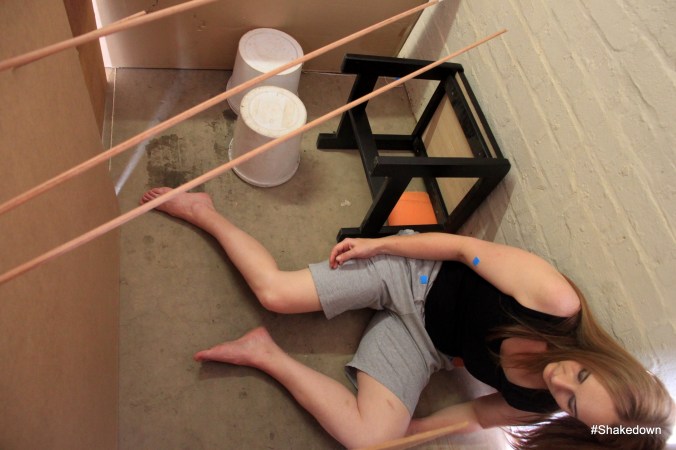
I handed my sister my phone. When I inserted a rod through Bullet A, it lined up perfectly with the hip wound. I took a photo at this point, showing that Reeva stood no more than a foot from the toilet door.

This was also more than enough space for her to be close to the door while holding up her phone in her right hand.

Bullet B, the only bullet that missed, was a lot more difficult to illustrate than Bullet A.  Although it lined up with the opposite wall, the difficultly lay in freezing Reeva’s movement at the time B flew through the door and smashed into the wall behind her. This difficulty was because Reeva was off-balance when the bullet flew harmlessly over her right shoulder. If Reeva remained in the same position she was in when A hit her, B would have sliced through the mid right section of her abdomen.

In order to have my sister in the right position, I gave her a large, purple Pilates ball to sit on. She needed to move slightly to her right, and back, and sit down on the ball in order to avoid the rod completely.

To reiterate: If she remained in the same position as she was when A struck her, B would have struck her in the middle to right of her abdomen. It may seem a small point, but Reeva was not static after being hit by the first bullet. Besides her movement, bullet B also gives us some indication of a pause between bangs A and B. The rod for B was inserted to its full length until it “hit” the wall behind her, immediately ricocheting against the adjacent wall.

For Bullet C, I inserted a small black table from my own bathroom, situated opposite my toilet, in the reconstructed toilet. It’s approximately the same height, but obviously it doesn’t hold magazines, and unlike the original magazine rack, this small table allows one to sit on it. In order for C to line up with my sister’s arm, she needed to be in an almost-sitting position on the magazine rack.

Let me explain what I mean by “almost-sitting”. Firstly, she is low enough on the magazine rack to be “sitting” on it, thus dislodging it, but only half of her is actually sitting on it [based on the bruise-impression].

This also suggests that Reeva’s back and head are almost in line with the rear wall of the cubicle as well. This stands to reason – in order for her to be sitting anywhere on the magazine rack, she needed to have fallen all the way back to the rear wall of the cubicle.

This suggests that prior to firing the third bullet, Reeva had already stumbled against the magazine rack, perhaps kicking it with the heel of her left foot as she fell backward, or falling onto it and prompting the wood to screetch and/or judder against the floor, thus alerting Oscar – in the pause after B – to her position.

In addition, Reeva likely screamed in agony after bullet A, and ironically, the scream that saved her [or alerted others to her plight] might have also doomed her, as the shooter was able to track her movement behind the door to the right from just 2 metres away.

Oscar knew his own home just as we know ours. So any sound from the magazine rack would have told him, a practised sharp shooter, exactly where Reeva was.

A final point to note about Bullet C – in order for the bullet to pierce her arm and pierce her shirt yet miss her torso, Reeva had to have turned slightly to her left. In other words, away from the toilet. While my sister’s shirt was skin-tight, Reeva’s was more baggy, and Reeva’s torso also had the classic hourglass shape which allowed a fragment to penetrate the shirt and yet miss her midriff.

Reeva’s motion behind the door now emerges as a rapid downward and [in terms of Reeva behind the door] right to left motion. This motion is in keeping with the width between Bullet A and B, and also Reeva’s ability to “dodge” B.

You will recall the distance at the door from A to B is 13 centimetres, ditto from B to C, making a total of 26 centimentres or ¼ of a metre. Remember the width of the cubicle from toilet wall to the opposite wall is 1.4 metres. [We’ll ignore for the moment that because of the toilet inside, that distance – the distance Reeva had to move from right to her left is actually less than 1 metre].

So the fan-shape of four bullets penetrating the door is 1/5th the width of the cubicle, or ¼ the width Reeva had to move in [taking the toilet space out of the equation].  However on the other side of the door the distance between bullets A and D is greater, closer to half a metre.

images

This is the view of the bullet trajectories from Reeva’s perspective – i.e. from behind the door. Notice the “fan” shape, indicating a very wide area of impact.

This means – effectively – that after Reeva was hit with the first bullet, she had to move from the point a foot away from the door where she sustained A in the hip, 1 metre backwards and half a metre to her left in order to be wounded on the right side of her head: Bullet D.

Reeva was struck by Bullet D as she was still falling. The impressions on Reeva’s spine are at a slightly off vertical angle, meaning the upper nick is almost in line with Reeva’s vertebra, while the lower nick is to Reeva’s right. If Reeva was falling down against the magazine rack, the lower nick would have inflicted first, followed by the higher. The crucial aspect here is that the higher wound is also slightly to the right, meaning as Reeva approached the ground, she was still moving towards her left [away from the toilet]. Let’s look at that image again, but more carefully and more closely this time.

Fullscreen capture 20171213 021157 PM

Image courtesy Calvin and Thomas Mollett, Oscar vs The Truth.

We can also see the height of the two wounds to her spine correspond to the height of the sharp flaring off the magazine rack, and the type of notches in the skin correspond to the beaked protrusion of the wood flaring.

magazine-rack-4

The Mollett’s were right that these injuries were made from wood, and not as the defense claimed, from bullet fragments bouncing off the wall. However, they weren’t made by the cricket bat but by the magazine rack.

In my experiment, even though my sister is 3 centimentres taller than Reeva, she was still some distance off the ground when Bullet D struck the skull. I had to place a rolled up yoga mat under her in order to achieve the right height. Again, Bullet D and Bullet C were undoubtedly fired AS REEVA STRUCK THE MAGAZINE RACK.

Further, there had to have been a pause after Bullet A in order to allow Reeva to fall backwards, approximately one metre, and for Bullet B [which was well to the right of Bullet A] to miss her.

Since Bullet C was the same distance to the right as Bullet B, the only reason it struck Reeva was because it [and D] was fired quicker after Reeva passed the “starting line” of B’s trajectory, compared to A.  How much quicker?

Gravitational acceleration is 9.80665 m/s.

Reeva’s height is 1.71 metres, and she was shot in the hip at a height of approximately 1 metre. Bullets C and D were fired at a height of roughly 1 metre as well, but with a 5 degree downward trajectory. So how long did it take for Reeva to fall from 1.71 metres in order for her head to align with a bullet below 1 metre?  How long did it take her to fall 800 mm [0.8 metres]?

If she was free-falling, Reeva would have achieved a speed of 3.96 metres per second, and taken 0.4 seconds to fall from a standing position until her buttocks hit the ground.  But she wasn’t freefalling. She fell backwards one metre, and sideways about half a metre, as well as down 0.8 metres.

Falling backwards to the right height would require a [not vertical] distance of 1.2 metres, and taken close to half a second. But if she fell straight down she’d still be out of the trajectory range for Bullet D. To get to D, she also has to fall half a metre to the right.

This suggests that there is something impeding the free fall, besides her left leg which still provides limited heft and mobility.   Obviously, the magazine rack also impeded Reeva’s fall, which is why the bruise appears on her right buttock, and the nicks against her spine.

This bruise was also noted in the autopsy summary sketch, it just wasn’t sketched very well.

Fullscreen capture 20171213 021157 PM

Notice the autopsy image sketch records the bulb of the bruise to the right buttock, but leaves out the tail to the right, left by the magazine rack.Image courtesy Calvin and Thomas Mollett, Oscar vs The Truth.

Since I’m not a genius in geometry, and since the algorithm has now becomes complex, what we can say is that Reeva’s fall from A to D is interrupted by landing on the magazine rack, which delays her fall but allows the shooter to track her [Bullet C].

Since there are effectively “two falls”, from the door onto the magazine rack, and from the magazine rack off it, we may assume 2 x 0.5 second drops. We’re still left with “only” a second. Except we’ve left out another equation: reaction time.

Reaction time is easy to leave out of the equation, simply because we know all the other metrics except the most important one: Reeva. What was this experience like for her? What would it be like for you? If a bullet struck you, out of the blue, would you immediately know what to do, or instantly move? It may stand to reason, but even the world’s most reactionary people – 100 metre track sprinters – even when primed to respond to a shot, take time to react.

The best Olympians in the world have a reaction time of 0.15 seconds. Since Reeva, I believe, was alarmed and thus “primed” for an emergency, we can assume the first shot triggered an immediate movement. Not just falling back, but to her left, away from Bullet A and B. This is why C and D needed to modify to track her, to the right.

The total time between Bullet A and D is estimated at around 1.5 to 2 seconds. That is an eternity when it comes to firing 4 bullets. It averages out to around two bullets per second, or 1 bullet every half second. But the four bullets weren’t fired in one burst, there was a pause at B, resulting in a miss. In that pause, I believe, lies Dolus Directus; the intent to shoot again after a moment’s reflection and recalibration.  Had the prosecution done the math, and had the judge had an appreciation for mathematics, the entire trial could have been reduced to a time-stamped algorithm.

This could also have been demonstrated via a real-time to-scale geometrically-verisimilar animation.

THE MISSING AUTOPSY TESTIMONY

None of the insights or reconstructions could have been achieved without the autopsy evidence, and obviously, that narrative is excised out of the trial testimony and for that matter, the media coverage.  It is this gaping hole, where one can join the dots through the door to Reeva’s wounds and to the ricochet off the rear wall, that allows one to really understand what it was like for Reeva behind the door.  No wonder Oscar smashed down the door the first chance he had. The door represents a vital link that allows us to reconstitute this crime in a way that few other high-profile crimes do.

In the Channel 7 reconstruction, ditto the Mollett’s, I noticed a plank was easily smashed out almost immediately. With one plank out it’s easy to unlock the door. So why did Oscar go on smashing until the entire door was smithereens?

pistoriusevidence8

Well, because there were four bullet holes to get rid of. The holes could not only show where Reeva was standing, and moving as she was shot, but also where Oscar was standing.
1-Fullscreen capture 20160803 124203 AMscreenshot-2014-09-10-07-19-57480

Oscar claimed the key was on the floor, this is why he had to smash the rest of the door down – so he could get to it.  But if you’ve dislodged a plank, what’s easier – to smash down a door or to reach in with the plank and move the key closer.

Fullscreen capture 20160711 091015 PM

Also, shouldn’t the key have fallen onto Reeva, if it fell, and if it did, if it was on the floor, wouldn’t it be covered in blood [it wasn’t].

WHAT IT MEANS

The main takeout from this experiment wasn’t to try to assess the period between A and D, although that remains a vital piece of data missing from this case.  No, the reconstruction was intended to test the intuition that if Reeva was moving to her left, away from the toilet, and landed on the wrong side of the magazine rack, on the ground, while falling to her left, how could she have changed direction and ended up with her arm and head over the toilet bowl?

Additionally, if she had landed with the centre of her body in line with the far side of the magazine rack, could she still have slumped over onto the toilet? The answer is unquestionably no.

Irrespective of which direction Reeva was falling in, any situation where she was sitting on the floor would have made “slumping” over the toilet impossible. You can try it at home. Sit next to your toilet, and try to press your right ear to the toilet seat, and then when you relax, come to rest in this position. The position only be achieved, temporarily, if one is around 15-20 centimentres from the toilet, with nothing in-between.  But the magazine rack was there!

According to the state Reeva lay over the magazine rack with her head on the toilet seat. Everyone seemed to make the same mistake, assuming the blood evidence on the seat was the finishing line, and thus, trying to get Reeva to that finishing line.

My experiment demonstrates that Reeva fell the other way, so that her head and torso faced towards the wall opposite the toilet [the wall towards which she fell from the commencement of Bullet A].

If Reeva fell to the left, where’s the blood? Why are there planks in this area? And why are there no large splodges of blood behind Reeva, against the wall, where the black talon made scarlet sprays of Reeva’s tissue, both from her head and her arm?

The answer is that some artefacts of this blood evidence do remain on the walls, on this side.

So – how did Reeva’s blood end up on and in the toilet bowl?

The only logical explanation, as I see it, is that when faced with the holocaust inside the cubicle, the accused immediately went to word minimising it.  He had to make it look less bad than it did, and that meant getting rid of red paint on the walls, and on the floor. If he was going to claim Reeva went to the toilet, then she also needed to lay over the toilet, not on the wrong side of it.

How would it look if Reeva’s shot dead, and found like this? It would imply [correctly], that she wasn’t using the toilet, and if she wasn’t using it, how could it be an accident?
1-IMG_6307

The state wrongly assumed that there was an innocent explanation for the light blood spatter on the magazine rack. This blood dripped from Reeva’s hair as she was hoisted over the bowl, and her blood from the wound on the right side of her head, and arm, allowed to drain directly into the bowl. There was also a flush to get rid of it, and perhaps to get rid of some pieces of wood too.

This is why there is barely one Coke can’s worth of blood in the cubicle and just outside of it.

If the idea of sanitising the crime scene seems extreme, consider that in no crime scene photos are there any clear foot or stump prints – in blood – leading to or away from the crime scene.  Why not?

Surely if Oscar beat down the door, picked Reeva up, was covered in her blood [so much so that he washed it off his hands and chest], surely he stepped in her blood at some stage? But he didn’t. Those prints should be there but they aren’t. 

There are no bloody stump prints in the passage of the carpet, in the bathroom, down the stairs, in the fabric of the carpet of Oscar’s bedroom, which he needed to navigate to go downstairs [while carrying Reeva].  So where are those bloody prints?

What happens when we put a real model behind the door?

Where is the remorse in someone who pretends someone is alive when they aren’t, and cleans up a crime scene moments after killing someone?

What happens when the real person re-emerges behind the door is that her murder is no longer trivialised. The opposite of minimising, or intentionally underestimating someone, is highlighting and emphasising who they were, and what happened to them.  Only when we do that is the true nature of the crime made manifest.

An Excerpt from DIABLO: Henri Van Breda

From the chapter

Into Darkness

John Harrison: You should have let me sleep! ― Star Trek Into Darkness


Henri ax

Exactly twenty minutes into the court session after lunch, Henri’s advocate draws another line through his checklist, and wraps up his direct examination.

BOTHA:  Did you kill your father with an axe?

The accused casts towards his Judge, and his lips seem to curl involuntarily as he wrestles them into a single, softly spoken word.

HENRI: No.

BOTHA: And did you kill your brother with an axe?

HENRI: No.

As Henri answers his advocate on these direct and dire accusations, something sinister has happened to his posture. There’s a dark look in his eyes. From the fig-leaf position, a classic defensive posture which he’s maintained throughout the day while standing, often pressing down on his right hand with his left, now suddenly his demeanour has transformed into something else. Henri looms in his grey suit, both arms brace the side of the dock in a kind of casual menace. He’s spread out, almost like wings, or the ears of Dumbo the elephant.

Having answered the second question, Henri briefly glances from the Judge to the quivering, key-tapping media gallery on the opposite end of the room. And then to his advocate.

BOTHA: Did you kill your mother with an axe?

HENRI: No.

BOTHA: Did you attack your sister with an axe?

HENRI [Mouth gaping]: No. [Henri almost seems to sigh as he answers that one.]

Look carefully and in each of the four ‘no’s’, Henri answers open-eyed while looking at the Judge, but in each case, blinks moments later.  So it’s no…BLINK, no…BLINK, no…BLINK, no…BLINK.

BOTHA: Did you change the crime scene in any way…?

HENRI [Shakes his head]: No, my Lord.

The throwing of the axe, and the hitting of the axe into the wall, is an incidental way of explaining away the absence of blood, touch DNA and tissue DNA on the leading edge of the implement, and fibres and fingerprints on the haft, throat and grip.

Just as we saw in the JonBenét Ramsey case, in a genuine kidnapping, one would expect to find the fingerprints of the parents’ on the Ransom Note. Didn’t they pick it up and read it?  Or if they wrote the note themselves, were they extra careful not to leave any traces of handling it?

In the same way, we’d expect to find Henri’s fingerprints on the axe based on his version of handling the axe.  This absence shows, perhaps, that in his care not to make a mistake, just as in the Ramsey’s case, he was too careful.

BOTHA: Did you have any reason to attack your family?

HENRI [Seemingly aghast]: No, none whatsoever.

It’s difficult to make out on the livestream, but Henri either glances down or blinks as he says the word “none”.  But Botha’s not quite done.  There are three additional cards he wants to put on the table.

1st Card: No Clean-Up

BOTHA: Did you attempt to wash away any blood on your hands, or body, through the course of that morning?

HENRI: No, my Lord.

Henri’s suddenly deferential again.  In the entire court transcript for October 31st …


The first installment of DIABLO is available now on Amazon

Fullscreen capture 20171103 105615 PM

shakedowntitle.com


The Dark Matter of the Oscar Behind the Great Pretender [White Horse II Review]

WHITE HORSE II: Oscar Pistorius

Review by Melissa Manzella, August 21, 2016

oscar 1

“A brilliant narrative, replete with super sharp observations of both the case and the characters, this narrative brings the truth into ever clearer focus, and does so by having a kind of running theme on the ‘real’ narrative, Oscar knowingly killed Reeva, versus the ‘bogus’ one, Oscar thought he faced an intruder, referencing both often. In doing this, one really sees the flaws in the bogus one.

These two have such a good grasp of the case, having sorted Oscar long ago, and that now applies to their narrative of what happened the night Oscar killed Reeva, and I consider it to be definitive. In this narrative, the reader is brought early on to what may be a fascinating juncture in the case, this involving the rescheduling of sentence date by Judge Masipa, a matter which otherwise might be seen as an ordinary one, except that it was sentencing and the author was in court and caught the face of surprise on Prosecutor Nel, who obviously wasn’t expecting it.

He also noted an awkward looking Masipa, whom he thought looked to be gazing Roux’s way, for some kind of direction. Perhaps guidance on that date? This is what occurred to Van der Leek as he watched this exchange unfold. She changed it from June 17th, to July 6. With this single observation by Van Der Leek, bewildered trial watchers the world over who’d witnessed two vastly different Oscars at the sentencing hearing as opposed to the sentencing, might have just received clarity. We’re talking about collusion here, or more appropriately, the possibility thereof.

Without giving too much of the book away, the author does establish a plausible nexus between the rescheduling of this sentencing date, and a particular activity Oscar was engaged in at the time, outside of the realm of court. Did it happen? Well, Van der Leek doesn’t commit to saying that it did, but does supply the reader with relevant facts that would support it, and leaves readers to draw their own conclusions. Who knows if there was trickery afoot? Who knows that there wasn’t?

Here’s what I like about Van der Leek, and Wilson too, for that matter. They see something that looks wrong, and aren’t afraid to say it. They’ve always called a spade a spade, and have gone where the evidence has led them. Nick also talks about where he thinks this case went wrong, and it’s his belief that Masipa might have had her limitations, with that said, might simply have been overwhelmed with so much evidence. He thinks the case could have benefitted from a narrative, something that might have served to help her focus. He wishes Nel might have employed such. I tend to agree with him. He mentions that as a legal matter, and especially before a judge, showing motive certainly isn’t required but in this case might have been helpful.

Oscar being the scoundrel that he is, did an interview for ITV weeks before his sentence, looked well as he lied and cried his way through it, and then wouldn’t bother to take the stand in court. Van der Leek considers Mark Williams-Thomas the king of the soft ball questions, noting his bias. This narrative also saw new evidence emerge to do with the blood, and the authors made a crucial find here to do with Reeva that is a real game changer! Wow. I’ve not seen what they found documented anywhere else, so leads me to believe they were first in this finding! Impressive.

Both lament the fact that the bogus narrative is now the legal one, and Nick was incensed at Masipa’s doubling down at sentencing, memorializing this joke of a conviction. I’m hearing now however, that there’s a chance for a counter that may be coming down the pike in White Horse III, and I definitely say cheers to that! Looking forward to that read.”

WHITE HORSE II is Available on Amazon

WH2 Cover

shakedowntitle.com

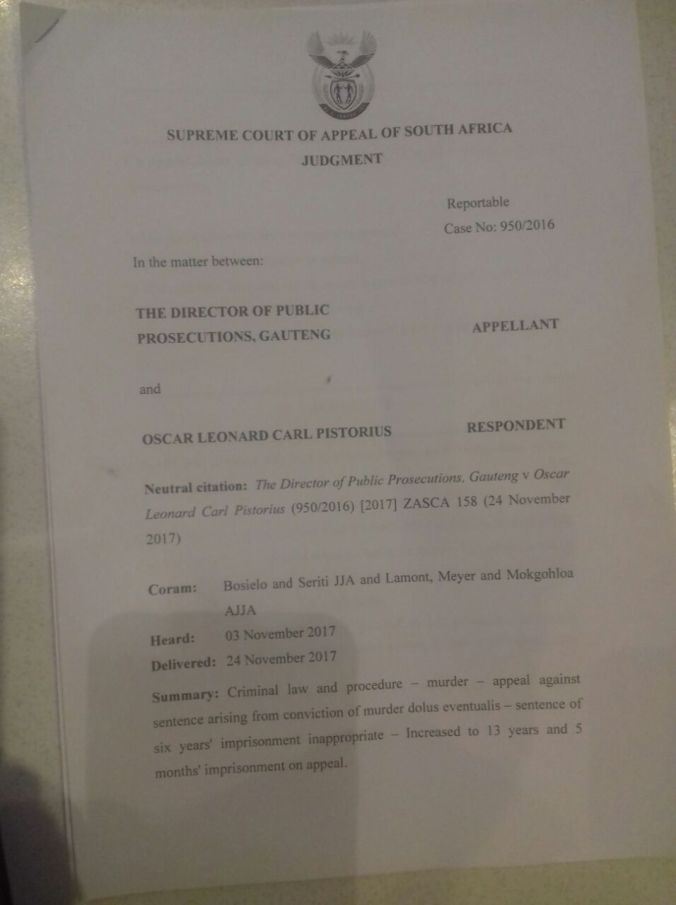
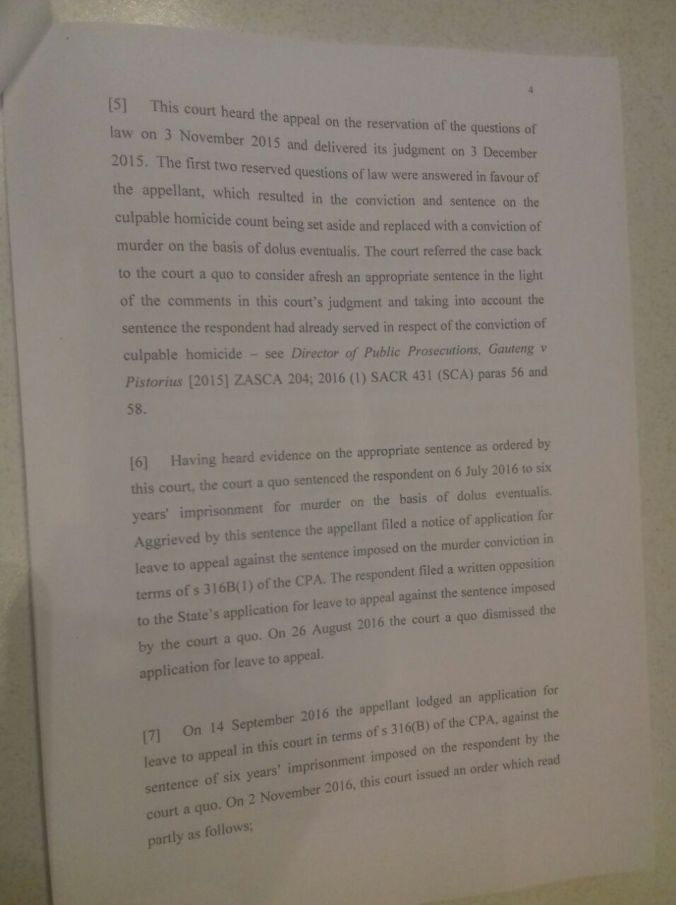
Justice Eventualis, Oscar’s Sentence Extended [Documents]

“The dead cannot cry out for justice.  It is a duty of the living to do so for them.” – Lois McMaster Bujold

Receiving credit for time already served, the respondent, Oscar Pistorius, receives a sentence of 13 years and 5 months [replacing his previous sentence of 6 years].

2017-11-24-PHOTO-000319102017-11-24-PHOTO-000319112017-11-24-PHOTO-000319122017-11-24-PHOTO-000319132017-11-24-PHOTO-000319142017-11-24-PHOTO-000319152017-11-24-PHOTO-000319162017-11-24-PHOTO-000319172017-11-24-PHOTO-000319182017-11-24-PHOTO-000319192017-11-24-PHOTO-000319202017-11-24-PHOTO-000319212017-11-24-PHOTO-00031922

shakedowntitle.com


Our Conclusions In “Deceit” & “Dark Matter” And How Our Journey Took Us To Them

Originally posted August 2015, by Nick van der Leek

Albert Einstein once said, “It’s not that I’m so smart, it’s just that I stay with problems longer.”

One of the tremendously rewarding experiences we [my co-author Lisa Wilson and I] have as authors is our research forces us to set up camp around questions.  We spend time: mornings, afternoons, days, weeks, even months asking questions and pursuing answers.  The amazing thing when it comes to True Crime, especially popular crime, is those answers are out there. One merely needs to go out and make the effort to look for them. And keep looking.  Seek and we do find!

What makes our narratives distinctive, I think, is that Lisa and I, more often than not, work as a team. How many other narratives have two researchers and authors, working from opposite sides of the Atlantic?  While Lisa provides a US perspective as a juror, a researcher and a True Crime buff, I’m most interested in the intuitive subtleties that underlie these cases.  The psychology, the economics, the motives. Human behavior is fascinating, especially when it drives people to the extreme. I’m also intrigued by what these intuitions reveals about us, and society.

humans

I wasn’t always into True Crime, in fact, like Ann Rule, I sort of fell into it by accident.  While Rule worked with Ted Bundy, I was Facebook friends with the model, Reeva Steenkamp, that Oscar Pistorius shot dead in his bathroom.  I didn’t intend to write a novel, I simply started asking questions, and then penned a 12 000 word magazine article [intended as a 4 part series].  That narrative eventually became my first bestseller.

Although I studied law and economics, I left the corporate environment to freelance full-time as a photographer and writer. My great grandfather was a famous South African artist, and my brother and aunt are also both well regarded artists [and yes, freelancers] in their own rights too.  I guess there is something restless in both mine and Lisa’s blood that makes us want to dig beneath the surface, to see expanded perspectives beyond what the media serves us.

I need to not only explore the world beyond my door, but represent it to myself and others in a constructive and meaningful way. I feel passionate about meaning above all, and it’s gratifying to find so much in such grim a setting where someone has lost their life.  When we honor the victims, when we remember them honestly, something unexpected happens: we also set ourselves straight, we also get ourselves [and society to some extent] back on track.

In terms of the Amanda Knox case, I stepped into the bullring for the first time in April this year [2015].  I knew virtually nothing about the case other than it had been newsworthy around the world.  I knew ‘something’ had happened in Italy, and that Amanda Knox was somehow involved [or not] because she was a housemate of a murdered British girl [also a student].  Before I started studying the case I had no bias either way – I didn’t know whether she was guilty or not.  Based on the little media that came my way, there seemed to me to be equal parts bias that she was innocent and…suspicious.

As soon as I started examining the case, literally within a few minutes, my interest was aroused.  It was along the lines of: she’s hiding something.  It was also along the lines that Amanda might be complicit in some way, but probably not involved in the actual murder.  How could she? Why would she?

Again, it is easy to ask these questions and then walk away from them without investing time in their answers. And when they do come they’re…well…stupefying.

While Lisa was in Italy, for work and research, I started working behind-the-scenes on a narrative Lisa and I designed a framework for called DOUBT.  The plan was that Lisa would return and then we would work on the narrative together.  I got so caught up in my own research I started on the narrative and by the time Lisa returned from Italy, DOUBT was done.  Interestingly, upon Lisa’s return, she still wasn’t 100% convinced Amanda was directly responsible for the murder.  The topic resulted in one or two heated Skype calls between us.

A lie repeated often enough [there was no DNA] eventually becomes, if not the truth, then a kind of truism, doesn’t it? A truism isn’t the truth, it’s a platitude. It’s something you say to get rid of inquiring minds.

No DNA? Well, of course there is – at least five instances of it, mixed with Meredith’s blood.  What’s perhaps more bizarre, for example, is the lack of Amanda’s fingerprints in her own home.  A single print? How many of us could say the same about fingerprints in our own homes?  Our computers, door handles, kitchen areas ought to be covered with prints.  Coming back to DNA, not only is Amanda’s DNA present in the villa, but so is Raffaele’s in Meredith’s bloody bedroom.

What’s the chance that Raffaele was at the villa, in Meredith’s room, but not Amanda?  What was he doing there if Amanda wasn’t with him? And is it any surprise that Meredith’s bra, cut with a knife after the murder, also had Raffaele’s DNA on the bra clasp? This is a guy who had a knife fetish, and who was carrying a knife at the time of his arrest.

In DOUBT [which was banned at first by strident Pro Knoxers and then resurrected as DECEIT], I identified 28 Red Flags.  These were singular signals that seem to show patterns of inconsistency.  Things just didn’t add up.  Indeed, Amanda did seem to be [and still is?] hiding something.  In our follow-up narrative, DARK MATTER, Lisa and I brought a binocular laser-like narrative focus to the four days of intense police investigation following the discovery of Meredith’s body at midday on November 2nd, 2007.

This time, we identified an additional 100+ Red Flags.  In addition to these, we listed several other highly suspicious events amongst other increasingly odd behaviors – not only from Amanda, but also Raffaele. It’s when we pool all of these clues together that a picture begins to emerge.  Patterns emerge.  And suddenly the mystery becomes…less mysterious.

If my initial ‘gut feel’ was that Amanda was simply ‘hiding something’, by the end of DECEIT there was little doubt that there was a lot more going on than that.  In fact, I’ve suggested to Lisa that based on forensic evidence alone [if one threw away all the circumstantial evidence], Amanda would still a have a major case to answer to. Lisa would eventually agree.  Conversely, if one took the entirety of circumstantial evidence, including the on-again-off-again alibi, and simultaneously ignored the totality of forensic evidence, Amanda would still have a major case to answer to.  That’s my opinion.  Lisa’s too, now that she’s gone beneath the surface of this case herself.

The irony is this case is so large, so convoluted, so full of spin and counter-spin, that it is easy to get lost in the details. As we see so often in court cases, it is not a lack of evidence that is a problem, it is the volume of it that gets disconcerting, and frequently confusing.  Confusion and doubt [and ‘reasonable doubt’] go hand in hand.  Of course, being confused by a lot of information is not the same as uncertainty based on a lack of evidence, or based on ambiguous evidence. The evidence isn’t ambiguous.

As such it is Lisa’s and my mission to demystify the eight years culminating in Amanda’s and Raffaele’s ultimate acquittal.  Our narratives, especially the first two or three in the series are probably better suited to newbies [people like us].  In the many narratives to come, Lisa and I expect to be as well versed as some folks on forums and resources like the incredibly valuable True Justice.org.

Before wrapping up, I’d like to share a final insight based on our experience writing another true crime series.  It may seem like Amanda Knox, Jodi Arias and Oscar Pistorius are three distinct individuals, with nothing in common.  But when we look closer, we don’t simply see matches in certain defense schemes, we see entire patterns of conduct [including motive] overlapping, and doing so perfectly.

what you thought

In South Africa, we have a similar situation where the media profit from stories on Oscar Pistorius.  They are reluctant to declare him guilty as that would be slaying a potential ‘cash cow’, and with book deals hanging in the balance [an acquittal is literally worth millions], the media are hedging their bets.

As a person involved in the media, I’m appalled at this, hence our multiple narratives on Oscar, two detailing his motive and the method of what we speculate was premeditated murder.  In terms of Amanda Knox, we suspect a similar game play between the media and Knox.  Both seem to be involved in a kind of PR waltz which both stand to benefit from, if they can dance consistently to their own music.

It was once said of Lance Armstrong that one shouldn’t make Lance Armstrong angry.  Anger is what motivates Lance to win.  And then the punch line: ‘Beating Lance makes him angry.’  Lisa and I have been astonished at the level of organisation and aggressive militancy [and dirty tricks] employed by Amanda’s supporters.  If this was intended to dissuade us from writing, these folks couldn’t be more wrong.

We are not out to make money, Lisa and I, although we care that our narratives resonate and are successful.  What we really care about is justice.  The bottom line, whether one is a criminal, or the supporter of a criminal is you never look good trying to make someone else look bad. The venom and personal insults Lisa and I have endured in our reviews is impressive.  The strategy is clear – attack the credibility of the messenger [since the message itself is problematic].

Our credibility is simple to establish. For my part, I am a professional writer. I did not gain a twitter following of almost 14 000 based on bad writing.  I work and write in partnership with Lisa because her research is often deeper and even more thorough than mine.  For me, our credibility is based on just two tests:  our personal standards and our level of honesty towards ourselves and others.  What distinguishes our narratives from all the others out there is the level of honesty – including self disclosure – both of us bring to our work.

This is because we care about something beyond justice. Besides wanting our readers to have a meaningful and genuine experience reading about these tragic crimes, we – as authors – also want to be enriched.  When we make it a personal journey, the insights and intuitions are truly rewarding. We find how these folks – not only the victim but also the perpetrators – are not so very different from us.  In this sense, if we genuinely learn something from these true stories, Meredith Kercher’s death need not be in vain.

Follow Nick van der Leek @HiRezLife and Lisa Wilson @lisawJ13

shakedowntitle.com


Shakedown Reviews Blade Runner Killer, Oscar Pistorius – Part 2

Listen to clips from the film and hear our views on the relationship between Reeva and Oscar…

Reeva’s Twitter timeline from January – February 2013…

The BEST mommy in the world  #flu #moms #love http://instagr.am/p/USx-pxwPZN/

3:38 AM – 10 Jan 2013

View this post on Instagram

The BEST mommy in the world ☺ #flu #moms #love

A post shared by Reeva Steenkamp (@reevasteenkamp) on

Yaaaaawn!!!! Let me know when you’re done wasting your time trying to wear me down *files my nails*

5:42 PM – 11 Jan 2013

Finally feeling better today! Time to get back into  #brandnewme #2013

12:05 AM – 14 Jan 2013

My favourite sketch at the moment #art #expression #thought #beautiful http://instagr.am/p/UjRot1wPdj/

1:23 PM – 16 Jan 2013

Out of every misery, you WILL find your rainbow. A lesson. A truth. Nothing is a wasted experience if you look with willing eyes!

4:38 AM – 16 Jan 2013

Still can’t believe I went to the movies last night! First time in years!!! It was fun but I prefer DVDs at home. What have u seen lately?

12:00 PM – 16 Jan 2013

” You built your walls so high, no one could climb it. But I’m gonna try boy … Would you let me see beneath your beautiful … ”

18 Jan 2013

My new apartment will have one of these guys in it ….  http://instagr.am/p/UrK8zewPbw/

2:58 PM – 19 Jan 2013

OK blocked and reported times 5. Seriously, if I am that distasteful and repulsive to you then please don’t follow what I am doing. Thanks.

1:45 PM – 21 Jan 2013

This week has taught me that people will say what they like about you regardless&others will believe them.Carry on anyway.Be brave.Be you.

2:17 PM – 27 Jan 2013

28 Jan 2013

Sometimes your blessings lay beneath a mountain of tribulations. Be patient and see them through. You will appreciate them far more!

Some days you just want to stay in bed and nap and think and watch tv and drink tea. It’s those “I need my mommy” days.

8:39 AM – 29 Jan 2013

#FF The most amazing PR company in SA @CapacityR Thank you for always looking after me at events. World class! Cc @CandyGoldring

5:32 AM – 1 Feb 2013

He certainly doesn’t need more followers but he’s beautiful to look at & says some smart stuff too 😉 @OscarPistorius

Fun at the Vaal  http://instagr.am/p/VRiyRowPbb/

12:37 PM – 3 Feb 2013

Thinking of Valentine’s Day well ahead of time – in love with love as Gina Myers put it


Grab a copy of the latest @People_SA I’m wearing a few numbers to inspire those ladies looking to spoil their men on Valentines Day 🙂 #Love

10:11 AM – 4 Feb 2013

The queue … Is queueish … At home affairs …. It’s all wrap around and stuff. Fml.

4:25 AM – 4 Feb 2013

Preparing to go overseas?

Feisty


Yes, push into the queue that we’ve all been patiently waiting in AND don’t say thank you.

11:55 AM – 6 Feb 2013

New rules:


8 Feb 2013

Lying on a blanky in the garden with my @gi_myers breathing in some fresh air and chatting about life. http://instagr.am/p/VeRGH5QPZm/


Let the hate motivate.

5:12 AM – 6 Feb 2013


Before you lift a pen or raise your voice to criticise, acknowledge people’s circumstances. You don’t know their struggles. Their journey.

1:54 AM – 8 Feb 2013


When it takes you an entire day to try and compose a fitting response, a lacking one at that, rather leave it. It’s just substandard.

7:48 PM – 7 Feb 2013

: Funeral begins for Anene Booysen: ” RIP princess!

Winter Throwback. Myself and at a track day with .


Excited for a chilled Saturday evening in with good food, movies, popcorn, frozen yoghurt & my boo. #happiness #love #chilling #weekend

6:56 AM – 9 Feb 2013

It’s the last supper with 😦 I think and I will kidnap you forever!!!!

(Martin Rooney leaves 10th of Feb. Murder happens 4 nights later.)

I woke up in a happy safe home this morning. Not everyone did. Speak out against the rape of individuals… http://instagr.am/p/Viq8nNwPRy/

11:17 PM – 9 Feb, 2013


When you fall in love with someone’s personality everything about them becomes beautiful.

12:15AM – 9 Feb, 2013

Check out The Link tonight 4 a sneak peek of “Tropika Islands of Treasure” , ,

It’s a beautiful day!Make things happen.Starting my day off with a yummy healthy shake from my boo 🙂

 What do you have up your sleeve for your love tomorrow???

3:37 AM – 13 Feb 2013

WEAR BLACK THIS FRIDAY IN SUPPORT AGAINST AND WOMAN ABUSE

4:34 AM – 13 Feb 2013


Revelations


shakedowntitle.com

Shakedown Reviews Blade Runner Killer, Oscar Pistorius – Part 1

p14586320_p_v8_aa

Listen to clips, and hear #Shakedown’s review of the film…


Reeva’s Twitter Timeline from 2007 – January 2013…

July 31, 2007

keeping a secret…

July 31, 2007

excited to see the King again xxxx.

But in August, whilst auditioning for a spot on Top Billing, and signing up with ice Models, Reeva hints at some financial difficulties in her early days in Johannesburg. She also reveals a protracted struggle to find the right man, losing her phone, the trials and tribulations of the nightclubbing scene, and her innermost feelings of conflict and frustration – did she make the right choice to pursue modelling?  A close friend passes away in the same month and Reeva is missing her parents.

After dropping a few hints, Reeva first mentions Warren on Facebook on October 11, 2007, nearly 4 months after their first meeting.

October 11, 2007

at home doing work…it’s nice having Warren here to keep me company…

But 2008 proves to be a year Reeva would prefer to forget.  On April 7 Reeva posts:

‘[I stand] corrected. You do not get over the past. The past decides when to let go of you.’

On May 8, 2008, Reeva changes her relationship status on Facebook to ‘In a relationship’ although Warren and Reeva have been an item since January.

(They spend Christmas and New Years apart)

Going to miss some of my best people tonight @OscarPistorius @gi_myers @Iamfomo Have the most amazing night crazies! Send piccies 🙂

1:33 PM – 31 Dec 2012

No reply from Oscar or deleted.

I’ve learnt many valuable lessons this year. Thank you 2012 for the education! Above all, “trust your inner voice” stands out for me. #2013

12:52 AM – 31 Dec 2012

Flies to Cape Town on New Years Day

The chauffeurs in Cape Town hey. Nice! http://instagr.am/p/UBZZG0wPV5/

4:38 AM – 3 Jan 2013

Home time! Back to work. Thank you Cape Town & all the special people who made this break memorable! #friends #family #ocean #sunshine

3:40 AM – 7 Jan 2013

Visiting my boo on set. He shoots more than me! I need to up my game!!! #manonfire

3:47 AM – 10 Jan 2013

1506863434 (1)april-screams-in-the-night-oscar-cp

shakedowntitle.com


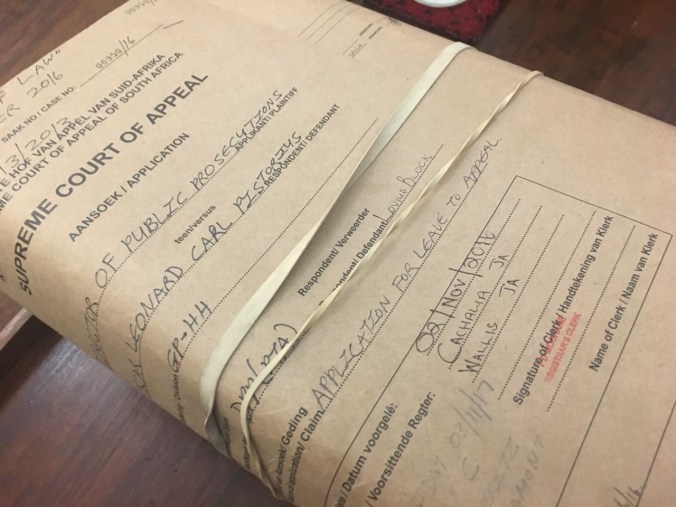
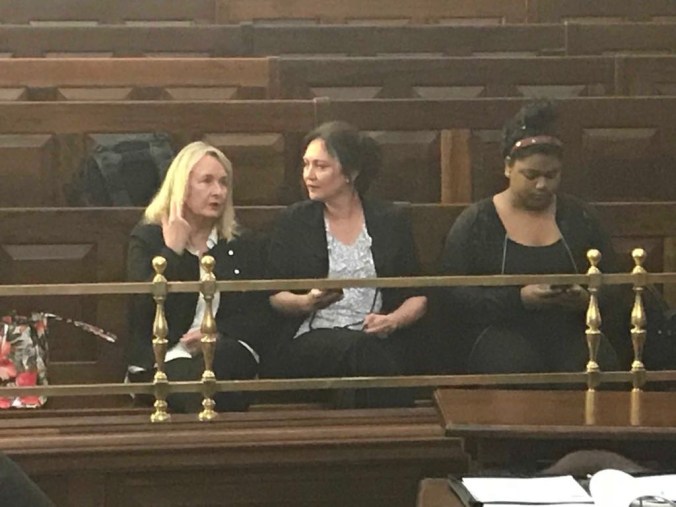
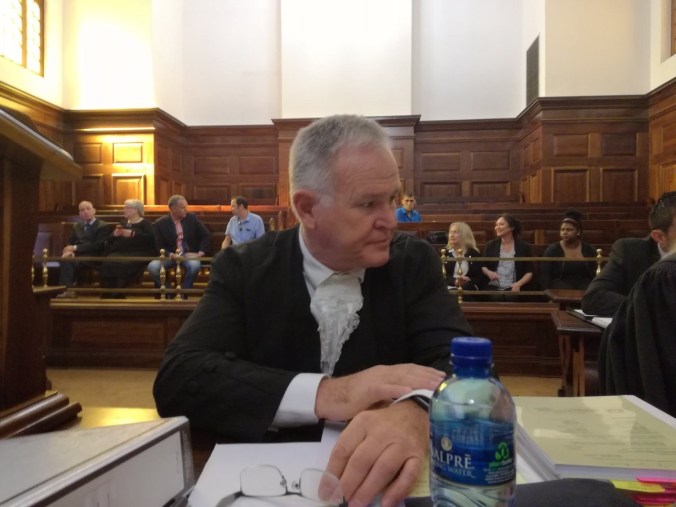
SCA Sentencing Appeal of Oscar Pistorius – LIVE Blog – November 3, 2017

Court to hear the case starting at 10:00am local time today.  Live feed on ENCA:  https://www.enca.com/south-africa/supreme-court-to-hear-why-oscar-should-serve-more-time

Follow @HiRezLife for live tweets

JUDGES:

Ronnie Bosielo, Willie Seriti, Pieter Meyer, Colin Lamont, Fikile Mokgohloa

LAWYERS:

Andrea Johnson for prosecution

Barry Roux for defense

UPDATES FROM COURT….

10:00am – Professor James Grant is once again assisting the prosecution

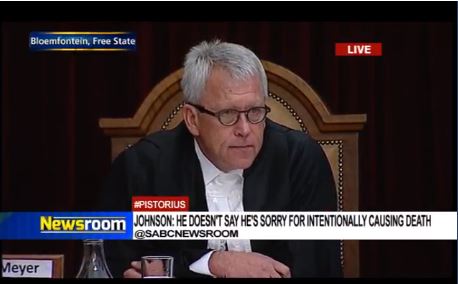
10:05am – Advocate Johnson is up first.  Justice Bosielo seems supportive of Masipa.  He raises his voices and says Oscar has apologized enough, and Steenkamps accepted.

Johnson:  “One really doesn’t know what his [Oscar’s] explanation is…”

10:18am – Advocate Johnson addresses what Oscar could have done more – she raises the point that feeling sorry for oneself is not remorse

10:20am – Johnson is reminding the SCA what their findings were.  She’s fired up, and arguing passionately as she reads from court record.

10:24am – Johnson:  “I refer this court to its judgement – as a matter of common sense at the time the fatal shots were fired the possibility the person behind the door would be killed was clearly an obvious result.”

Can barely keep up with Johnson…she’s racing through the findings, and judges are racing to keep up with her, flipping through the papers.  Only 2 judges have spoken so far.

10:28am – Johnson says dolus eventualis is serious and the mitigating factors delivered by the defense were not sufficient – there were no substantial compelling factors why Oscar received a less than 15 years sentence

10:35am – Johnson says Judge Masipa elevated Pistorius’ regret

10:37am – Justice Meyer:  “Recognition must be given for time already served”  #bullshit

These judges are coming at Johnson hard

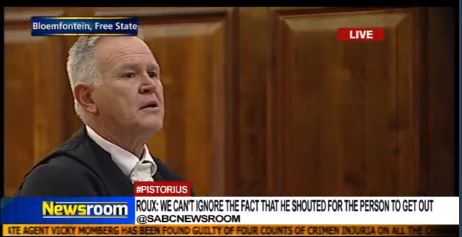
10:42am – Johnson says Oscar never explained why he didn’t fire a warning shot, nor can he justify it.  Even if he thought in his mind there was an intruder, he can’t explain the threat he faced.  He could not tell the court what the danger was, yet he fired four shots.

Johnson wants the court to recognize the brutality of this death.

Roux listens with eyes closed, hand to face, deep in thought

Johnson:  “No acceptable reason has been advanced by the accused on why he killed [Reeva]” #hernamewasReeva

10:54am Johnson: “the court misdirected itself by considering rehabilitation as a factor to deviate from minimum sentence”

Johnson speaks the whopping obvious – the first step to proper rehab is acknowledging what you have done.  Oscar has never acknowledged what he’s done… he’s made excuses, sobbed for himself, changed his stories, changed his defenses.

Simply put – there is absolutely nothing that justifies a lesser sentence in this case.

11:02am – Johnson says Reeva had her whole life ahead of her.  “No reasonable court” would have imposed 6 year sentence.  It is shockingly light.  Ends by saying the court [Masipa] misdirected itself.

Court adjourns for tea break.   Such a civilized thing for such uncivilized business.

Nick in court

From Nick:  “Kinda weird seeing both counsels hanging out during adjournment.  Like a family of crows.”

11:30am  Roux is up.  Says he’s responding to the remorse and regret argument.  Roux wants to start here.

Roux argues Oscar wasn’t convicted of murdering Reeva.  Which is unfortunately true.

Meyer:  “Consequences were dire”  There is no explanation for firing 4 shots.

Seriti:  “Which version [of Oscar’s] do we choose?”

The justices are really pushing Roux… WHY shoot 4 times?

Roux starts now with the “slow burn” argument that he used at the last appeal proceedings.  Disabled Oscar has had fears brewing his whole life.  He argues, Oscar has an anxiety disorder.

Meyer:  “Why impose a death sentence on who was in that cubicle?”

10:43am – Roux:  “I cannot stand here and justify the 4 shots.  What I’m trying to do is explain the state of mind.  Maybe if I’m able-bodied, and I don’t suffer from anxiety disorder, and I get there, I would be far more calculated, and think better but that person in that situation did not – he was just firing.  It was his reaction as a result of something he had no control over.  It was not a person standing there with confidence, that feels he can protect himself, that feels he can run away.”

Roux talks himself in circles.  You can’t have a terrified, incompetent, defenseless person then running after & confronting a potentially deadly person.  You also can’t have a person who’s completely not in control of his thinking and faculties, then consciously deciding what he needs to do to defend himself.

Justices are also showing Roux little mercy.

Roux:  Cannot hand down 15 years to a person in that situation that evening.  He argues, Masipa did consider the four shots, the cubicle, the shooter and the circumstances.

Roux says Masipa was unfairly criticized for the sentence she handed down.  Justices debate with him over the issue of retribution when imposing sentences, especially for grave crimes.

Meyer wants to know why Oscar didn’t testify on his own behalf – after the murder conviction, for his sentencing.  Roux wants to pawn it off on the state of his mind, but even the justices can see that’s rubbish.

Seriti points out the obvious – Oscar didn’t testify because he told so many different stories, he was afraid of another cross-exam.  But Roux says he suffers severe PTSD and it was getting worse at that time.

Let’s take a moment to remember, Oscar’s ITV interview – which was given/aired PRIOR to Oscar’s appeal.

Roux ends with:  “We submit that leave be refused”

Johnson back up and reads from Masipa’s judgement.  Even Masipa noted she felt unease over the witness after witness giving testimony about Oscar’s vulnerability – in other words, it was over-emphasized.

Ah, thank you Ms. Johnson.  She brings up Oscar’s television “expose”

Johnson repeats herself saying there is a lack of an admission in terms of acknowledging the wrong and Bosielo cuts her off.  He says “don’t spoil the good point you made”

Johnson:  “This court is duty bound because there were misdirections.  This court has the power to interfere”

Bosielo swiftly ends the hearing and judgement is reserved to future date.


What are they saying on Twitter?….

IMG_2537IMG_2539IMG_2543IMG_2544IMG_2555IMG_2557IMG_2558IMG_2560IMG_2561IMG_2562IMG_2563IMG_2564IMG_2565

tweet7tweet4tweet3tweet2tweet


IMAGES FROM COURT…

IMG_2551IMG_2552IMG_2553IMG_2554IMG_2556IMG_2568IMG_2569IMG_2570IMG_2572IMG_2573IMG_2575

OP5OP4OP3OP2OPAJ

Roux


On Writing for Kindle

Seventeen years have passed since Stephen King released his seminal tome on writing books – print books for print publishing. What’s changed in publishing since then? Is King’s print-based manifesto obsolete?

desk

“No, but it’s in serious need of an update.  Not only has writing changed, the mechanisms of publishing and reading have changed – are changing – too. Writers need to get with the right program if they want to become full-time authors.”

Who better to guide you through the realities of making a living writing for Kindle full-time, than a photojournalist who successfully made this transition? Nick van der Leek, an ex-magazine journalist, writes bestselling true crime books for Amazon: full-time.  And they’re self-published.

nick2

“I’m here to say it’s possible, and it’s not rocket science, just knowing how and working hard.”

King

Van der Leek offers would-be authors insights to make the hard road to writing full-time less hard, by working smarter, faster and more effectively.

Another Memoir of the Craft is based on practical lessons learned writing and publishing articles and books, and on refining these lessons in presentations made to creative writing graduates.

The result is an empowering guidebook for getting the motivated writer to poll position on Amazon. On Writing for Kindle will strap you to Van der Leek’s narrative rocket, get you onto the track, dialed in and ready to race.

On Writing for Kindle is available on Amazon

1-Fullscreen capture 20170921 022653 PM

shakedowntitle.com


How John Ramsey Continues to Perpetrate a Fraud Upon the Public

By Juror13 and guest-blogger, Cottonstar

The battered justice system had creaked and shuddered, but it had worked!  We had not been indicted! People would have to finally see the jury’s decision as our vindication.”

– John Ramsey, Death of Innocence, 2000

That wasn’t the jury’s decision.  More importantly, John Ramsey knew that wasn’t their decision when he and Patsy co-wrote their book the following year.  That’s fraud.  Rather than saying we weren’t formally indicted by the DA, which is factually true, he chose to manipulate the narrative and instead say the jury – a group of their peers – vindicated them.  They did not.

One would think, now that the grand jury indictments are public knowledge after Judge Robert Lowenbach unsealed them in 2013, that John would be a little humbler with his responses regarding the jury’s vote.

When asked by CNN in September 2016 how he felt about being labeled an accessory to Murder via the indictments, his response:

“Really?  I didn’t know that. I don’t even know what that means, frankly.” – John Ramsey

Frankly, nobody’s buying it anymore.  In fact, Aphrodite Jones, who previously believed an intruder was likely responsible for the crime, spoke to Tricia Griffith on Websleuths Radio this week and said she’s since changed her mind.

aphrodite

In 2011, Aphrodite wanted to sincerely explore the intruder theory.  In support of her show, she interviewed John San Agustin, one of the Ramseys’ (multiple) private investigators, as well as John Ramsey in private [for three hours].  She describes San Agustin’s lengthy PowerPoint presentation, including crime scene photos, fancy slides about Touch DNA, and stun guns, as a “nicely wrapped present”.  Add to that Mary Lacy’s public exoneration letter to the Ramseys, and indeed it was a gift – for the Ramseys.  It worked.  It wasn’t until this past year that Aphrodite started to look at the case in more detail, partly due to some of the insights shared by the investigators involved in the CBS show. What she discovered was that there was clearly a diligent effort on behalf of Team Ramsey to distort the investigation.

mary-lacy

As Tricia pointed out, why wouldn’t you believe a DA; never before have we ever seen anything as outrageous as a DA “exonerating” individuals while a case is still open.  So at face value, one may be inclined to believe the DA had good reason to clear the family.

“I feel that I had been taken for a ride.” – Aphrodite Jones, October 15, 2017

Believe me, Aphrodite, you’re not alone.

In a People magazine article from December 2016, current DA Stan Garnett says then Boulder DA, Mary Lacy, jumped the gun on July 9, 2008, when, on the basis of DNA analysis from the crime scene, she issued a letter to John Ramsey stating “we do not consider your immediate family including you, your wife, Patsy, and your son Burke to be under any suspicion.  “When any district attorney goes around and starts issuing exonerations based on a particular piece of evidence, that can be very misleading to the public about the nature of the case.”

For 20+ years, the Ramseys have misled and bullied the public.  They’ve hypocritically sat down for interviews and documentaries, touting “the truth [will be] uncovered” while chastising so many others for trying to do the same.  Lin Wood, goes so far as to describe seasoned investigators who participated in the CBS show as playing “an acting role”.  Meanwhile, John is seen “acting” out his new life for the camera, walking on the beach, hand-in-hand with Jan, walking thru picturesque mountains, hob-nobbing with legal analysts. The narrative, I suppose, is that we should think John is a really swell guy.

jeanandjohn  johnandjan

Nevertheless, the public continues to dissent, and team Ramsey responds by suing somebody else.  The latest civil suit filed by John last month, brings us to at least twelve suits (on behalf of Burke and themselves) to-date, related to the case.

If you read through the Complaint, you’ll find, many of the central arguments are rehashed from suit to suit.   Their arguments are old and for the most part, consistent.  What’s far less consistent is what the Ramseys have uttered to the police, to TV and newspaper reporters, and written in their books, over the years.

Cottonstar, who’s vigorously investigated this case, and I, teamed up to analyze the Factual Allegations set out in John’s Complaint.

What is a Factual Allegation?  An allegation, of course, is a claim or assertion that somebody has done something wrong, typically absent of proof.  Factual allegations in a legal complaint have one purpose – to narrate a story.  If the Factual Allegations don’t satisfy each element of the complaint, the case faces dismissal.  John Ramsey’s claims, we feel, are flagrantly unsatisfactory.

Lin Wood recently told Westword during a Q&A that one of the central claims in John’s lawsuit is the accusation that John perpetrated a criminal cover-up of the crime [CBS asserts] committed by Burke.

Wood sells this as if it’s the most absurd thing he’s ever heard.  I guess, just like John, Wood kinda sorta forgot that a Grand Jury, after examining the evidence, also believed John may have committed a criminal cover-up [was an accessory to Murder] and wanted him to answer to those allegations at trial.  It would be nice if rather than completely and repeatedly evading the details of the indictment by moaning about unsophisticated jurors and ham sandwiches, somebody on Team Ramsey could actually, intelligently, address the following:

On or about December 25, and December 26, 1996 in Boulder County, Colorado, John Bennett Ramsey did unlawfully, knowingly and feloniously render assistance to a person, with intent to hinder, delay and prevent the discovery, detention, apprehension, prosecution, conviction and punishment of such person for the commission of a crime, knowing the person being assisted has committed and was suspected of the crime of Murder in the First Degree and Child Abuse Resulting in Death. – Count VII [A True Bill]

Since the statute of limitations for these charges has long since passed, it’ll never adequately be addressed in court.  All we can do now, for the time being, is address the fraud perpetrated by the Ramseys, with the help of their council, by pointing out their changing stories.

Note:  The complaint contains 141 Factual Allegations.  For purposes of brevity, we’ve addressed some of the most glaring contradictions and mendacious statements.

FACTUAL ALLEGATIONS & OUR REBUTTAL

  1. Twenty years later, with the crime remaining unsolved, Defendants stole the headlines and viewership by maliciously and falsely accusing John of covering-up Burke’s crime in their four-hour Documentary, which they promised would reveal JonBenet’s killer.

REBUTTAL:  Burke Ramsey’s interview with Dr. Phil was the first JonBenet special to air in September 2016, ahead of the other special programming, including CBS’s The Case of: JonBenet Ramsey.  Weren’t John and Burke Ramsey the ones to “steal the headlines” by jockeying to have their interview broadcast first?  Also, let’s not ignore that Dr. Phil and John Ramsey share Lin Wood as their lawyer and both men conveniently appeared on the show in defense of Burke, along with Dr. Phil – not exactly an impartial host – who defended Burke himself in Episode 3.  Making sure you’re first in line to share your story is indeed controlling the narrative, is it not?

  1. Both the judicial system and the Boulder County District Attorney’s Office have previously declared John’s innocence in the death of his daughter.

REBUTTAL:  While John may enjoy a presumption of innocence, considering the case never went to trial, a judicial system has not declared John innocent.

  1. Despite being fully aware of Judge Carnes’ order, Defendants ignored and did not disclose the Wolf Decision during the Documentary, including many of key facts and information cited therein in support of Judge Carne’s decision.

REBUTTAL:  First, the purpose of the CBS show was to investigate the homicide of JonBenet Ramsey, not to revisit a civil case filed by a journalist, presided over by Judge Carnes.  Second, see the first paragraph of this blog post.  The Ramseys repeatedly made public statements about the Grand Jury clearing them of all charges, when they knew that was a total fabrication.  When John and Patsy appeared on Connecting Point with Reverend Wayne Cordiero, on a show where John praised God and spoke of living a good and spiritual life, he not only lied, but threw in a joke for good measure when he said [at 7:25 in the video]: “Thankfully the system did work.  Obviously a grand jury looked at our case and said, No.  And [chuckling] I will always be available for jury duty now that I see how important it is.”

  1. On July 9, 2008, former Boulder DA Lacy relied on newly discovered [Touch] DNA evidence to officially exonerate the Ramsey family (including John) in an open letter released to the public. DA Lacy found: New scientific evidence convinces us that it is appropriate, given the circumstances of this case, to state that we do not consider your immediate family including you, your wife, Patsy, and your son, Burke, to be under any suspicion in the commission of this crime. [snipped]

REBUTTAL:   First, start with this article which talks about the efficacy of Touch DNA.  Then consider this…. From thedailycamera.com…experts said the evidence showed that the DNA samples recovered from the long johns came from at least two people in addition to JonBenet – something Lacy’s office was told, according to documents obtained by the Camera and 9NEWs, but that she made no mention of in clearing the Ramseys. The presence of a third person’s genetic markers has never before been publicly revealed. The presence of that DNA on JonBenet’s underwear and long johns, be it from one or multiple people, may very well be innocent; the profiles were developed from minute samples that could have been the result of inconsequential contact with other people, or transferred from another piece of clothing.”  And this is the rock-solid evidence Lacy used to declare this murder a “DNA case” and in turn, completely cleared the Ramsey family of any wrong-doing.

  1. In early 1998, former Boulder PD Chief Mark Beckner stated during a news conference that Burke was not involved in the killing of JonBenet, was not a suspect in JonBenet’s murder, and was not being looked at as a suspect.

REBUTTAL:   If they’re referring to the well-known, televised press conference by Becker, the date was actually Dec 1997, not early 1998.  Beckner says in December 1997, “one of the most important tasks yet to do is the re-interviewing of some family members, specifically Mr. and Mrs. Ramsey, and their son, Burke Ramsey. We have made a formal request for these interviews and do expect this to completed in the near future.”

“We have an umbrella of suspicion and people have come and gone under that umbrella.  They [the Ramseys] do remain under an umbrella of suspicions, but, uh, we’re not ready to name any suspects.”  When asked if Burke was a suspect, Beckner answered “At this time, we’re treating him as a witness.” The implication of that statement is not the same as “Burke was not involved in the killing of JonBenet.”

mark-beckner

When asked why they were calling the Ramseys back, Beckner also says “it’s been 6 months since they last spoke with them and “it’s not unusual to call people back and re-interview, especially in a case that’s this complex.  Also understand, it’s been approximately 6 months since we last interviewed the Ramseys During that time, there’s been a lot of investigation, we’ve uncovered a lot of new information, we have a lot of new questions, and, uh, they can help us answer those questions.  They are significant in this case and they have information that’s important to us.”

  1. In a sworn affidavit dated October 12, 2000, former Boulder DA Alex Hunter reaffirmed under oath that Burke had never been a suspect in the investigation into his sister’s murder. [snipped]

REBUTTAL:  From sequin star 2000-2006Alex Hunter didn’t devise this affidavit on his own. He was propositioned by Lin Wood on October 11, 2000, to sign an already written [by Wood] affidavit that would help minimize any future appearances by the DA’s office, including Hunter, in further Burke Ramsey litigation.  It’s important to note that Hunter didn’t automatically agree to sign what Wood sent him.  In fact, the portions of the affidavit that Hunter either revised or deleted are telling.  The following is the suggested Paragraph 6 that Hunter revised before signing:

“All questions related to Burke Ramsey’s possible involvement in the murder of JonBenet Ramsey were resolved to the satisfaction of the investigators and Burke Ramsey has never been viewed by investigators as a suspect in connection with the murder of his sister.”   And here’s what Hunter agreed to sign:

“From December 26, 1996, to the date of this affidavit, no evidence has ever been developed in the investigation to justify elevating Burke Ramsey’s status from that of witness to suspect.”  In other words, just because Burke wasn’t formally named a “suspect” doesn’t mean he wasn’t or hasn’t [or won’t be] investigated.  Hunter address this by deleting paragraph 9 and not replacing it.  Here’s the deleted text that he felt was necessary to remove before signing:

“from December 26, 1996 to the date of this Affidavit, Burke Ramsey has not been and is not at present, a suspect in the investigation into the murder of his sister, JonBenet Ramsey.”

  1. After the family returned home, John and Patsy put their children to bed and went to bed themselves soon after.

REBUTTAL:  In Linda Arndt’s police report, she stated: “JonBenet and her brother, Burke, went to bed shortly after the family returned home.  John Ramsey had read to JonBenet after she’d gone to bed, and before she went to sleepThis, reportedly, is what John told Arndt that morning.  Of course, he denies it, but Arndt doesn’t.  It was the last time John would mention reading in his narrative.  In all subsequent questioning, John never mentions reading again.

  1. Burke did not leave his bedroom during the night.

REBUTTAL to 112 & 117:  Burke said on Dr. Phil, in response Dr. Phil’s question about him sneaking out [that night] and going downstairs to play: “Yea. I remember being downstairs after everyone was kinda in bed.”

  1. John and Patsy checked on Burke, who appeared to them to be sleeping in his room.

REBUTTAL:  In Death of Innocence from 2000, and John’s book, the Other Side of Suffering from 2012, both John and Patsy claim to have gone to check on Burke, yet this is in contradiction to what Patsy stated in both her April 1997 and June 1998 interviews with police.  She says she didn’t check on Burke.

April 1997 Transcript:

TRUJILLO:  Right around the corner. Okay. When did you check on Burke during all this? You talked about John going to check on Burke.

PATSY:  Yeah. I think he ran and check on him when I was up, up there uh, you know, it just all happened so fast. I said, ‘Oh, my God. What about Burke?’ And I think he ran in and checked him while I was running back downstairs or something.

TRUJILLO:  Okay.

PATSY:  But I remember he, you know, I think he ran and checked on him and, and he told me he was okay or whatever.

TRUJILLO:  Okay. Was Burke still in the same bed? He hadn’t moved beds or anything like that?

PATSY:  I don’t know. I didn’t go in there and look.

June 1998 Transcript:

HANEY: Okay. Do you ever go up and check on Burke, you yourself?

PATSY: Oh, yeah. I mean, you mean like that or —

HANEY: This morning, the 26th. Let’s get you back there. We are still pacing around?

PATSY: Right. I don’t think I did. I think John said he was fine

  1. John opened the door to the Wine Cellar, turned on the light, and discovered JonBenet’s body.

This is also addressed later in John’s complaint with the following point:

  1. Defendants [CBS] knew and failed to disclose that John turned the light on before finding JonBenét as confirmed by John and the sole witness, Fleet White.

REBUTTAL:  John has no recollection of turning on the light, so he can’t factually state that he did.  From John’s deposition in Wolf v Ramsey, 2001:

HOFFMAN: When you opened the cellar door, can you describe with the best of your recollection today, what it was that you saw?

JOHN: I saw a white blanket and I knew immediately, I’d found JonBenét.

HOFFMAN: Had you turned the light on? Or.

JOHN: I don’t remember turning the light on (shaking head from side to side)

  1. The Ramsey home was not secure on the night of December 25, 1996. They had not turned their security alarm on, and at least seven windows and one door were found unlocked on the morning of December 26, 1996. A door from the kitchen to the outside was found open.

REBUTTAL:  In Perfect Murder, Perfect Town, Linda Hoffman-Pugh, the Ramsey’s housekeeper, recalls a conversation with Patsy at the memorial service in Boulder:

“Who could have done this to JonBenét?” Patsy asked.

“I wish I knew,” I said. “Are you sure you had all the doors locked?”

Yes, we are sure.”

“Are you sure you pushed the button on the patio door?”

We had all the windows and doors locked,” Patsy said.

  1. A rope was found inside of a brown paper sack in the guest bedroom on the second floor.

REBUTTAL:  The rope was not found in a brown paper sack as proven by the questioning of John by Smit in June 1998.  The brown paper sack seen in the picture was a Boulder PD evidence bag, yet, Wood seems to be implying in his Factual Allegation that somebody carried this rope into the house in a bag.  The rope was found in John Andrew’s back pack (used for climbing/scouting activities – John Andrew, just like Burke, was a scout)

June 1998 Transcript:

SMIT: But he could have had things there in his [John Andrew’s] backpack?

RAMSEY: It wouldn’t have been out of the question.

SMIT: Just for the camera, the photographs we are looking at is photo 113, 114, 115 and 116. – (0535-24)

MORGAN: May I ask just one question. Can you tell us if this is the form in which it was originally found?

SMIT: No, that’s the bag it was put in for evidence.

MORGAN: So the paper bag is just in evidence.

SMIT: Evidence bag. And again that was just found in the room, and it was found in a bag in her room, that’s all I can tell you at this time.

  1. Small pieces of the material of this brown sack were found in JonBenét’s bed and in the body bag that was used to transport her body.

REBUTTAL:  Revisit point #170 above, and you’ll understand just how mischievous this is.  Yes, there were pieces of brown sack found in the body bag and in JonBenet’s bed because it’s from the evidence bags used to collect evidence at the crime scene – as is typical in all investigations.

JonBenet 3

  1. John and Patsy disclaimed ownership and knowledge of that rope.

REBUTTAL:  In Patsy’s June 1998 interview, she couldn’t seem to recall the rope, yet, the rope, or one identical, can be seen in numerous pictures taken around the home from various timeframes.

June 1998 Transcript:

PATSY: I don’t recognize it, specifically.”

DEMUTH: “Okay. And that, that particular piece of rope, do you ever remember seeing anything like it around? And if you look at photo 115, you notice the… ends are unusually secured… can you think of any reason to have that kind of rope around?”

PATSY: “I’ve just never seen ends like that, done like that. John had some, you know, boat ropes and things up at the lake, but it seems like when they cut those they kind of melt the ends of them or something to keep them from fraying or something. I’ve never seen one done like that.”

DEMUTH: “The kind of ropes you’re talking about that John used up there”

PATSY: “For the sailboat or”

DEMUTH: “Are they colored the same or similar?”

PATSY: “Well, some of them have like little blue flecks in them or red, or there’s some white ones, you know.”

DEMUTH: “Okay. Do you know what, what those are composed of? Is it a nylon-like that melts?”

PATSY: “Yeah, it must, something that melts, yeah. But it seems to me like they somehow torch the ends and kind of keep them from fraying. I can’t remember seeing any one looking like that.”

DEMUTH: “You don’t remember that being used anywhere in the house or yard or”

PATSY: No

DEMUTH: “Would you think that unusual to be found in the house?”

PATSY: Yeah, I mean, Burke had some ropes that he would play with through something out on the playground, you know, in that, in that picture yesterday the rope around the, the fort, you know, or something.” 

DEMUTH: “Right”

PATSY: “Always trying to make a boat or something like that.”

DEMUTH: “This was found inside the house”

PATSY: “Inside the house?”

DEMUTH: “In John Andrew’s room?”

PATSY: “Oh. Maybe it was a, some rope he used for camping or something, I don’t know.”

DEMUTH: “Did he have rope in his room that he would use for camping?”

PATSY: “…I don’t know. I just don’t remember seeing this specifically, and I don’t remember ever seeing a rope like that.”

DEMUTH: “Do you know John Andrew had a rope in that room?”

PATSY: “No”

410bat

  1. An unidentified baseball bat was found on the north side of the house containing fibers consistent with fibers found in the carpet in the basement where JonBenét Ramsey’s body was found.

REBUTTAL:  Burke on Dr. Phil: “They showed me a picture of the baseball bat like on the side of the house or something [referring to the black bat on the ledge]. That was my baseball bat.” And by claiming ownership of that bat – he then claims ownership of the basement carpet fibers on the bat as well.

  1. In 2013, it was leaked to the media that the grand jury had voted to recommend that John and Patsy be indicted by the Boulder DA for “commit[ting] a child to be unreasonably placed in a situation which posed a threat of injury to the child’s life or health” and for “render[ing] assistance to a person with the intent to hinder, delay and prevent the discovery, detention, apprehension, prosecution, conviction and punishment of such a person knowing the person being assisted has committed and was suspected of the crime of Murder in the First Degree and Child Abuse Resulting in Death.”

REBUTTAL:  The [unsigned] True Bill Grand Jury indictments weren’t leaked.  Charlie Brennan successfully filed suit in court requesting the documents be made public, citing the Freedom of Information Act, and the judge unsealed the documents.  Unsealed documents are public record.  To my point from the beginning of this post, it resonates that all Lin Wood can say about these extremely damning indictments is that they’re leaked, and even that’s not true.

We’ll leave it at that… for now… and will leave you with this thought from one of the [anonymous] grand jurors who voted to indict John and Patsy on four counts, collectively, in 1999.

“It’s still unresolved,” one juror said. “Somebody did something pretty horrible that wasn’t punished. I’m not saying that I am at peace. But I had sympathy with his (Hunter’s) decision. I could see the problem that he was in. I could understand what he was doing.”Daily Camera, 1/27/13

Why would a juror who spent over a year of their time considering the evidence be understanding of Hunter’s decision to ignore their vote?  What do the jurors know?

shakedowntitle.com

jonbenet 11